Download Mendeley
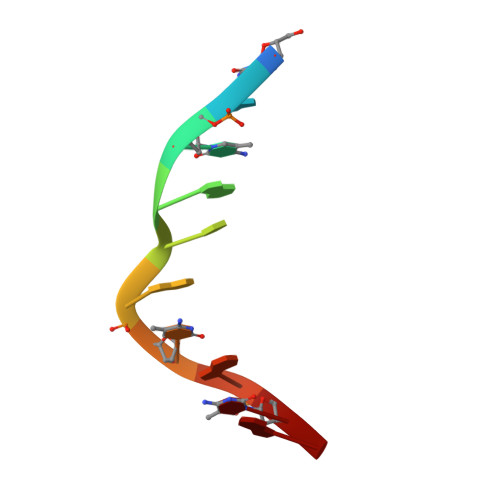
A two B-Z junction containing DNA resolves into an all right-handed double-helix.
Mauffret, O., El Amri, C., Santamaria, F., Tevanian, G., Rayner, B., Fermandjian, S.(2000) Nucleic Acids Res 28: 4403-4409
- PubMed: 11071926 Search on PubMedSearch on PubMed Central
- DOI: https://doi.org/10.1093/nar/28.22.4403
- Primary Citation Related Structures:
1FV7 - PubMed Abstract:
Natural and artificial oligonucleotides are capable of assuming many different conformations and functions. Here we present results of an NMR restrained molecular modelling study on the conformational preferences of the modified decanucleotide d((m)C1G2(m)C3G4C5(L)G6(L)(m)C7G8(m)C9G10) .d((m)C11G12(m)C13G14C15(L)G (L)16(m)C17-G18(m)C19G20 ) which contains L deoxynucleotides in its centre. This chimeric DNA was expected to form a right-left-right-handed B-type double-helix (BB*B) at low salt concentration. Actually, it matured into a fully right-handed double helix with its central C(L)pG(L) core forming a right-handed Z-DNA helix embedded in a B-DNA matrix (BZ*B). The interplay between base-base and base-sugar stackings within the core and its immediately adjacent residues was found to be critical in ensuring the stabilisation of the right-handed helix. The structure could serve as a model for the design of antisense oligonucleotides resistant to nucleases and capable of hybridising to natural DNAs and RNAs.
- Département de Biologie et Pharmacologie Structurales, UMR 8532 CNRS, PR2, Institut Gustave-Roussy, 39 rue Camille-Desmoulins, 94805 Villejuif Cedex, France.
Organizational Affiliation: