1FQI | pdb_00001fqi

RGS9 RGS DOMAIN


Experimental Data Snapshot

  • Method: X-RAY DIFFRACTION
  • Resolution: 1.94 Å
  • R-Value Free: 
    0.250 (Depositor) 
  • R-Value Work: 
    0.223 (Depositor), 0.240 (DCC) 
  • R-Value Observed: 
    0.223 (Depositor) 

wwPDB Validation 3D Report Full Report

Validation slider image for 1FQI

This is version 1.3 of the entry. See complete history

Literature

Structural determinants for regulation of phosphodiesterase by a G protein at 2.0 A.

Slep, K.C.Kercher, M.A.He, W.Cowan, C.W.Wensel, T.G.Sigler, P.B.

(2001) Nature 409: 1071-1077

  • DOI: https://doi.org/10.1038/35059138
  • Primary Citation Related Structures: 
    1FQI, 1FQJ, 1FQK

  • PubMed Abstract: 

    A multitude of heptahelical receptors use heterotrimeric G proteins to transduce signals to specific effector target molecules. The G protein transducin, Gt, couples photon-activated rhodopsin with the effector cyclic GMP phosophodiesterase (PDE) in the vertebrate phototransduction cascade. The interactions of the Gt alpha-subunit (alpha(t)) with the inhibitory PDE gamma-subunit (PDEgamma) are central to effector activation, and also enhance visual recovery in cooperation with the GTPase-activating protein regulator of G-protein signalling (RGS)-9 (refs 1-3). Here we describe the crystal structure at 2.0 A of rod transducin alpha x GDP x AlF4- in complex with the effector molecule PDEgamma and the GTPase-activating protein RGS9. In addition, we present the independently solved crystal structures of the RGS9 RGS domain both alone and in complex with alpha(t/i1) x GDP x AlF4-. These structures reveal insights into effector activation, synergistic GTPase acceleration, RGS9 specificity and RGS activity. Effector binding to a nucleotide-dependent site on alpha(t) sequesters PDEgamma residues implicated in PDE inhibition, and potentiates recruitment of RGS9 for hydrolytic transition state stabilization and concomitant signal termination.


  • Organizational Affiliation
    • Department of Molecular Biophysics and Biochemistry, Yale University, New Haven, Connecticut 06511, USA. kcs@mail.csb.yale.edu

Macromolecule Content 

  • Total Structure Weight: 17.65 kDa 
  • Atom Count: 1,281 
  • Modeled Residue Count: 138 
  • Deposited Residue Count: 147 
  • Unique protein chains: 1

Macromolecules

Find similar proteins by:|  3D Structure
Entity ID: 1
MoleculeChains  Sequence LengthOrganismDetailsImage
REGULATOR OF G-PROTEIN SIGNALING 9147Bos taurusMutation(s): 5 
UniProt
Find proteins for O46469 (Bos taurus)
Explore O46469 
Go to UniProtKB:  O46469
Entity Groups
Sequence Clusters30% Identity50% Identity70% Identity90% Identity95% Identity100% Identity
UniProt GroupO46469
Sequence Annotations
Expand
Reference Sequence

Small Molecules

Modified Residues  1 Unique
IDChains TypeFormula2D DiagramParent
MSE
Query on MSE
A
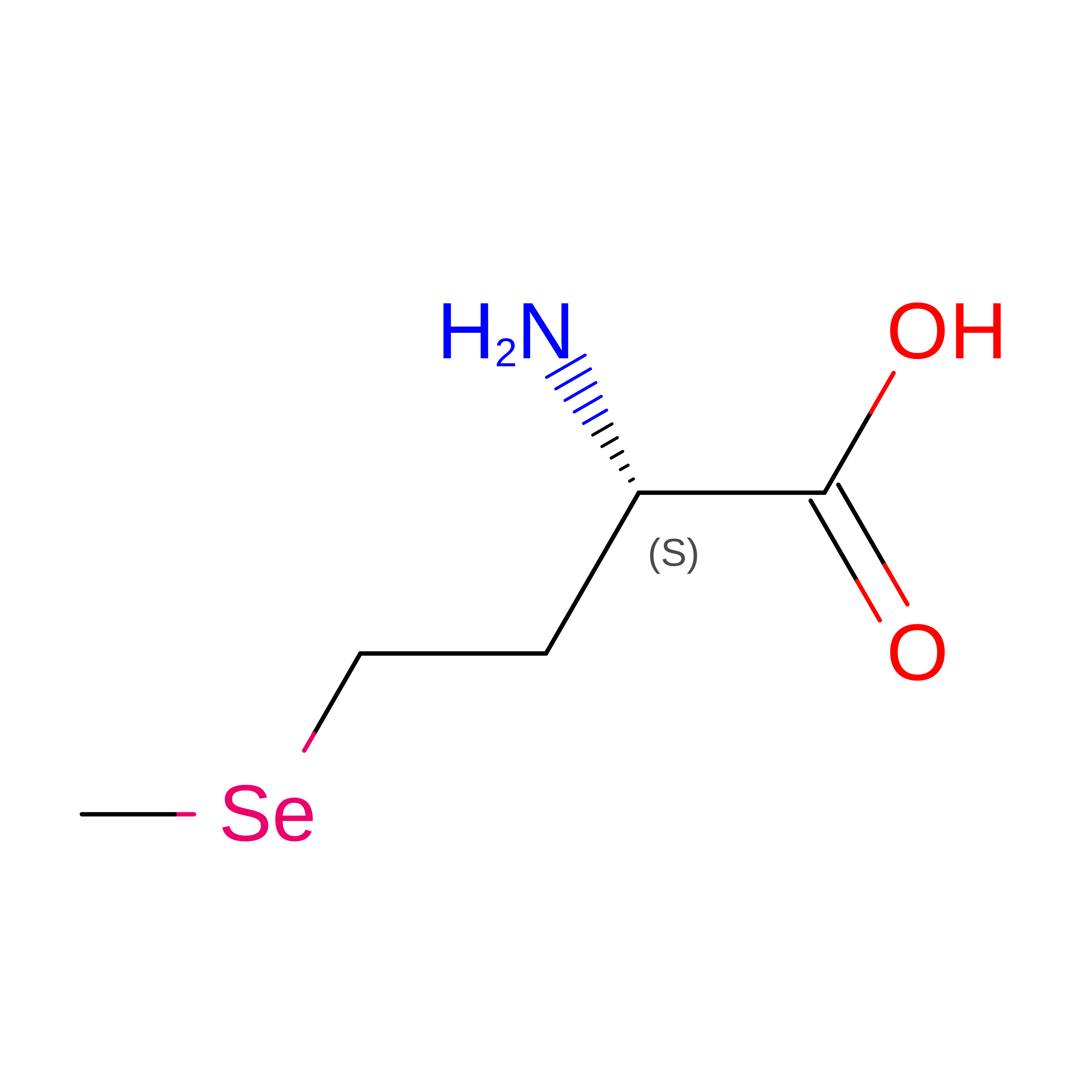
L-PEPTIDE LINKINGC5 H11 N O2 SeMET

Experimental Data & Validation

Experimental Data

  • Method: X-RAY DIFFRACTION
  • Resolution: 1.94 Å
  • R-Value Free:  0.250 (Depositor) 
  • R-Value Work:  0.223 (Depositor), 0.240 (DCC) 
  • R-Value Observed: 0.223 (Depositor) 
Space Group: C 1 2 1
Unit Cell:
Length ( Å )Angle ( ˚ )
a = 67.309α = 90
b = 71.836β = 96.13
c = 34.625γ = 90
Software Package:
Software NamePurpose
CNSrefinement
HKL-2000data reduction
SCALEPACKdata scaling
CNSphasing

Structure Validation

View Full Validation Report


Entry History 

Deposition Data

Revision History  (Full details and data files)

  • Version 1.0: 2001-02-28
    Type: Initial release
  • Version 1.1: 2008-04-27
    Changes: Version format compliance
  • Version 1.2: 2011-07-13
    Changes: Version format compliance
  • Version 1.3: 2024-11-13
    Changes: Data collection, Database references, Derived calculations, Structure summary