1FO3 | pdb_00001fo3

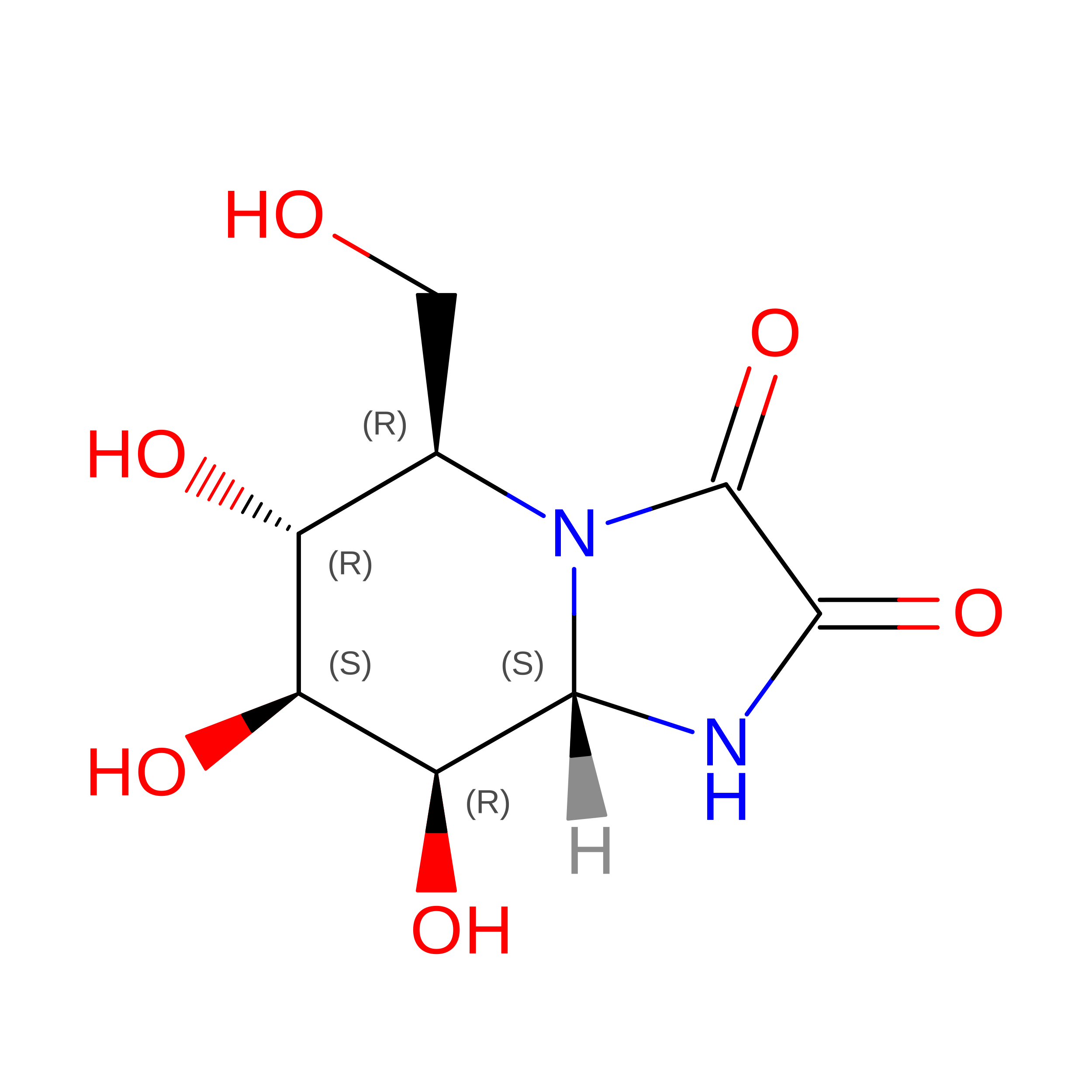
CRYSTAL STRUCTURE OF HUMAN CLASS I ALPHA1,2-MANNOSIDASE IN COMPLEX WITH KIFUNENSINE


Experimental Data Snapshot

  • Method: X-RAY DIFFRACTION
  • Resolution: 1.75 Å
  • R-Value Free: 
    0.241 (Depositor) 
  • R-Value Work: 
    0.218 (Depositor) 
  • R-Value Observed: 
    0.218 (Depositor) 

wwPDB Validation 3D Report Full Report

Validation slider image for 1FO3

This is version 1.3 of the entry. See complete history

Literature

Structural basis for catalysis and inhibition of N-glycan processing class I alpha 1,2-mannosidases.

Vallee, F.Karaveg, K.Herscovics, A.Moremen, K.W.Howell, P.L.

(2000) J Biological Chem 275: 41287-41298

  • DOI: https://doi.org/10.1074/jbc.M006927200
  • Primary Citation Related Structures: 
    1FMI, 1FO2, 1FO3

  • PubMed Abstract: 

    Endoplasmic reticulum (ER) class I alpha1,2-mannosidase (also known as ER alpha-mannosidase I) is a critical enzyme in the maturation of N-linked oligosaccharides and ER-associated degradation. Trimming of a single mannose residue acts as a signal to target misfolded glycoproteins for degradation by the proteasome. Crystal structures of the catalytic domain of human ER class I alpha1,2-mannosidase have been determined both in the presence and absence of the potent inhibitors kifunensine and 1-deoxymannojirimycin. Both inhibitors bind to the protein at the bottom of the active-site cavity, with the essential calcium ion coordinating the O-2' and O-3' hydroxyls and stabilizing the six-membered rings of both inhibitors in a (1)C(4) conformation. This is the first direct evidence of the role of the calcium ion. The lack of major conformational changes upon inhibitor binding and structural comparisons with the yeast alpha1, 2-mannosidase enzyme-product complex suggest that this class of inverting enzymes has a novel catalytic mechanism. The structures also provide insight into the specificity of this class of enzymes and provide a blueprint for the future design of novel inhibitors that prevent degradation of misfolded proteins in genetic diseases.


  • Organizational Affiliation
    • Program in Structural Biology and Biochemistry, Research Institute, Hospital for Sick Children, Toronto, Ontario M5G 1X8, Canada.

Macromolecule Content 

  • Total Structure Weight: 53.34 kDa 
  • Atom Count: 4,115 
  • Modeled Residue Count: 455 
  • Deposited Residue Count: 460 
  • Unique protein chains: 1

Macromolecules

Find similar proteins by:|  3D Structure
Entity ID: 1
MoleculeChains  Sequence LengthOrganismDetailsImage
ALPHA1,2-MANNOSIDASE460Homo sapiensMutation(s): 0 
EC: 3.2.1.24 (PDB Primary Data), 3.2.1.113 (UniProt)
UniProt & NIH Common Fund Data Resources
Find proteins for Q9UKM7 (Homo sapiens)
Explore Q9UKM7 
Go to UniProtKB:  Q9UKM7
PHAROS:  Q9UKM7
GTEx:  ENSG00000177239 
Entity Groups
Sequence Clusters30% Identity50% Identity70% Identity90% Identity95% Identity100% Identity
UniProt GroupQ9UKM7
Sequence Annotations
Expand
Reference Sequence

Experimental Data & Validation

Experimental Data

  • Method: X-RAY DIFFRACTION
  • Resolution: 1.75 Å
  • R-Value Free:  0.241 (Depositor) 
  • R-Value Work:  0.218 (Depositor) 
  • R-Value Observed: 0.218 (Depositor) 
Space Group: P 31 2 1
Unit Cell:
Length ( Å )Angle ( ˚ )
a = 95.975α = 90
b = 95.975β = 90
c = 137.028γ = 120
Software Package:
Software NamePurpose
DENZOdata reduction
SCALEPACKdata scaling
AMoREphasing
CNSrefinement

Structure Validation

View Full Validation Report


Entry History 

Deposition Data

Revision History  (Full details and data files)

  • Version 1.0: 2001-01-17
    Type: Initial release
  • Version 1.1: 2008-04-27
    Changes: Version format compliance
  • Version 1.2: 2011-07-13
    Changes: Version format compliance
  • Version 1.3: 2024-11-20
    Changes: Data collection, Database references, Derived calculations, Structure summary