Download Mendeley
Crystal structure of a polyhistidine-tagged recombinant catalytic subunit of cAMP-dependent protein kinase complexed with the peptide inhibitor PKI(5-24) and adenosine.
Narayana, N., Cox, S., Shaltiel, S., Taylor, S.S., Xuong, N.(1997) Biochemistry 36: 4438-4448
- PubMed: 9109651 Search on PubMed
- DOI: https://doi.org/10.1021/bi961947+
- Primary Citation Related Structures:
1FMO - PubMed Abstract:
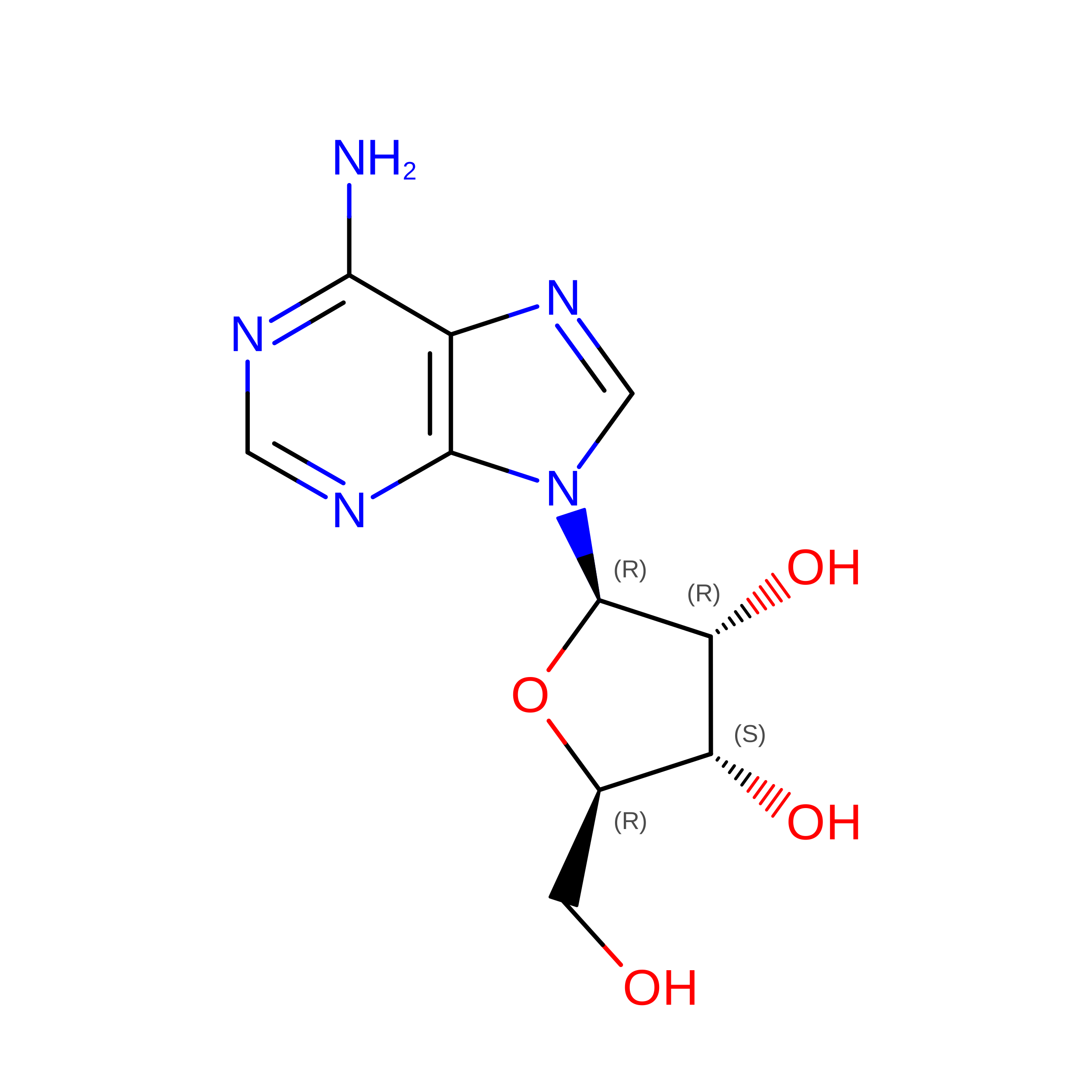
The crystal structure of the hexahistidine-tagged mouse recombinant catalytic subunit (H6-rC) of cAMP-dependent protein kinase (cAPK), complexed with a 20-residue peptide inhibitor from the heat-stable protein kinase inhibitor PKI(5-24) and adenosine, was determined at 2.2 A resolution. Novel crystallization conditions were required to grow the ternary complex crystals. The structure was refined to a final crystallographic R-factor of 18.2% with good stereochemical parameters. The "active" enzyme adopts a "closed" conformation as found in rC:PKI(5-24) [Knighton et al. (1991a,b) Science 253, 407-414, 414-420] and packs in a similar manner with the peptide providing a major contact surface. This structure clearly defines the subsites of the unique nucleotide binding site found in the protein kinase family. The adenosine occupies a mostly hydrophobic pocket at the base of the cleft between the two lobes and is completely buried. The missing triphosphate moiety of ATP is filled with a water molecule (Wtr 415) which replaces the gamma-phosphate of ATP. The glycine-rich loop between beta1 and beta2 helps to anchor the phosphates while the ribose ring is buried beneath beta-strand 2. Another ordered water molecule (Wtr 375) is pentacoordinated with polar atoms from adenosine, Leu 49 in beta-strand 1, Glu 127 in the linker strand between the two lobes, Tyr 330, and a third water molecule, Wtr 359. The conserved nucleotide fold can be defined as a lid comprised of beta-strand 1, the glycine-rich loop, and beta-strand 2. The adenine ring is buried beneath beta-strand 1 and the linker strand (120-127) that joins the small and large lobes. The C-terminal tail containing Tyr 330, a segment that lies outside the conserved core, covers this fold and anchors it in a closed conformation. The main-chain atoms of the flexible glycine-rich loop (residues 50-55) in the ATP binding domain have a mean B-factor of 41.4 A2. This loop is quite mobile, in striking contrast to the other conserved loops that converge at the active site cleft. The catalytic loop (residues 166-171) and the Mg2+ positioning loop (residues 184-186) are a stable part of the large lobe and have low B-factors in all structures solved to date. The stability of the glycine-rich loop is highly dependent on the ligands that occupy the active site cleft with maximum stability achieved in the ternary complex containing Mg x ATP and the peptide inhibitor. In this ternary complex the gamma-phosphate is secured between both lobes by hydrogen bonds to the backbone amide of Ser 53 in the glycine-rich loop and the amino group of Lys 168 in the catalytic loop. In the adenosine ternary complex the water molecule replacing the gamma-phosphate hydrogen bonds between Lys 168 and Asp 166 and makes no contact with the small lobe. This glycine-rich loop is thus the most mobile component of the active site cleft, with the tip of the loop being highly sensitive to what occupies the gamma-subsite.
- Department of Chemistry and Biochemistry, University of California, San Diego, La Jolla 92093-0654, USA.
Organizational Affiliation: