Download Mendeley
The reaction of fluorocitrate with aconitase and the crystal structure of the enzyme-inhibitor complex.
Lauble, H., Kennedy, M.C., Emptage, M.H., Beinert, H., Stout, C.D.(1996) Proc Natl Acad Sci U S A 93: 13699-13703
- PubMed: 8942997 Search on PubMedSearch on PubMed Central
- DOI: https://doi.org/10.1073/pnas.93.24.13699
- Primary Citation Related Structures:
1FGH - PubMed Abstract:
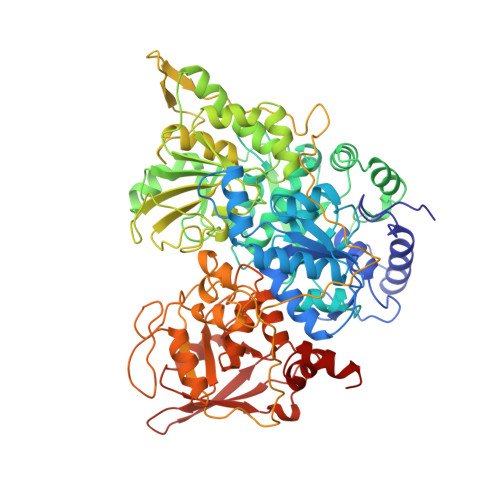
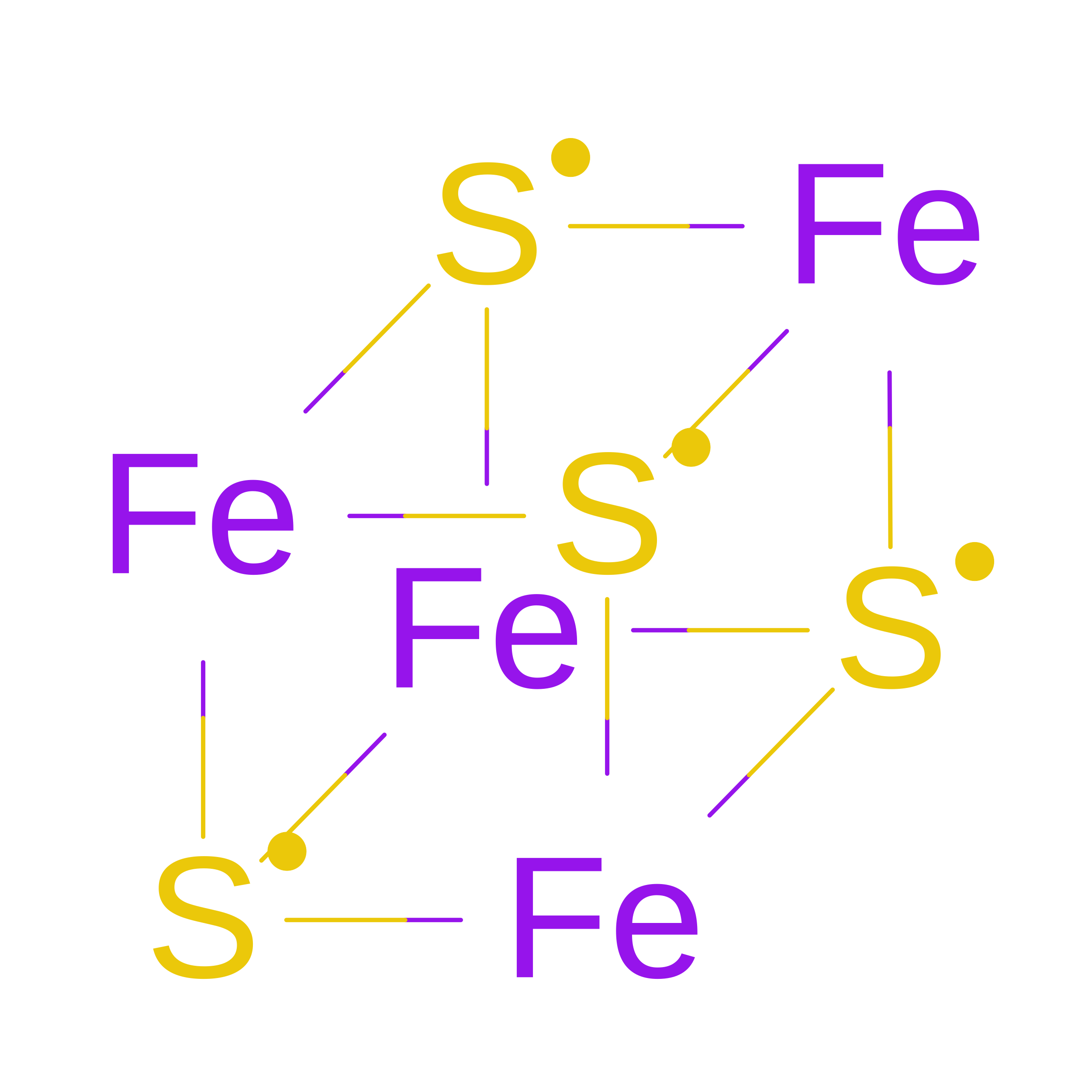
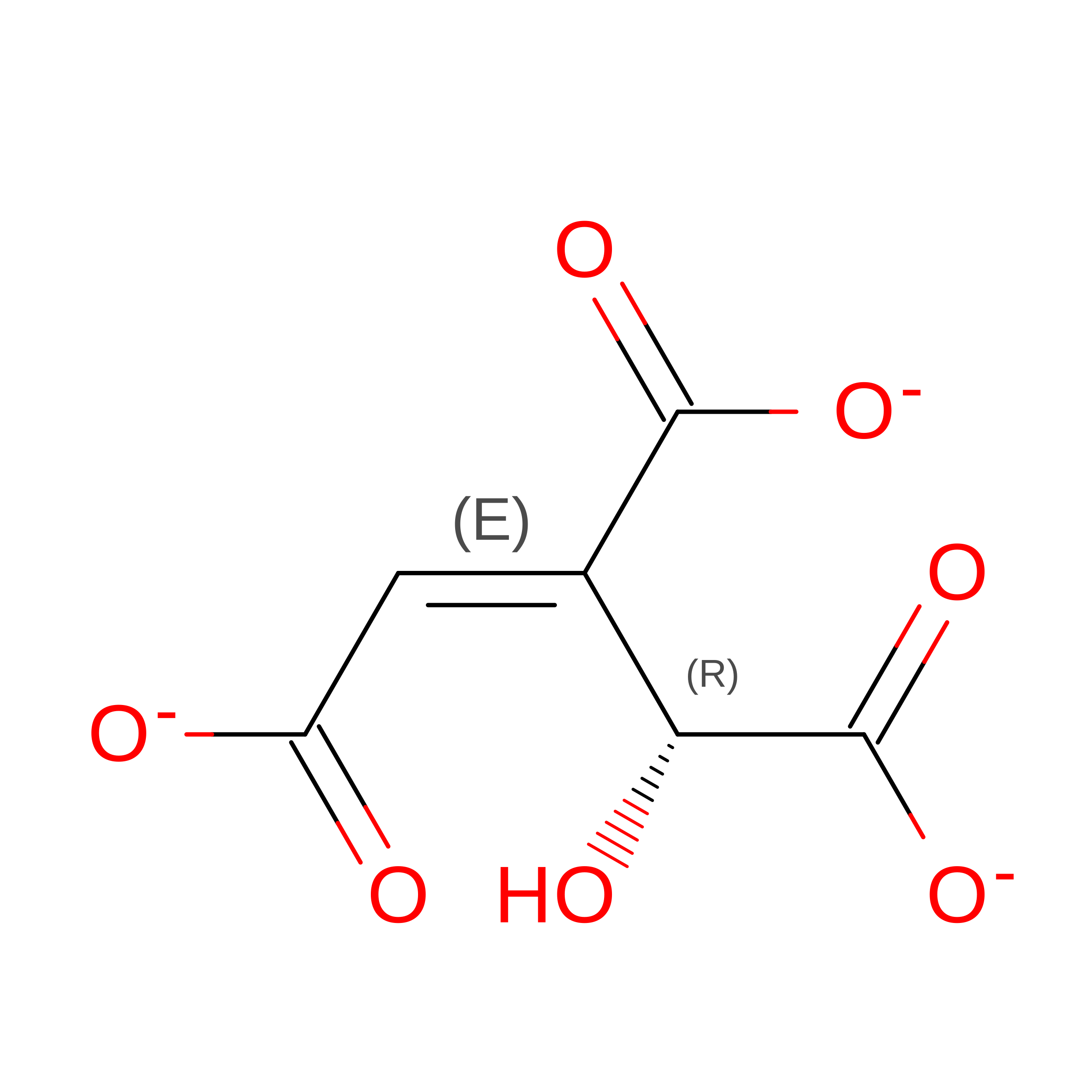
It has been known for many years that fluoroacetate and fluorocitrate when metabolized are highly toxic, and that at least one effect of fluorocitrate is to inactivate aconitase. In this paper we present evidence supporting the hypothesis that the (-)-erythro diastereomer of 2-fluorocitrate acts as a mechanism based inhibitor of aconitase by first being converted to fluoro-cis-aconitate, followed by addition of hydroxide and with loss of fluoride to form 4-hydroxy-trans-aconitate (HTn), which binds very tightly, but not covalently, to the enzyme. Formation of HTn by these reactions is in accord with the working model for the enzyme mechanism. That HTn is the product of fluorocitrate inhibition is supported by the crystal structure of the enzyme-inhibitor complex at 2.05-A resolution, release of fluoride stoichiometric with total enzyme when (-)-erythro-2-fluorocitrate is added, HPLC analysis of the product, slow displacement of HTn by 10(6)-fold excess of isocitrate, and previously published Mössbauer experiments. When (+)-erythro-2-fluorocitrate is added to aconitase, the release of fluoride is stoichiometric with total substrate added, and HPLC analysis of the products indicates the formation of oxalosuccinate, and its derivative alpha-ketoglutarate. This is consistent with the proposed mechanism, as is the formation of HTn from (-)-erythro-2-fluorocitrate. The structure of the inhibited complex reveals that HTn binds like the inhibitor trans-aconitate while providing all the interactions of the natural substrate, isocitrate. The structure exhibits four hydrogen bonds < 2.7 A in length involving HTn, H2O bound to the [4Fe-4S] cluster, Asp-165 and His-167, as well as low temperature factors for these moieties, consistent with the observed very tight binding of the inhibitor.
- Universität Stuttgart, Institut für Organische Chemie, Germany.
Organizational Affiliation: