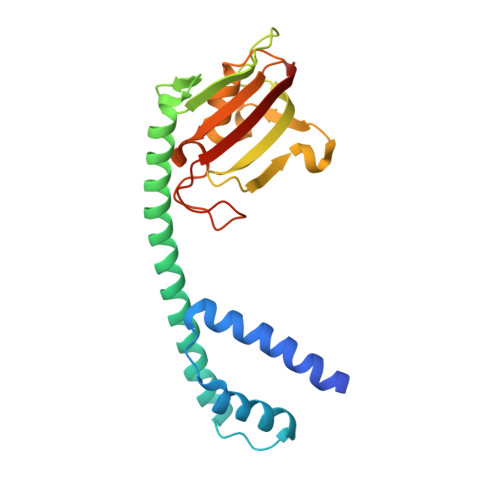
1FD9 | pdb_00001fd9

CRYSTAL STRUCTURE OF THE MACROPHAGE INFECTIVITY POTENTIATOR PROTEIN (MIP) A MAJOR VIRULENCE FACTOR FROM LEGIONELLA PNEUMOPHILA


Experimental Data Snapshot

  • Method: X-RAY DIFFRACTION
  • Resolution: 2.41 Å
  • R-Value Free: 
    0.280 (Depositor) 
  • R-Value Work: 
    0.230 (Depositor) 
  • R-Value Observed: 
    0.230 (Depositor) 

wwPDB Validation 3D Report Full Report

Validation slider image for 1FD9

This is version 1.4 of the entry. See complete history

Re-refinement Note

A newer entry is available that reflects an alternative modeling of the original data: 8BJC

Literature

Crystal structure of Mip, a prolylisomerase from Legionella pneumophila

Riboldi-Tunnicliffe, A.Konig, B.Jessen, S.Weiss, M.S.Rahfeld, J.Hacker, J.Fischer, G.Hilgenfeld, R.

(2001) Nat Struct Biol 8: 779-783

  • DOI: https://doi.org/10.1038/nsb0901-779
  • Primary Citation Related Structures: 
    1FD9

  • PubMed Abstract: 

    The human pathogen Legionella pneumophila, the etiological agent of the severe and often fatal Legionnaires' disease, produces a major virulence factor, termed 'macrophage infectivity potentiator protein' (Mip), that is necessary for optimal multiplication of the bacteria within human alveolar macrophages. Mip exhibits a peptidyl prolyl cis-trans isomerase (PPIase) activity, which appears to be important for infection. Here we report the 2.4 A crystal structure of the Mip protein from L. pneumophila Philadelphia 1 and the 3.2 A crystal structure of its complex with the drug FK506. Each monomer of the homodimeric protein consists of an N-terminal dimerization module, a long (65 A) connecting alpha-helix and a C-terminal PPIase domain exhibiting similarity to human FK506-binding protein. In view of the recent significant increase in the number of reported cases of Legionnaires' disease and other intracellular infections, these structural results are of prime interest for the design of new drugs directed against Mip proteins of intracellular pathogens.


  • Organizational Affiliation
    • Institute of Molecular Biotechnology, Beutenbergstr. 11, D-07745 Jena, Germany.

Macromolecule Content 

  • Total Structure Weight: 23 kDa 
  • Atom Count: 1,645 
  • Modeled Residue Count: 204 
  • Deposited Residue Count: 213 
  • Unique protein chains: 1

Macromolecules

Find similar proteins by:|  3D Structure
Entity ID: 1
MoleculeChains  Sequence LengthOrganismDetailsImage
PROTEIN (MACROPHAGE INFECTIVITY POTENTIATOR PROTEIN)213Legionella pneumophilaMutation(s): 0 
EC: 5.2.1.8
UniProt
Find proteins for Q5ZXE0 (Legionella pneumophila subsp. pneumophila (strain Philadelphia 1 / ATCC 33152 / DSM 7513))
Explore Q5ZXE0 
Go to UniProtKB:  Q5ZXE0
Entity Groups
Sequence Clusters30% Identity50% Identity70% Identity90% Identity95% Identity100% Identity
UniProt GroupQ5ZXE0
Sequence Annotations
Expand
Reference Sequence

Small Molecules

Experimental Data & Validation

Experimental Data

  • Method: X-RAY DIFFRACTION
  • Resolution: 2.41 Å
  • R-Value Free:  0.280 (Depositor) 
  • R-Value Work:  0.230 (Depositor) 
  • R-Value Observed: 0.230 (Depositor) 
Space Group: P 43 21 2
Unit Cell:
Length ( Å )Angle ( ˚ )
a = 80.75α = 90
b = 80.75β = 90
c = 103.26γ = 90
Software Package:
Software NamePurpose
SHARPphasing
CNSrefinement
DENZOdata reduction
CCP4data scaling

Structure Validation

View Full Validation Report


Entry History 

Deposition Data

Revision History  (Full details and data files)

  • Version 1.0: 2001-07-25
    Type: Initial release
  • Version 1.1: 2008-04-27
    Changes: Version format compliance
  • Version 1.2: 2011-07-13
    Changes: Derived calculations, Version format compliance
  • Version 1.3: 2018-01-24
    Changes: Advisory, Structure summary
  • Version 1.4: 2024-02-07
    Changes: Advisory, Data collection, Database references, Derived calculations