1EYI | pdb_00001eyi

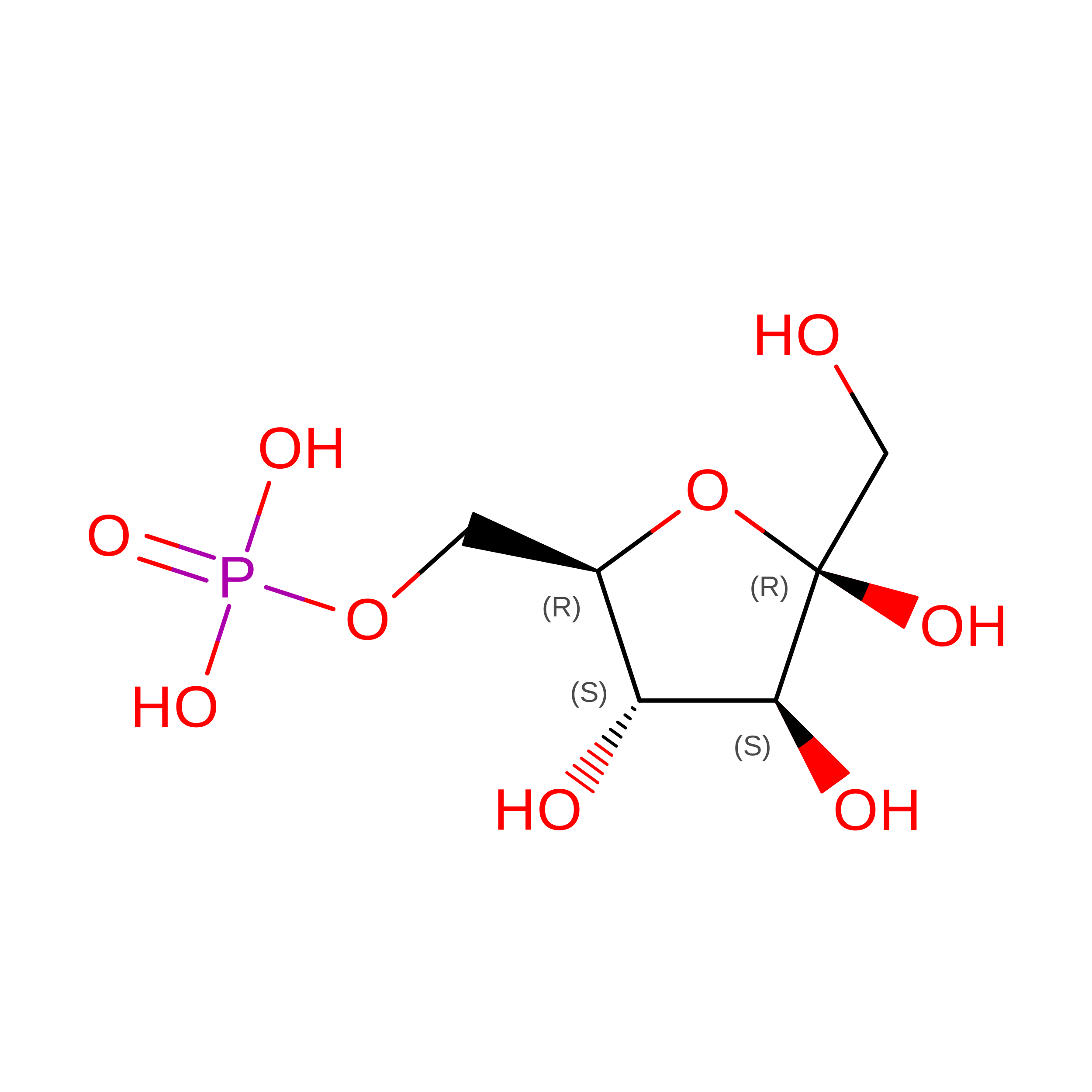
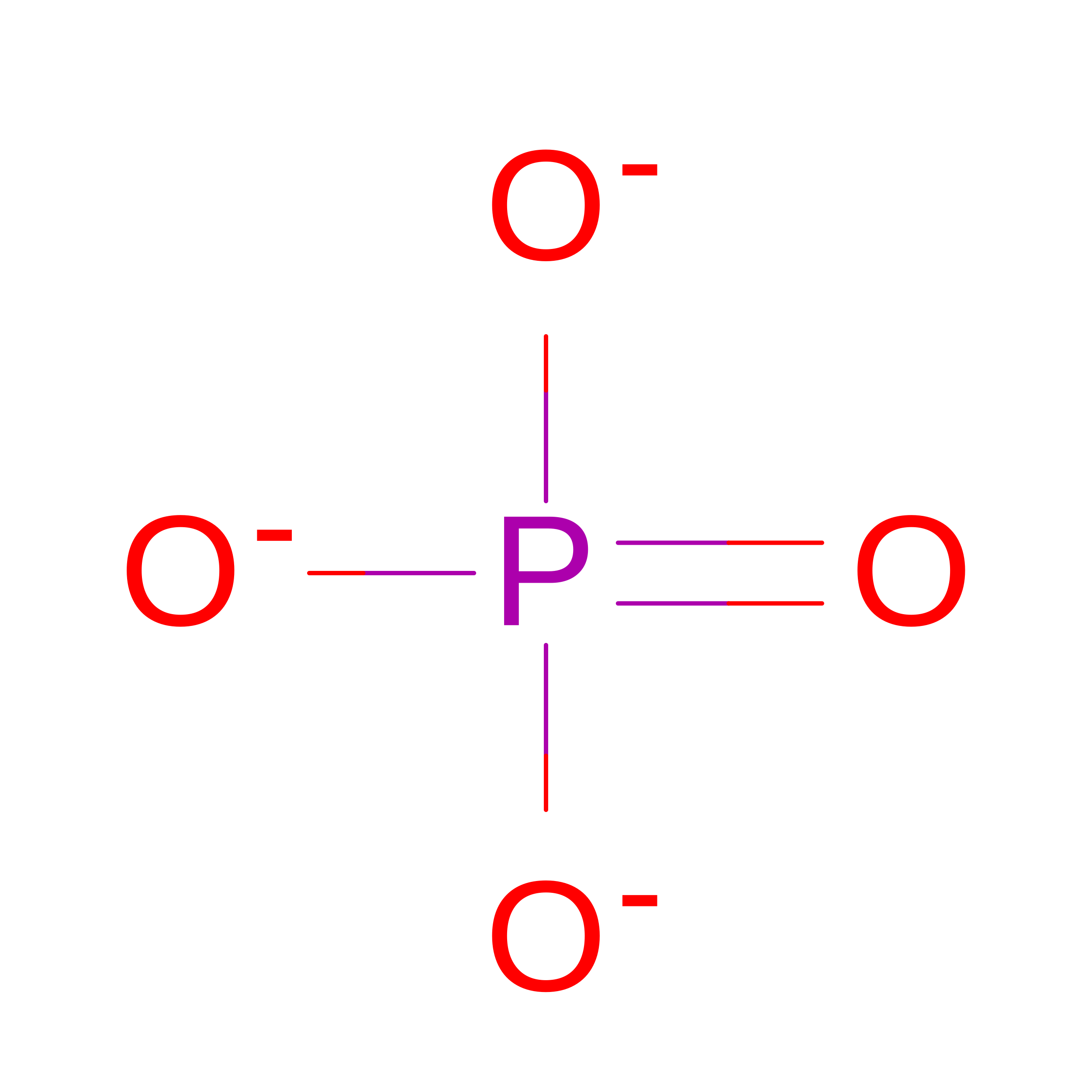
FRUCTOSE-1,6-BISPHOSPHATASE COMPLEX WITH MAGNESIUM, FRUCTOSE-6-PHOSPHATE AND PHOSPHATE (R-STATE)


Experimental Data Snapshot

  • Method: X-RAY DIFFRACTION
  • Resolution: 2.32 Å
  • R-Value Free: 
    0.242 (Depositor) 
  • R-Value Work: 
    0.190 (Depositor) 

Starting Model: experimental
View more details

wwPDB Validation 3D Report Full Report

Validation slider image for 1EYI

This is version 1.6 of the entry. See complete history

Literature

Crystal structures of fructose 1,6-bisphosphatase: mechanism of catalysis and allosteric inhibition revealed in product complexes.

Choe, J.Y.Fromm, H.J.Honzatko, R.B.

(2000) Biochemistry 39: 8565-8574

  • DOI: https://doi.org/10.1021/bi000574g
  • Primary Citation Related Structures: 
    1EYI, 1EYJ, 1EYK

  • PubMed Abstract: 

    Crystal structures of metal-product complexes of fructose 1, 6-bisphosphatase (FBPase) reveal competition between AMP and divalent cations. In the presence of AMP, the Zn(2+)-product and Mg(2+)-product complexes have a divalent cation present only at one of three metal binding sites (site 1). The enzyme is in the T-state conformation with a disordered loop of residues 52-72 (loop 52-72). In the absence of AMP, the enzyme crystallizes in the R-state conformation, with loop 52-72 associated with the active site. In structures without AMP, three metal-binding sites are occupied by Zn(2+) and two of three metal sites (sites 1 and 2) by Mg(2+). Evidently, the association of AMP with FBPase disorders loop 52-72, the consequence of which is the release of cations from two of three metal binding sites. In the Mg(2+) complexes (but not the Zn(2+) complexes), the 1-OH group of fructose 6-phosphate (F6P) coordinates to the metal at site 1 and is oriented for a nucleophilic attack on the bound phosphate molecule. A mechanism is presented for the forward reaction, in which Asp74 and Glu98 together generate a hydroxide anion coordinated to the Mg(2+) at site 2, which then displaces F6P. Development of negative charge on the 1-oxygen of F6P is stabilized by its coordination to the Mg(2+) at site 1.


  • Organizational Affiliation
    • Department of Biochemistry, Iowa State University, Ames 50011, USA.

Macromolecule Content 

  • Total Structure Weight: 37.19 kDa 
  • Atom Count: 2,718 
  • Modeled Residue Count: 331 
  • Deposited Residue Count: 337 
  • Unique protein chains: 1

Macromolecules

Find similar proteins by:|  3D Structure
Entity ID: 1
MoleculeChains  Sequence LengthOrganismDetailsImage
FRUCTOSE-1,6-BISPHOSPHATASE337Sus scrofaMutation(s): 0 
EC: 3.1.3.11
UniProt
Find proteins for P00636 (Sus scrofa)
Explore P00636 
Go to UniProtKB:  P00636
Entity Groups
Sequence Clusters30% Identity50% Identity70% Identity90% Identity95% Identity100% Identity
UniProt GroupP00636
Sequence Annotations
Expand
Reference Sequence

Experimental Data & Validation

Experimental Data

  • Method: X-RAY DIFFRACTION
  • Resolution: 2.32 Å
  • R-Value Free:  0.242 (Depositor) 
  • R-Value Work:  0.190 (Depositor) 
Space Group: I 2 2 2
Unit Cell:
Length ( Å )Angle ( ˚ )
a = 52.12α = 90
b = 82.51β = 90
c = 165.49γ = 90
Software Package:
Software NamePurpose
CNSrefinement
X-GENdata reduction
X-GENdata scaling
CNSphasing

Structure Validation

View Full Validation Report


Entry History 

Deposition Data

Revision History  (Full details and data files)

  • Version 1.0: 2000-08-09
    Type: Initial release
  • Version 1.1: 2008-04-27
    Changes: Version format compliance
  • Version 1.2: 2011-07-13
    Changes: Derived calculations, Version format compliance
  • Version 1.3: 2017-10-04
    Changes: Refinement description
  • Version 1.4: 2019-11-20
    Changes: Derived calculations
  • Version 1.5: 2020-07-29
    Type: Remediation
    Reason: Carbohydrate remediation
    Changes: Data collection, Derived calculations, Structure summary
  • Version 1.6: 2023-08-09
    Changes: Data collection, Database references, Refinement description, Structure summary