1ESS | pdb_00001ess

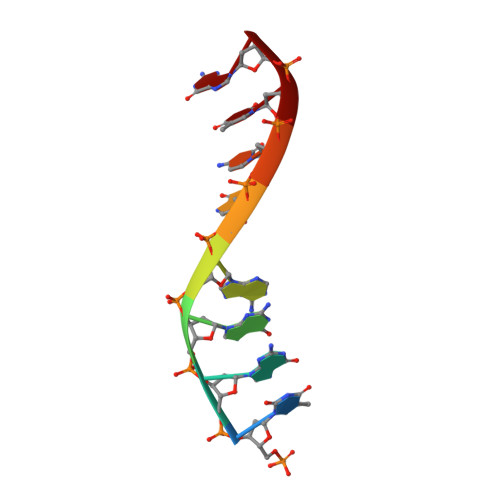
STEROID TETHERED DNA, NMR, MINIMIZED AVERAGE STRUCTURE


Experimental Data Snapshot

  • Method: SOLUTION NMR
  • Conformers Calculated: 17 
  • Conformers Submitted: 
  • Selection Criteria: LOWEST ENERGY, BEST AGREEMENT WITH NOE VOLUMES 

wwPDB Validation 3D Report Full Report

Validation slider image for 1ESS

This is version 1.4 of the entry. See complete history

Literature

The NMR structure of estrone (Es)-tethered tandem DNA duplex: [d(5'pCAGCp3')-Es] + [Es-d(5'pTCCA3')]: d(5'pTGGAGCTG3').

Denisov, A.Y.Sandstrom, A.Maltseva, T.V.Pyshnyi, D.V.Ivanova, E.M.Zarytova, V.F.Chattopadhyaya, J.

(1997) J Biomol Struct Dyn 15: 499-516

  • DOI: https://doi.org/10.1080/07391102.1997.10508961
  • Primary Citation Related Structures: 
    1ESS, 1TAN

  • PubMed Abstract: 

    The solution structure of an estrone (Es)-tethered tandem DNA duplex consisting of two Es-tethered tetranucleotides and a target octameric DNA sequence is reported. The structure of this Es-tethered tandem duplex has been compared with a corresponding natural tandem duplex without estrones. The Tm of the 3'-Es-tethered tetranucleotide part of the tandem duplex increases by 5 degrees C, whereas the Tm of the 5'-Es-tethered tetranucleotide part increases by 7 degrees C, compared with the corresponding natural counterpart. The NMR structures of both the Es-tethered tandem duplex and the natural counterpart have been based on 24 experimental NMR constraints per residue. Despite the fact that there is considerable distortion at the junction of two Es-tethered tetranucleotides in the major groove of the Es-tethered DNA duplex compared to the natural counterpart, both duplexes do take up B-type DNA structures. It is likely that the spatial proximity of two Es residues, and the resulting hydrophobic interaction between them might be responsible for the increase of the thermal stability of the Es-tethered tandem duplex in comparison with the natural counterpart.


  • Organizational Affiliation
    • Department of Bioorganic Chemistry, University of Uppsala, Sweden.

Macromolecule Content 

  • Total Structure Weight: 5.51 kDa 
  • Atom Count: 373 
  • Modeled Residue Count: 16 
  • Deposited Residue Count: 16 
  • Unique nucleic acid chains: 3

Macromolecules

Find similar nucleic acids by:  Sequence
Entity ID: 1
MoleculeChains LengthOrganismImage
DNA (5'-D(P*TP*GP*GP*AP*GP*CP*TP*G)-3')8N/A
Sequence Annotations
Expand
Reference Sequence
Find similar nucleic acids by:  Sequence
Entity ID: 2
MoleculeChains LengthOrganismImage
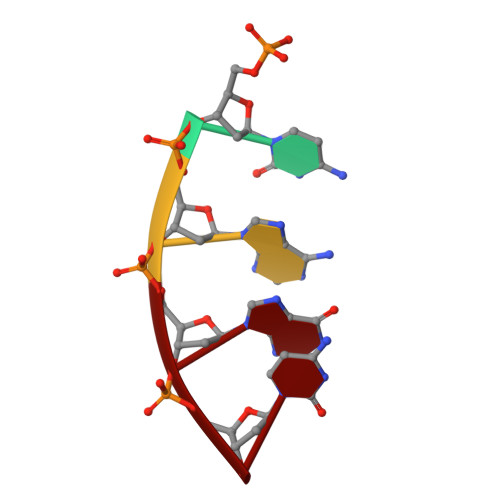
DNA (5'-D(P*CP*AP*GP*C)-3')4N/A
Sequence Annotations
Expand
Reference Sequence
Find similar nucleic acids by:  Sequence
Entity ID: 3
MoleculeChains LengthOrganismImage
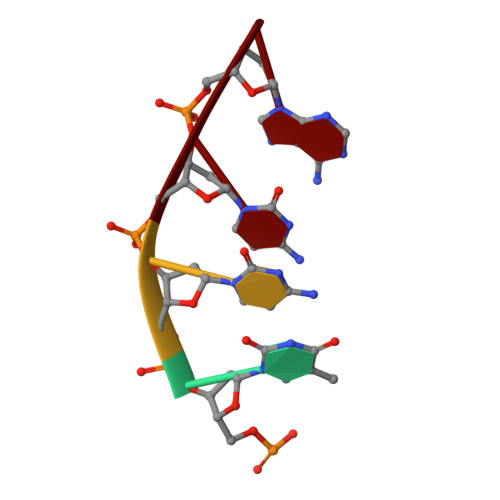
DNA (5'-D(P*TP*CP*CP*A)-3')4N/A
Sequence Annotations
Expand
Reference Sequence

Small Molecules

Ligands 1 Unique
IDChains Name / Formula / InChI Key2D Diagram3D Interactions
ESO

Query on ESO


Download:Ideal Coordinates CCD File
D [auth B],
E [auth C]
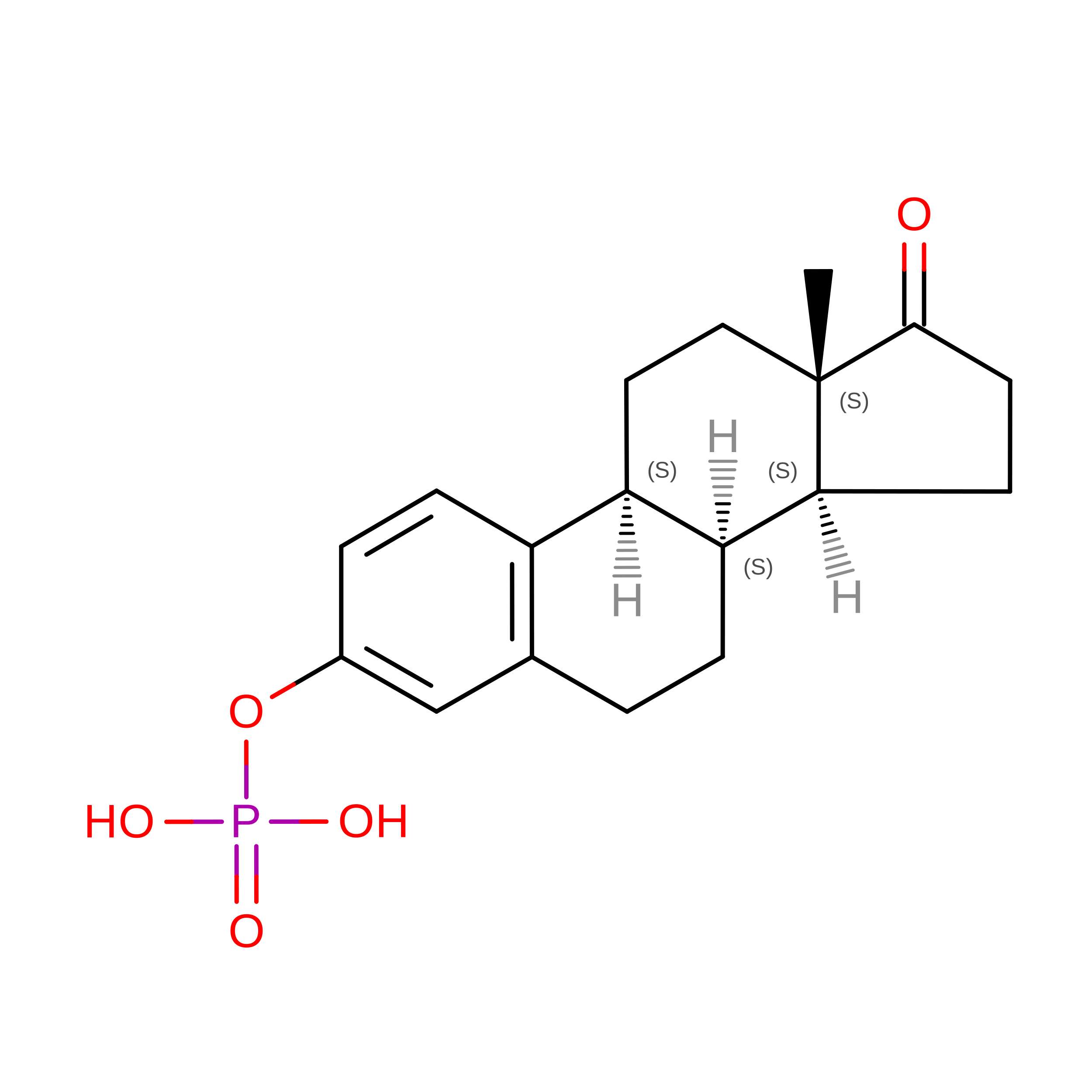
O3-PHOSPHONOESTRONE
C18 H23 O5 P
XYNRXDLLYXFCRS-CBZIJGRNSA-N

Experimental Data & Validation

Experimental Data

  • Method: SOLUTION NMR
  • Conformers Calculated: 17 
  • Conformers Submitted: 
  • Selection Criteria: LOWEST ENERGY, BEST AGREEMENT WITH NOE VOLUMES 

Structure Validation

View Full Validation Report


Entry History 

Deposition Data

Revision History  (Full details and data files)

  • Version 1.0: 1997-09-17
    Type: Initial release
  • Version 1.1: 2008-03-24
    Changes: Version format compliance
  • Version 1.2: 2011-07-13
    Changes: Version format compliance
  • Version 1.3: 2022-02-16
    Changes: Advisory, Data collection, Database references, Derived calculations, Other
  • Version 1.4: 2024-05-22
    Changes: Data collection