1ESR | pdb_00001esr

CRYSTAL STRUCTURE OF HUMAN MONOCYTE CHEMOTACTIC PROTEIN-2


Experimental Data Snapshot

  • Method: X-RAY DIFFRACTION
  • Resolution: 2.00 Å
  • R-Value Free: 
    0.320 (Depositor) 
  • R-Value Work: 
    0.232 (Depositor), 0.227 (DCC) 
  • R-Value Observed: 
    0.244 (Depositor) 

Starting Model: experimental
View more details

wwPDB Validation 3D Report Full Report

Validation slider image for 1ESR

This is version 2.4 of the entry. See complete history

Literature

Complete crystal structure of monocyte chemotactic protein-2, a CC chemokine that interacts with multiple receptors.

Blaszczyk, J.Coillie, E.V.Proost, P.Damme, J.V.Opdenakker, G.Bujacz, G.D.Wang, J.M.Ji, X.

(2000) Biochemistry 39: 14075-14081

  • DOI: https://doi.org/10.1021/bi0009340
  • Primary Citation Related Structures: 
    1ESR

  • PubMed Abstract: 

    Monocyte chemotactic protein 2 (MCP-2) is a CC chemokine that utilizes multiple cellular receptors to attract and activate human leukocytes. MCP-2 is a potent inhibitor of HIV-1 by virtue of its high-affinity binding to the receptor CCR5, one of the major coreceptors for HIV-1. Although a few structures of CC chemokines have been reported, none of these was determined with the N-terminal pyroglutamic acid residue (pGlu1) and a complete C-terminus. pGlu1 is essential for the chemotactic activity of MCP-2. Recombinant MCP-2 has Gln1 at the N terminus, 12-15% of which cyclizes automatically and forms pGlu1. The chemotactic activity of such MCP-2 mixture, which contains 12-15% pGlu1-form and 85-88% Gln1-form protein, is approximately 10 times lower when compared with that of fully cyclized MCP-2 preparation. Therefore, this chemokine is practically inactive without pGlu1. We have determined the complete crystal structure of MCP-2 that contains both pGlu1 and an intact C-terminus. With the existence of pGlu1, the conformation of the N-terminus allows two additional interactions between the two subunits of MCP-2 dimer: a hydrogen bond between pGlu1 and Asn17 and a salt bridge between Asp3 and Arg18. Consequently, both pGlu1 are anchored and buried, and thereby, both N-terminal regions are protected against protease degradation. We have also observed not previously reported extended helical nature of the C terminal region, which covers residues 58-74.


  • Organizational Affiliation
    • Program in Structural Biology and Laboratory of Molecular Immunoregulation, National Cancer Institute, Frederick, Maryland 21702, USA.

Macromolecule Content 

  • Total Structure Weight: 8.91 kDa 
  • Atom Count: 713 
  • Modeled Residue Count: 76 
  • Deposited Residue Count: 76 
  • Unique protein chains: 1

Macromolecules

Find similar proteins by:|  3D Structure
Entity ID: 1
MoleculeChains  Sequence LengthOrganismDetailsImage
MONOCYTE CHEMOTACTIC PROTEIN 276Homo sapiensMutation(s): 1 
UniProt & NIH Common Fund Data Resources
Find proteins for P80075 (Homo sapiens)
Explore P80075 
Go to UniProtKB:  P80075
PHAROS:  P80075
GTEx:  ENSG00000108700 
Entity Groups
Sequence Clusters30% Identity50% Identity70% Identity90% Identity95% Identity100% Identity
UniProt GroupP80075
Sequence Annotations
Expand
Reference Sequence

Small Molecules

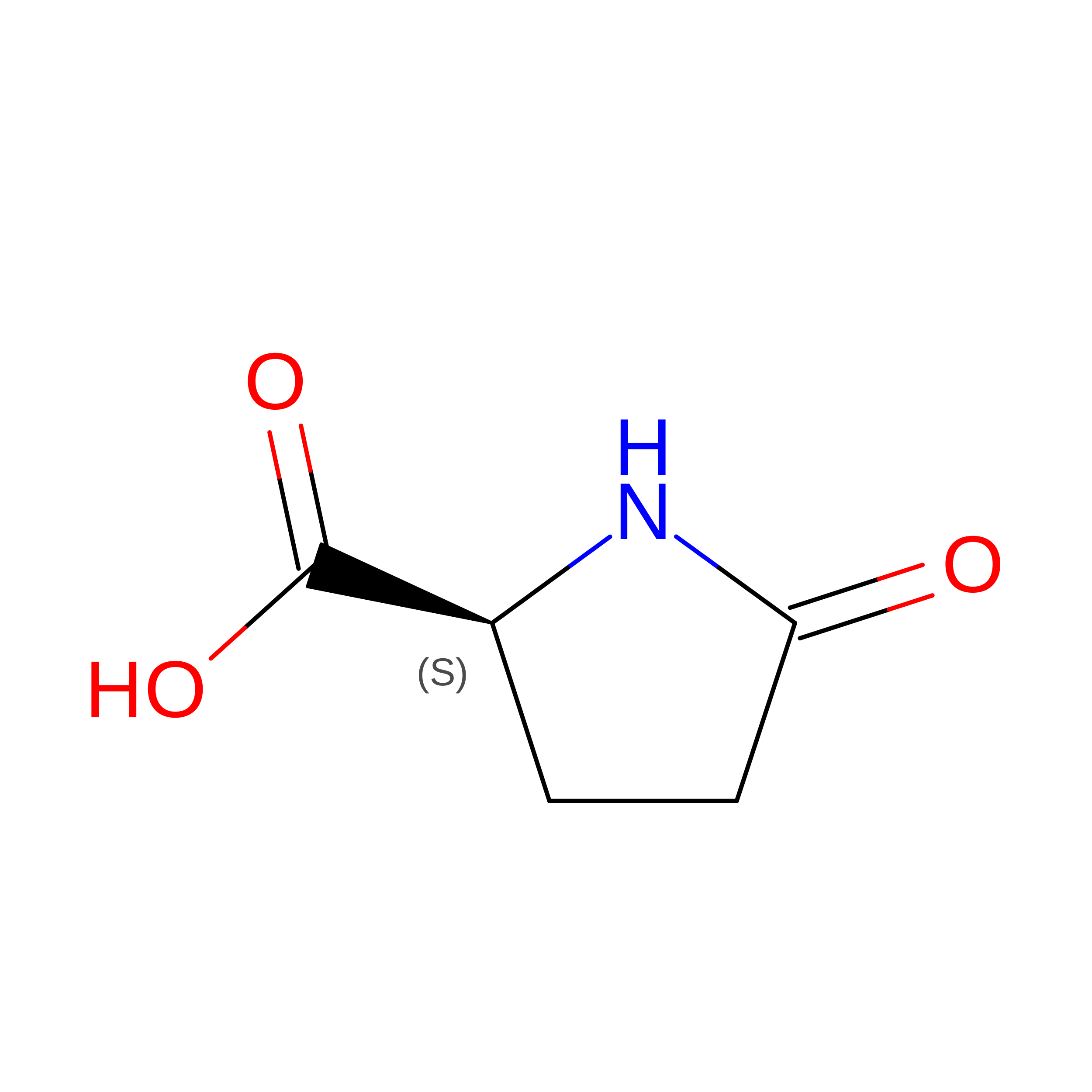
Modified Residues  1 Unique
IDChains TypeFormula2D DiagramParent
PCA
Query on PCA
A
L-PEPTIDE LINKINGC5 H7 N O3GLN

Experimental Data & Validation

Experimental Data

  • Method: X-RAY DIFFRACTION
  • Resolution: 2.00 Å
  • R-Value Free:  0.320 (Depositor) 
  • R-Value Work:  0.232 (Depositor), 0.227 (DCC) 
  • R-Value Observed: 0.244 (Depositor) 
Space Group: P 61 2 2
Unit Cell:
Length ( Å )Angle ( ˚ )
a = 61.012α = 90
b = 61.012β = 90
c = 114.926γ = 120
Software Package:
Software NamePurpose
DENZOdata reduction
SCALEPACKdata scaling
AMoREphasing
SHELXL-97refinement

Structure Validation

View Full Validation Report


Entry History 

Deposition Data

Revision History  (Full details and data files)

  • Version 1.0: 2000-12-06
    Type: Initial release
  • Version 1.1: 2008-04-27
    Changes: Version format compliance
  • Version 1.2: 2011-07-13
    Changes: Version format compliance
  • Version 2.0: 2019-12-25
    Changes: Database references, Derived calculations, Polymer sequence
  • Version 2.1: 2021-11-03
    Changes: Database references
  • Version 2.2: 2023-08-09
    Changes: Data collection, Refinement description
  • Version 2.3: 2023-08-30
    Changes: Database references, Structure summary
  • Version 2.4: 2024-11-20
    Changes: Structure summary