1EJ4 | pdb_00001ej4

COCRYSTAL STRUCTURE OF EIF4E/4E-BP1 PEPTIDE


Experimental Data Snapshot

  • Method: X-RAY DIFFRACTION
  • Resolution: 2.25 Å
  • R-Value Free: 
    0.267 (Depositor), 0.274 (DCC) 
  • R-Value Work: 
    0.219 (Depositor), 0.229 (DCC) 

wwPDB Validation 3D Report Full Report

Validation slider image for 1EJ4

Ligand Structure Quality Assessment 


This is version 2.0 of the entry. See complete history

Literature

Cap-dependent translation initiation in eukaryotes is regulated by a molecular mimic of eIF4G.

Marcotrigiano, J.Gingras, A.C.Sonenberg, N.Burley, S.K.

(1999) Mol Cell 3: 707-716

  • DOI: https://doi.org/10.1016/s1097-2765(01)80003-4
  • Primary Citation Related Structures: 
    1EJ4, 1EJH

  • PubMed Abstract: 

    eIF4G uses a conserved Tyr-X-X-X-X-Leu-phi segment (where X is variable and phi is hydrophobic) to recognize eIF4E during cap-dependent translation initiation in eukaryotes. High-resolution X-ray crystallography and complementary biophysical methods have revealed that this eIF4E recognition motif undergoes a disorder-to-order transition, adopting an L-shaped, extended chain/alpha-helical conformation when it interacts with a phylogenetically invariant portion of the convex surface of eIF4E. Inhibitors of translation initiation known as eIF4E-binding proteins (4E-BPs) contain similar eIF4E recognition motifs. These molecules are molecular mimics of eIF4G, which act by occupying the same binding site on the convex dorsum of eIF4E and blocking assembly of the translation machinery. The implications of our results for translation initiation are discussed in detail, and a molecular mechanism for relief of translation inhibition following phosphorylation of the 4E-BPs is proposed.


  • Organizational Affiliation
    • Laboratories of Molecular Biophysics, Rockefeller University, New York, New York 10021, USA.

Macromolecule Content 

  • Total Structure Weight: 24.46 kDa 
  • Atom Count: 1,713 
  • Modeled Residue Count: 193 
  • Deposited Residue Count: 204 
  • Unique protein chains: 2

Macromolecules

Find similar proteins by:|  3D Structure
Entity ID: 1
MoleculeChains  Sequence LengthOrganismDetailsImage
EUKARYOTIC INITIATION FACTOR 4E190Mus musculusMutation(s): 0 
UniProt & NIH Common Fund Data Resources
Find proteins for P63073 (Mus musculus)
Explore P63073 
Go to UniProtKB:  P63073
IMPC:  MGI:95305
Entity Groups
Sequence Clusters30% Identity50% Identity70% Identity90% Identity95% Identity100% Identity
UniProt GroupP63073
Sequence Annotations
Expand
Reference Sequence
Find similar proteins by:  Sequence   |   3D Structure  
Entity ID: 2
MoleculeChains  Sequence LengthOrganismDetailsImage
EUKARYOTIC TRANSLATION INITIATION FACTOR 4E BINDING PROTEIN 114N/AMutation(s): 0 
UniProt & NIH Common Fund Data Resources
Find proteins for Q13541 (Homo sapiens)
Explore Q13541 
Go to UniProtKB:  Q13541
PHAROS:  Q13541
GTEx:  ENSG00000187840 
Entity Groups
Sequence Clusters30% Identity50% Identity70% Identity90% Identity95% Identity100% Identity
UniProt GroupQ13541
Sequence Annotations
Expand
Reference Sequence

Small Molecules

Ligands 1 Unique
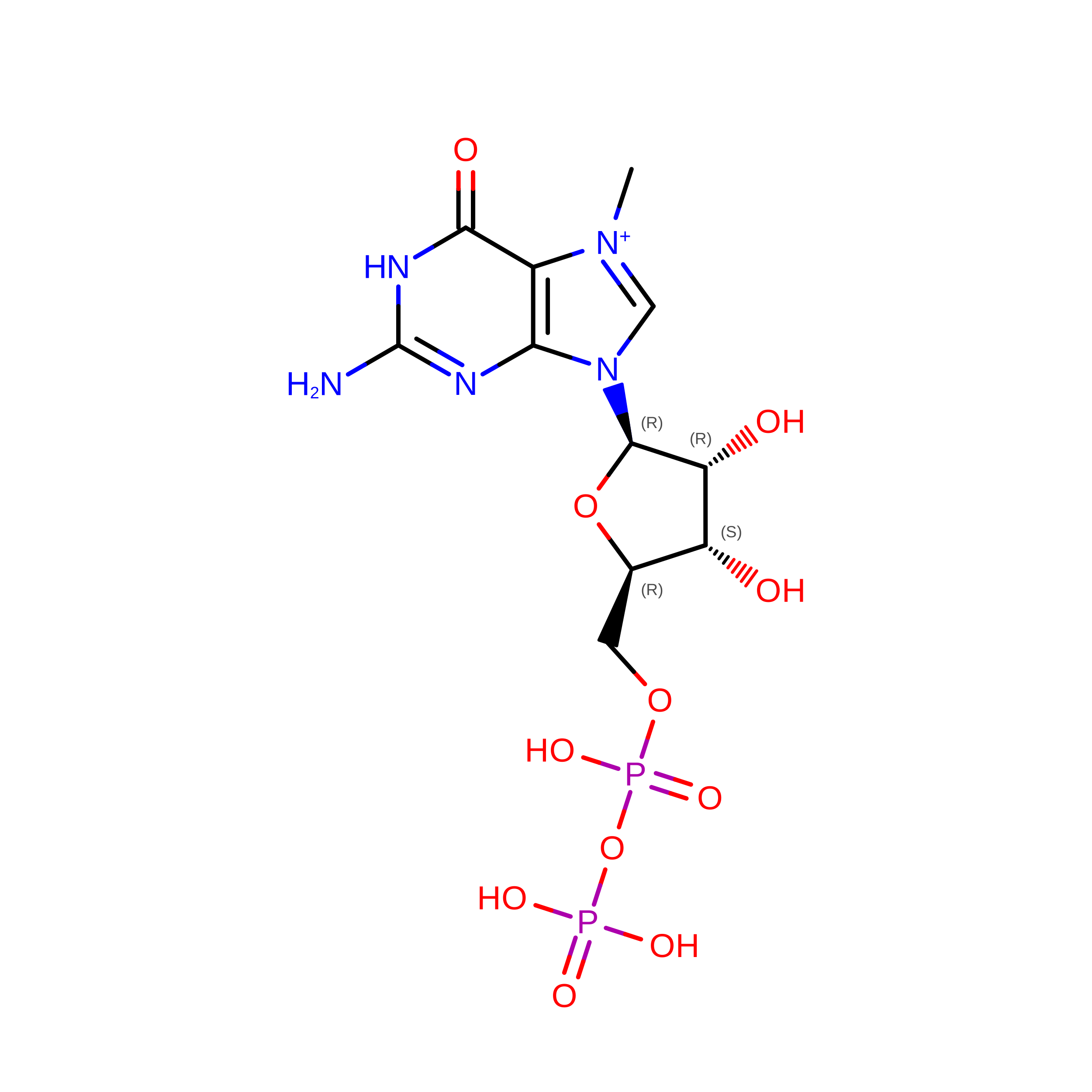
IDChains Name / Formula / InChI Key2D Diagram3D Interactions
M7G

Query on M7G


Download:Ideal Coordinates CCD File
C [auth A]7N-METHYL-8-HYDROGUANOSINE-5'-DIPHOSPHATE
C11 H18 N5 O11 P2
SBASPRRECYVBRF-KQYNXXCUSA-O

Experimental Data & Validation

Experimental Data

  • Method: X-RAY DIFFRACTION
  • Resolution: 2.25 Å
  • R-Value Free:  0.267 (Depositor), 0.274 (DCC) 
  • R-Value Work:  0.219 (Depositor), 0.229 (DCC) 
Space Group: C 1 2 1
Unit Cell:
Length ( Å )Angle ( ˚ )
a = 81.9α = 90
b = 45.2β = 101.8
c = 62.1γ = 90
Software Package:
Software NamePurpose
AMoREphasing
CNSrefinement
DENZOdata reduction
SCALEPACKdata scaling

Structure Validation

View Full Validation Report


Ligand Structure Quality Assessment 


Entry History 

Deposition Data

Revision History  (Full details and data files)

  • Version 1.0: 2000-03-15
    Type: Initial release
  • Version 1.1: 2008-04-27
    Changes: Version format compliance
  • Version 1.2: 2011-07-13
    Changes: Version format compliance
  • Version 1.3: 2018-01-31
    Changes: Experimental preparation
  • Version 1.4: 2021-02-03
    Changes: Database references, Derived calculations, Structure summary
  • Version 1.5: 2024-02-07
    Changes: Data collection, Database references
  • Version 2.0: 2024-03-06
    Changes: Data collection, Non-polymer description, Structure summary