1EAG | pdb_00001eag

Secreted aspartic proteinase (SAP2) from Candida albicans complexed with A70450


Experimental Data Snapshot

  • Method: X-RAY DIFFRACTION
  • Resolution: 2.10 Å
  • R-Value Free: 
    0.268 (Depositor) 
  • R-Value Work: 
    0.195 (Depositor) 

wwPDB Validation 3D Report Full Report

Validation slider image for 1EAG

This is version 1.4 of the entry. See complete history

Literature

The crystal structure of a major secreted aspartic proteinase from Candida albicans in complexes with two inhibitors.

Cutfield, S.M.Dodson, E.J.Anderson, B.F.Moody, P.C.E.Marshall, C.J.Sullivan, P.A.Cutfield, J.F.

(1995) Structure 3: 1261-1271

  • DOI: https://doi.org/10.1016/s0969-2126(01)00261-1
  • Primary Citation Related Structures: 
    1EAG

  • PubMed Abstract: 

    Infections caused by Candida albicans, a common fungal pathogen of humans, are increasing in incidence, necessitating development of new therapeutic drugs. Secreted aspartic proteinase (SAP) activity is considered an important virulence factor in these infections and might offer a suitable target for drug design. Amongst the various SAP isozymes, the SAP2 gene product is the major form expressed in a number of C. albicans strains. The three-dimensional structures of SAP2 complexed with the tight-binding inhibitor A70450 (a synthetic hexapeptide analogue) and with the general aspartic proteinase inhibitor pepstatin A (a microbial natural product) have been determined to 2.1 A and 3.0 A resolution, respectively. Although the protein structure retains the main features of a typical aspartic proteinase, it also shows some significant differences, due mainly to several sequence insertions and deletions (as revealed by homology modelling), that alter the shape of the binding cleft. There is also considerable variation in the C-terminal structural domain. The differences in side chains, and in the conformations adopted by the two inhibitors, particularly at their P4, P3 and P'2 positions (using standard notation for protease-inhibitor residues), allows the A70450 structure to complement, more accurately, that of the substrate-binding site of SAP2. Some differences in the binding clefts of other SAP isoenzymes may be deduced from the SAP2 structure.


  • Organizational Affiliation
    • Biochemistry Department, University of Otago, Dunedin, New Zealand.

Macromolecule Content 

  • Total Structure Weight: 37.1 kDa 
  • Atom Count: 2,710 
  • Modeled Residue Count: 339 
  • Deposited Residue Count: 342 
  • Unique protein chains: 1

Macromolecules

Find similar proteins by:|  3D Structure
Entity ID: 1
MoleculeChains  Sequence LengthOrganismDetailsImage
ASPARTIC PROTEINASE (SAP2 GENE PRODUCT)342Candida albicansMutation(s): 0 
EC: 3.4.23.24
UniProt
Find proteins for P0CS83 (Candida albicans)
Explore P0CS83 
Go to UniProtKB:  P0CS83
Entity Groups
Sequence Clusters30% Identity50% Identity70% Identity90% Identity95% Identity100% Identity
UniProt GroupP0CS83
Sequence Annotations
Expand
Reference Sequence

Small Molecules

Ligands 1 Unique
IDChains Name / Formula / InChI Key2D Diagram3D Interactions
A70

Query on A70


Download:Ideal Coordinates CCD File
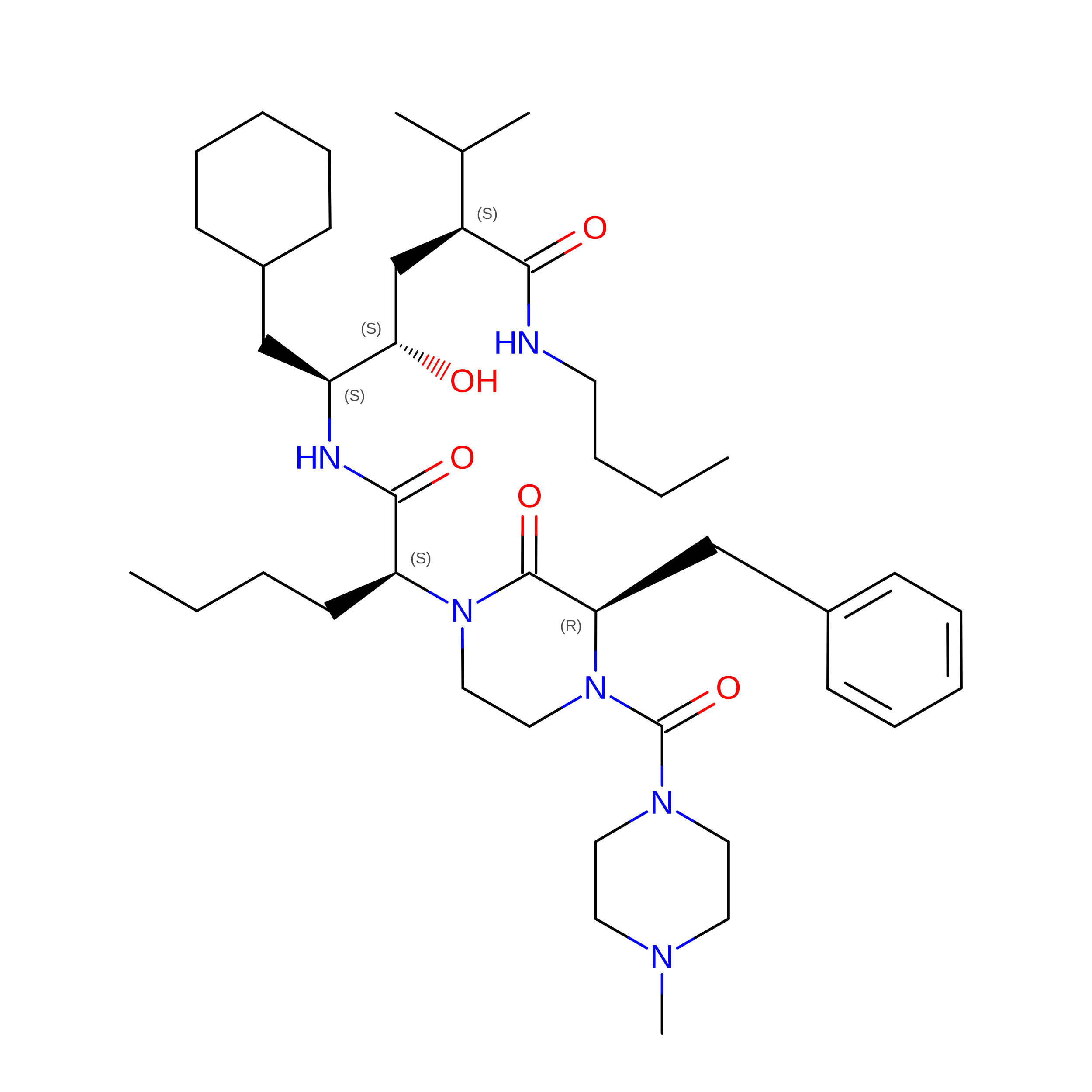
B [auth A]N-ethyl-N-[(4-methylpiperazin-1-yl)carbonyl]-D-phenylalanyl-N-[(1S,2S,4R)-4-(butylcarbamoyl)-1-(cyclohexylmethyl)-2-hyd roxy-5-methylhexyl]-L-norleucinamide
C42 H70 N6 O5
NGCGSAFHWCZMPV-AKHKZFQHSA-N

Experimental Data & Validation

Experimental Data

  • Method: X-RAY DIFFRACTION
  • Resolution: 2.10 Å
  • R-Value Free:  0.268 (Depositor) 
  • R-Value Work:  0.195 (Depositor) 
Space Group: P 43 21 2
Unit Cell:
Length ( Å )Angle ( ˚ )
a = 76.2α = 90
b = 76.2β = 90
c = 126.1γ = 90
Software Package:
Software NamePurpose
DENZOdata reduction
PROLSQrefinement

Structure Validation

View Full Validation Report


Entry History 

Deposition Data

Revision History  (Full details and data files)

  • Version 1.0: 1996-12-23
    Type: Initial release
  • Version 1.1: 2008-03-24
    Changes: Version format compliance
  • Version 1.2: 2011-07-13
    Changes: Atomic model, Database references, Derived calculations, Non-polymer description, Structure summary, Version format compliance
  • Version 1.3: 2012-01-18
    Changes: Non-polymer description
  • Version 1.4: 2024-10-30
    Changes: Data collection, Database references, Derived calculations, Structure summary