1DV2 | pdb_00001dv2

The structure of biotin carboxylase, mutant E288K, complexed with ATP


Experimental Data Snapshot

  • Method: X-RAY DIFFRACTION
  • Resolution: 2.50 Å
  • R-Value Free: 
    0.203 (Depositor) 
  • R-Value Work: 
    0.171 (Depositor) 
  • R-Value Observed: 
    0.172 (Depositor) 

wwPDB Validation 3D Report Full Report

Validation slider image for 1DV2

This is version 1.6 of the entry. See complete history

Literature

Movement of the biotin carboxylase B-domain as a result of ATP binding.

Thoden, J.B.Blanchard, C.Z.Holden, H.M.Waldrop, G.L.

(2000) J Biological Chem 275: 16183-16190

  • DOI: https://doi.org/10.1074/jbc.275.21.16183
  • Primary Citation Related Structures: 
    1DV1, 1DV2

  • PubMed Abstract: 

    Acetyl-CoA carboxylase catalyzes the first committed step in fatty acid synthesis. In Escherichia coli, the enzyme is composed of three distinct protein components: biotin carboxylase, biotin carboxyl carrier protein, and carboxyltransferase. The biotin carboxylase component has served for many years as a paradigm for mechanistic studies devoted toward understanding more complicated biotin-dependent carboxylases. The three-dimensional x-ray structure of an unliganded form of E. coli biotin carboxylase was originally solved in 1994 to 2.4-A resolution. This study revealed the architecture of the enzyme and demonstrated that the protein belongs to the ATP-grasp superfamily. Here we describe the three-dimensional structure of the E. coli biotin carboxylase complexed with ATP and determined to 2.5-A resolution. The major conformational change that occurs upon nucleotide binding is a rotation of approximately 45(o) of one domain relative to the other domains thereby closing off the active site pocket. Key residues involved in binding the nucleotide to the protein include Lys-116, His-236, and Glu-201. The backbone amide groups of Gly-165 and Gly-166 participate in hydrogen bonding interactions with the phosphoryl oxygens of the nucleotide. A comparison of this closed form of biotin carboxylase with carbamoyl-phosphate synthetase is presented.


  • Organizational Affiliation
    • Department of Biochemistry, University of Wisconsin, Madison, Wisconsin 53705, USA.

Macromolecule Content 

  • Total Structure Weight: 100.35 kDa 
  • Atom Count: 7,113 
  • Modeled Residue Count: 898 
  • Deposited Residue Count: 904 
  • Unique protein chains: 1

Macromolecules

Find similar proteins by:|  3D Structure
Entity ID: 1
MoleculeChains  Sequence LengthOrganismDetailsImage
BIOTIN CARBOXYLASE
A, B
452Escherichia coliMutation(s): 1 
EC: 6.3.4.14
UniProt
Find proteins for P24182 (Escherichia coli (strain K12))
Explore P24182 
Go to UniProtKB:  P24182
Entity Groups
Sequence Clusters30% Identity50% Identity70% Identity90% Identity95% Identity100% Identity
UniProt GroupP24182
Sequence Annotations
Expand
Reference Sequence

Small Molecules

Ligands 1 Unique
IDChains Name / Formula / InChI Key2D Diagram3D Interactions
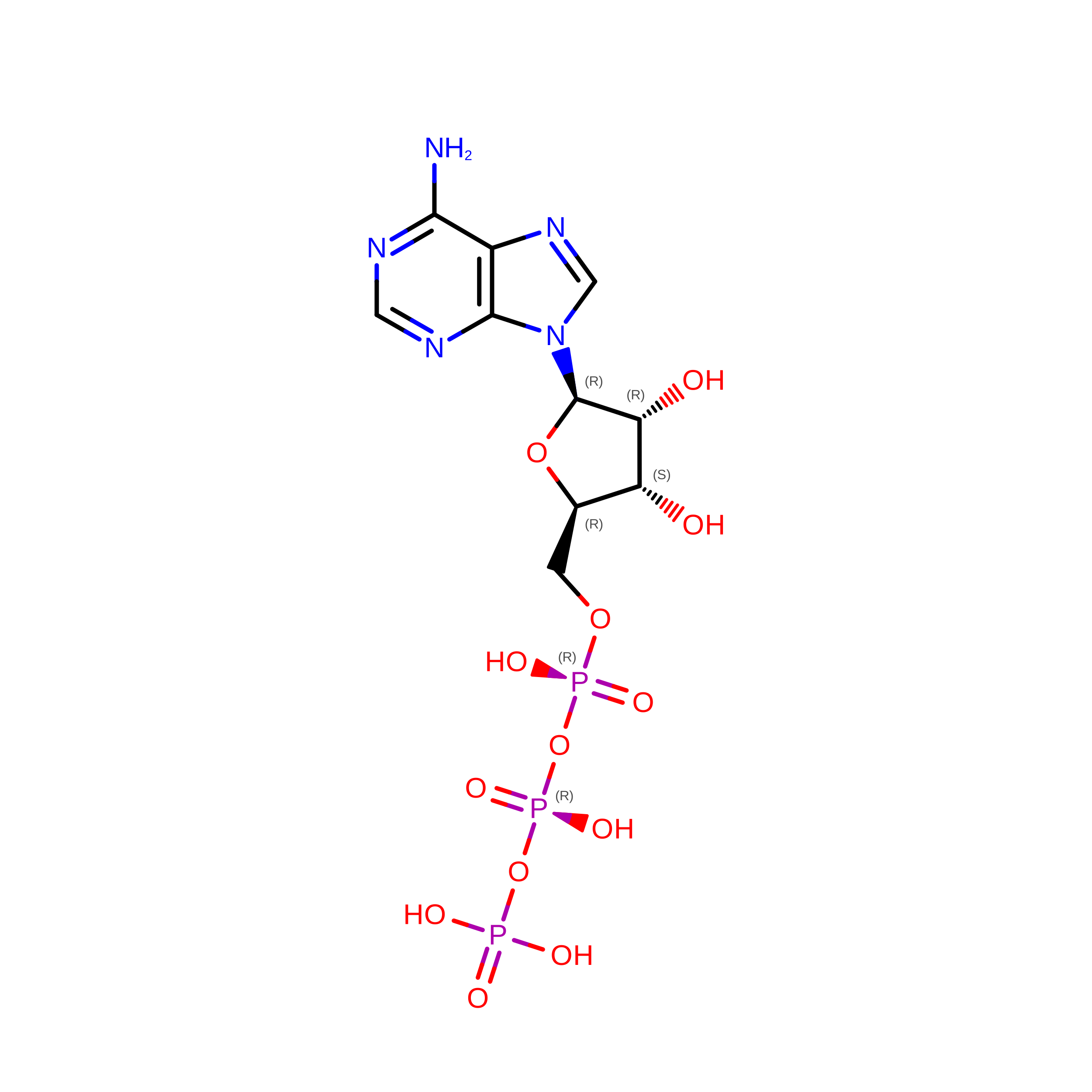
ATP

Query on ATP


Download:Ideal Coordinates CCD File
C [auth A],
D [auth B]
ADENOSINE-5'-TRIPHOSPHATE
C10 H16 N5 O13 P3
ZKHQWZAMYRWXGA-KQYNXXCUSA-N

Experimental Data & Validation

Experimental Data

  • Method: X-RAY DIFFRACTION
  • Resolution: 2.50 Å
  • R-Value Free:  0.203 (Depositor) 
  • R-Value Work:  0.171 (Depositor) 
  • R-Value Observed: 0.172 (Depositor) 
Space Group: P 21 21 21
Unit Cell:
Length ( Å )Angle ( ˚ )
a = 81.3α = 90
b = 115.5β = 90
c = 122.4γ = 90
Software Package:
Software NamePurpose
FRAMBOdata collection
SAINTdata reduction
AMoREphasing
TNTrefinement
SAINTdata scaling

Structure Validation

View Full Validation Report


Entry History 

Deposition Data

Revision History  (Full details and data files)

  • Version 1.0: 2000-06-09
    Type: Initial release
  • Version 1.1: 2008-04-27
    Changes: Version format compliance
  • Version 1.2: 2011-07-13
    Changes: Version format compliance
  • Version 1.3: 2017-10-04
    Changes: Refinement description
  • Version 1.4: 2018-03-14
    Changes: Database references
  • Version 1.5: 2022-12-21
    Changes: Database references, Derived calculations
  • Version 1.6: 2024-05-22
    Changes: Data collection