1DLJ | pdb_00001dlj

THE FIRST STRUCTURE OF UDP-GLUCOSE DEHYDROGENASE (UDPGDH) REVEALS THE CATALYTIC RESIDUES NECESSARY FOR THE TWO-FOLD OXIDATION


Experimental Data Snapshot

  • Method: X-RAY DIFFRACTION
  • Resolution: 1.80 Å
  • R-Value Free: 
    0.213 (Depositor) 
  • R-Value Work: 
    0.179 (Depositor) 
  • R-Value Observed: 
    0.179 (Depositor) 

wwPDB Validation 3D Report Full Report

Validation slider image for 1DLJ

This is version 1.4 of the entry. See complete history

Literature

The first structure of UDP-glucose dehydrogenase reveals the catalytic residues necessary for the two-fold oxidation.

Campbell, R.E.Mosimann, S.C.van De Rijn, I.Tanner, M.E.Strynadka, N.C.

(2000) Biochemistry 39: 7012-7023

  • Primary Citation Related Structures: 
    1DLI, 1DLJ

  • PubMed Abstract: 

    Bacterial UDP-glucose dehydrogenase (UDPGlcDH) is essential for formation of the antiphagocytic capsule that protects many virulent bacteria such as Streptococcus pyogenes andStreptococcus pneumoniae type 3 from the host's immune system. We have determined the X-ray structures of both native and Cys260Ser UDPGlcDH from S. pyogenes (74% similarity to S. pneumoniae) in ternary complexes with UDP-xylose/NAD(+) and UDP-glucuronic acid/NAD(H), respectively. The 402 residue homodimeric UDPGlcDH is composed of an N-terminal NAD(+) dinucleotide binding domain and a C-terminal UDP-sugar binding domain connected by a long (48 A) central alpha-helix. The first 290 residues of UDPGlcDH share structural homology with 6-phosphogluconate dehydrogenase, including conservation of an active site lysine and asparagine that are implicated in the enzyme mechanism. Also proposed to participate in the catalytic mechanism are a threonine and a glutamate that hydrogen bond to a conserved active site water molecule suitably positioned for general acid/base catalysis.


  • Organizational Affiliation
    • Department of Biochemistry and Molecular Biology, University of British Columbia, Vancouver, British Columbia, Canada V6T 1Z3.

Macromolecule Content 

  • Total Structure Weight: 47.33 kDa 
  • Atom Count: 3,744 
  • Modeled Residue Count: 402 
  • Deposited Residue Count: 402 
  • Unique protein chains: 1

Macromolecules

Find similar proteins by:|  3D Structure
Entity ID: 1
MoleculeChains  Sequence LengthOrganismDetailsImage
UDP-GLUCOSE DEHYDROGENASE402Streptococcus pyogenesMutation(s): 1 
EC: 1.1.1.22
UniProt
Find proteins for P0C0F4 (Streptococcus pyogenes)
Explore P0C0F4 
Go to UniProtKB:  P0C0F4
Entity Groups
Sequence Clusters30% Identity50% Identity70% Identity90% Identity95% Identity100% Identity
UniProt GroupP0C0F4
Sequence Annotations
Expand
Reference Sequence

Small Molecules

Ligands 4 Unique
IDChains Name / Formula / InChI Key2D Diagram3D Interactions
NAI

Query on NAI


Download:Ideal Coordinates CCD File
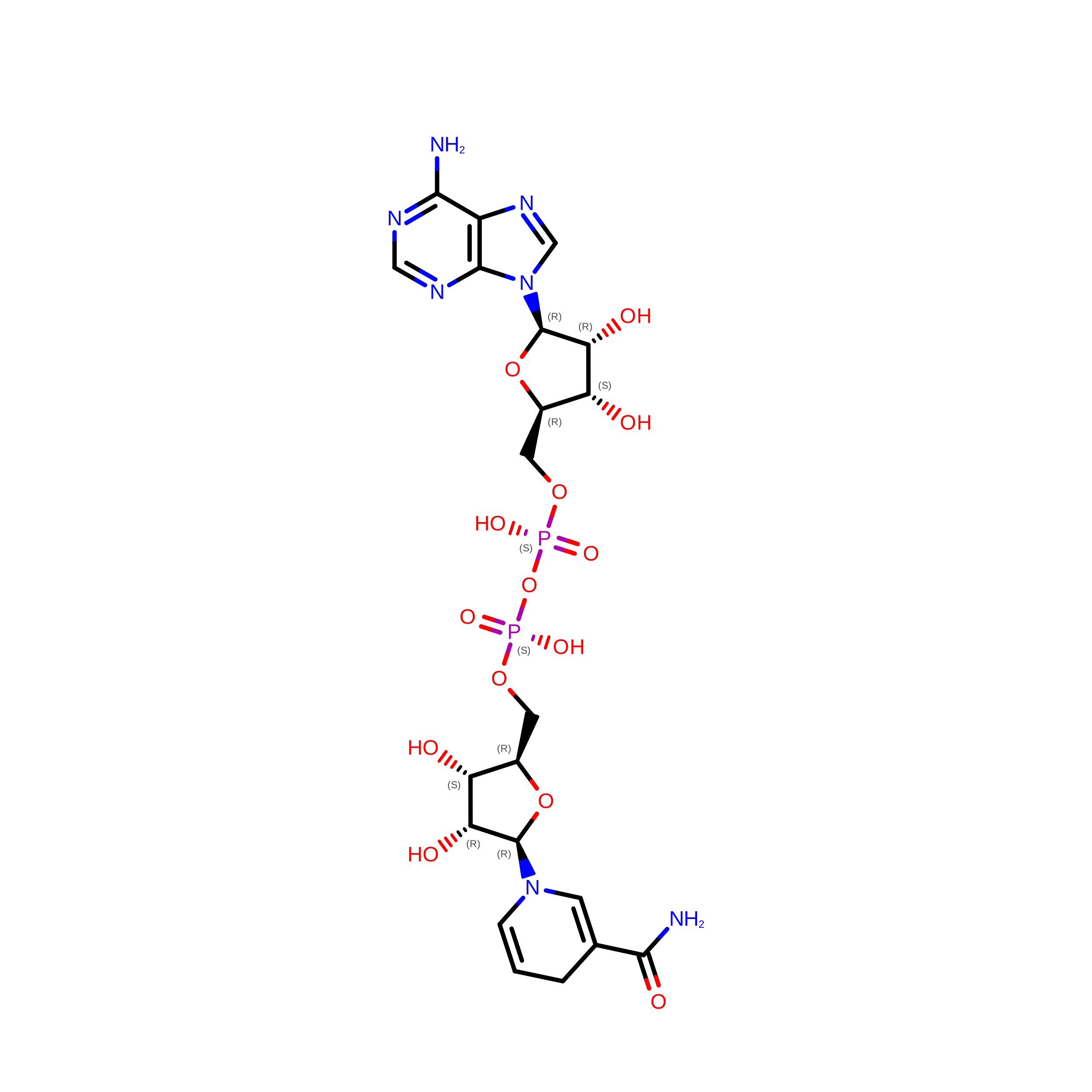
E [auth A]1,4-DIHYDRONICOTINAMIDE ADENINE DINUCLEOTIDE
C21 H29 N7 O14 P2
BOPGDPNILDQYTO-NNYOXOHSSA-N
UGA

Query on UGA


Download:Ideal Coordinates CCD File
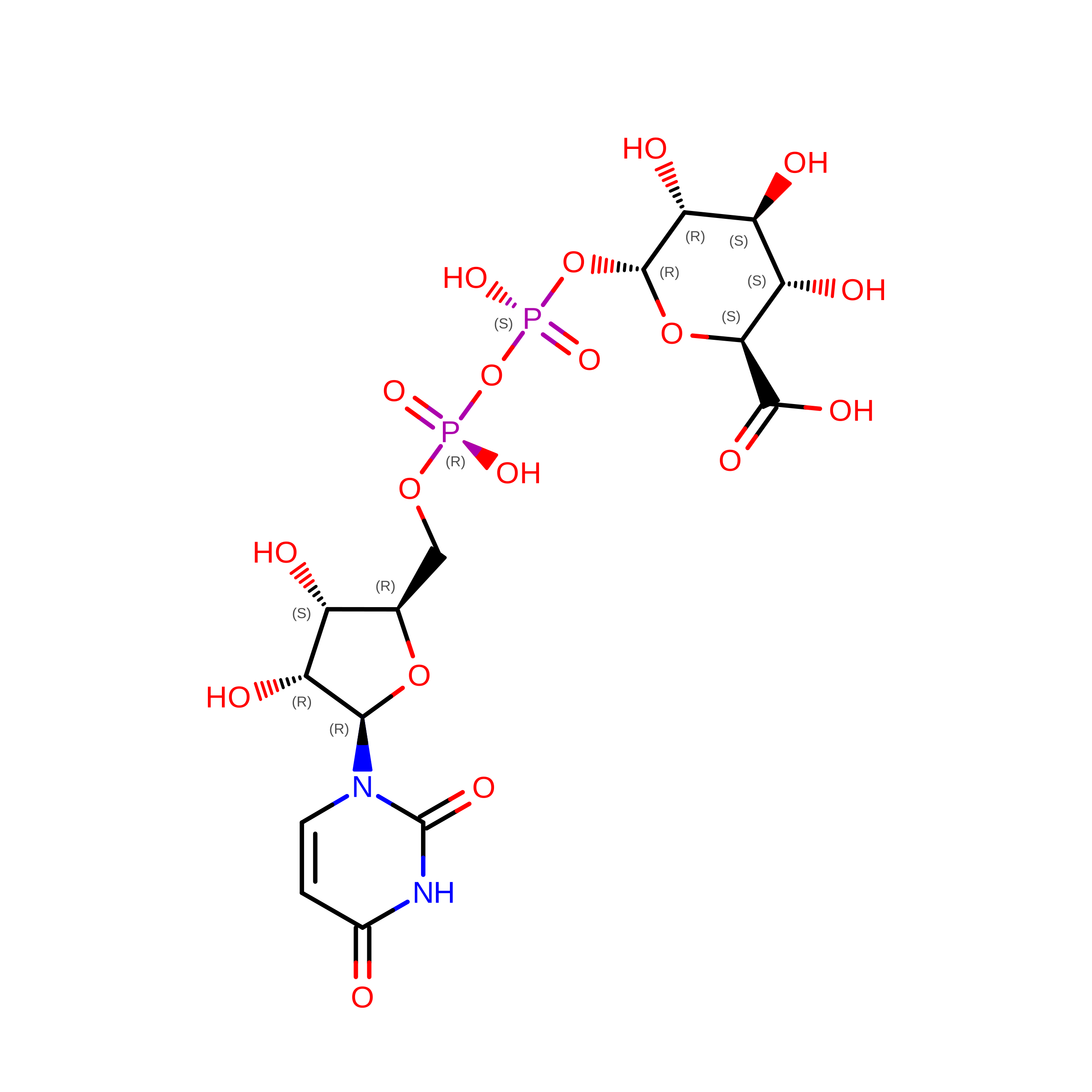
F [auth A]URIDINE-5'-DIPHOSPHATE-GLUCURONIC ACID
C15 H22 N2 O18 P2
HDYANYHVCAPMJV-LXQIFKJMSA-N
SO4

Query on SO4


Download:Ideal Coordinates CCD File
B [auth A],
C [auth A],
D [auth A]
SULFATE ION
O4 S
QAOWNCQODCNURD-UHFFFAOYSA-L
GOL

Query on GOL


Download:Ideal Coordinates CCD File
G [auth A],
H [auth A],
I [auth A]
GLYCEROL
C3 H8 O3
PEDCQBHIVMGVHV-UHFFFAOYSA-N

Experimental Data & Validation

Experimental Data

  • Method: X-RAY DIFFRACTION
  • Resolution: 1.80 Å
  • R-Value Free:  0.213 (Depositor) 
  • R-Value Work:  0.179 (Depositor) 
  • R-Value Observed: 0.179 (Depositor) 
Space Group: P 4 21 2
Unit Cell:
Length ( Å )Angle ( ˚ )
a = 106.961α = 90
b = 106.961β = 90
c = 81.744γ = 90
Software Package:
Software NamePurpose
DENZOdata reduction
SCALEPACKdata scaling
SOLVEphasing
CNSrefinement

Structure Validation

View Full Validation Report


Entry History 

Deposition Data

Revision History  (Full details and data files)

  • Version 1.0: 2000-05-31
    Type: Initial release
  • Version 1.1: 2008-04-27
    Changes: Version format compliance
  • Version 1.2: 2011-07-13
    Changes: Derived calculations, Version format compliance
  • Version 1.3: 2021-11-03
    Changes: Database references, Derived calculations
  • Version 1.4: 2024-02-07
    Changes: Data collection