1DCW | pdb_00001dcw

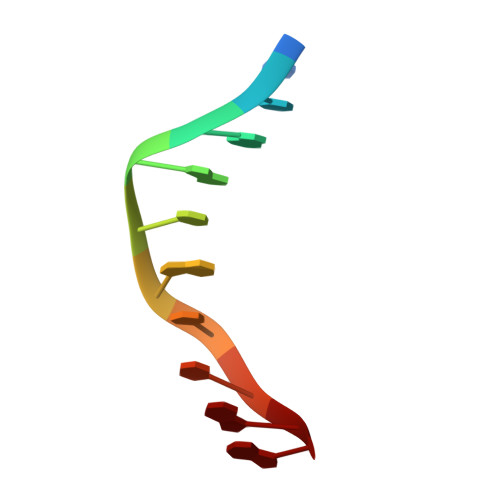
STRUCTURE OF A FOUR-WAY JUNCTION IN AN INVERTED REPEAT SEQUENCE.


Experimental Data Snapshot

  • Method: X-RAY DIFFRACTION
  • Resolution: 2.10 Å
  • R-Value Free: 
    0.317 (Depositor) 
  • R-Value Work: 
    0.230 (Depositor), 0.244 (DCC) 
  • R-Value Observed: 
    0.230 (Depositor) 

wwPDB Validation 3D Report Full Report

Validation slider image for 1DCW

This is version 1.3 of the entry. See complete history

Literature

The Holliday junction in an inverted repeat DNA sequence: sequence effects on the structure of four-way junctions.

Eichman, B.F.Vargason, J.M.Mooers, B.H.Ho, P.S.

(2000) Proc Natl Acad Sci U S A 97: 3971-3976

  • DOI: https://doi.org/10.1073/pnas.97.8.3971
  • Primary Citation Related Structures: 
    1DCV, 1DCW

  • PubMed Abstract: 

    Holliday junctions are important structural intermediates in recombination, viral integration, and DNA repair. We present here the single-crystal structure of the inverted repeat sequence d(CCGGTACCGG) as a Holliday junction at the nominal resolution of 2. 1 A. Unlike the previous crystal structures, this DNA junction has B-DNA arms with all standard Watson-Crick base pairs; it therefore represents the intermediate proposed by Holliday as being involved in homologous recombination. The junction is in the stacked-X conformation, with two interconnected duplexes formed by coaxially stacked arms, and is crossed at an angle of 41.4 degrees as a right-handed X. A sequence comparison with previous B-DNA and junction crystal structures shows that an ACC trinucleotide forms the core of a stable junction in this system. The 3'-C x G base pair of this ACC core forms direct and water-mediated hydrogen bonds to the phosphates at the crossover strands. Interactions within this core define the conformation of the Holliday junction, including the angle relating the stacked duplexes and how the base pairs are stacked in the stable form of the junction.


  • Organizational Affiliation
    • Department of Biochemistry and Biophysics, ALS 2011, Oregon State University, Corvallis, OR 97331-7305, USA.

Macromolecule Content 

  • Total Structure Weight: 12.21 kDa 
  • Atom Count: 900 
  • Modeled Residue Count: 40 
  • Deposited Residue Count: 40 
  • Unique nucleic acid chains: 1

Macromolecules

Find similar nucleic acids by:  Sequence
Entity ID: 1
MoleculeChains LengthOrganismImage
DNA (5'-D(*CP*CP*GP*GP*TP*AP*CP*CP*GP*G)-3')
A, B, C, D
10N/A
Sequence Annotations
Expand
Reference Sequence

Small Molecules

Ligands 1 Unique
IDChains Name / Formula / InChI Key2D Diagram3D Interactions
NA

Query on NA


Download:Ideal Coordinates CCD File
E [auth D]SODIUM ION
Na
FKNQFGJONOIPTF-UHFFFAOYSA-N

Experimental Data & Validation

Experimental Data

  • Method: X-RAY DIFFRACTION
  • Resolution: 2.10 Å
  • R-Value Free:  0.317 (Depositor) 
  • R-Value Work:  0.230 (Depositor), 0.244 (DCC) 
  • R-Value Observed: 0.230 (Depositor) 
Space Group: C 1 2 1
Unit Cell:
Length ( Å )Angle ( ˚ )
a = 66.5α = 90
b = 23.5β = 114.8
c = 76.9γ = 90
Software Package:
Software NamePurpose
AMoREphasing
X-PLORrefinement
DENZOdata reduction
SCALEPACKdata scaling

Structure Validation

View Full Validation Report


Entry History 

Deposition Data

Revision History  (Full details and data files)

  • Version 1.0: 2000-04-17
    Type: Initial release
  • Version 1.1: 2008-04-27
    Changes: Version format compliance
  • Version 1.2: 2011-07-13
    Changes: Version format compliance
  • Version 1.3: 2024-02-07
    Changes: Data collection, Database references, Derived calculations