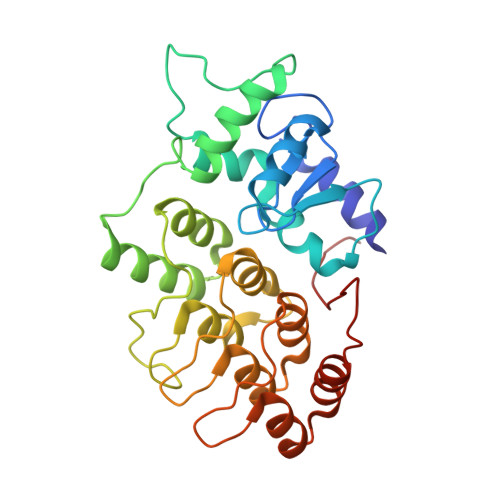
1DCQ | pdb_00001dcq

CRYSTAL STRUCTURE OF THE ARF-GAP DOMAIN AND ANKYRIN REPEATS OF PAPBETA.


Experimental Data Snapshot

  • Method: X-RAY DIFFRACTION
  • Resolution: 2.10 Å
  • R-Value Free: 
    0.266 (Depositor) 
  • R-Value Work: 
    0.213 (Depositor), 0.225 (DCC) 
  • R-Value Observed: 
    0.230 (Depositor) 

wwPDB Validation 3D Report Full Report

Validation slider image for 1DCQ

This is version 1.4 of the entry. See complete history

Literature

Crystal structure of the ARF-GAP domain and ankyrin repeats of PYK2-associated protein beta.

Mandiyan, V.Andreev, J.Schlessinger, J.Hubbard, S.R.

(1999) EMBO J 18: 6890-6898

  • DOI: https://doi.org/10.1093/emboj/18.24.6890
  • Primary Citation Related Structures: 
    1DCQ

  • PubMed Abstract: 

    ADP ribosylation factors (ARFs), which are members of the Ras superfamily of GTP-binding proteins, are critical components of vesicular trafficking pathways in eukaryotes. Like Ras, ARFs are active in their GTP-bound form, and their duration of activity is controlled by GTPase-activating proteins (GAPs), which assist ARFs in hydrolyzing GTP to GDP. PAPbeta, a protein that binds to and is phosphorylated by the non-receptor tyrosine kinase PYK2, contains several modular signaling domains including a pleckstrin homology domain, an SH3 domain, ankyrin repeats and an ARF-GAP domain. Sequences of ARF-GAP domains show no recognizable similarity to those of other GAPs, and contain a characteristic Cys-X(2)-Cys-X(16-17)-Cys-X(2)-Cys motif. The crystal structure of the PAPbeta ARF-GAP domain and the C-terminal ankyrin repeats has been determined at 2.1 A resolution. The ARF-GAP domain comprises a central three-stranded beta-sheet flanked by five alpha-helices, with a Zn(2+) ion coordinated by the four cysteines of the cysteine-rich motif. Four ankyrin repeats are also present, the first two of which form an extensive interface with the ARF-GAP domain. An invariant arginine and several nearby hydrophobic residues are solvent exposed and are predicted to be the site of interaction with ARFs. Site-directed mutagenesis of these residues confirms their importance in ARF-GAP activity.


  • Organizational Affiliation
    • Department of Pharmacology, Skirball Institute of Biomolecular Medicine, New York University Medical School, New York, NY 10016, USA.

Macromolecule Content 

  • Total Structure Weight: 30.95 kDa 
  • Atom Count: 2,169 
  • Modeled Residue Count: 276 
  • Deposited Residue Count: 278 
  • Unique protein chains: 1

Macromolecules

Find similar proteins by:|  3D Structure
Entity ID: 1
MoleculeChains  Sequence LengthOrganismDetailsImage
PYK2-ASSOCIATED PROTEIN BETA278Mus musculusMutation(s): 0 
UniProt & NIH Common Fund Data Resources
Find proteins for Q7SIG6 (Mus musculus)
Explore Q7SIG6 
Go to UniProtKB:  Q7SIG6
IMPC:  MGI:2685438
Entity Groups
Sequence Clusters30% Identity50% Identity70% Identity90% Identity95% Identity100% Identity
UniProt GroupQ7SIG6
Sequence Annotations
Expand
Reference Sequence

Small Molecules

Ligands 1 Unique
IDChains Name / Formula / InChI Key2D Diagram3D Interactions
ZN

Query on ZN


Download:Ideal Coordinates CCD File
B [auth A]ZINC ION
Zn
PTFCDOFLOPIGGS-UHFFFAOYSA-N

Experimental Data & Validation

Experimental Data

  • Method: X-RAY DIFFRACTION
  • Resolution: 2.10 Å
  • R-Value Free:  0.266 (Depositor) 
  • R-Value Work:  0.213 (Depositor), 0.225 (DCC) 
  • R-Value Observed: 0.230 (Depositor) 
Space Group: C 2 2 21
Unit Cell:
Length ( Å )Angle ( ˚ )
a = 73.935α = 90
b = 132.208β = 90
c = 59.817γ = 90
Software Package:
Software NamePurpose
CNSrefinement
DENZOdata reduction
SCALEPACKdata scaling
CNSphasing

Structure Validation

View Full Validation Report


Entry History 

Deposition Data

Revision History  (Full details and data files)

  • Version 1.0: 1999-12-22
    Type: Initial release
  • Version 1.1: 2008-04-27
    Changes: Version format compliance
  • Version 1.2: 2011-07-13
    Changes: Version format compliance
  • Version 1.3: 2016-12-14
    Changes: Other
  • Version 1.4: 2024-10-09
    Changes: Data collection, Database references, Derived calculations, Structure summary