1DBB | pdb_00001dbb

THREE-DIMENSIONAL STRUCTURE OF AN ANTI-STEROID FAB' AND PROGESTERONE-FAB' COMPLEX


Experimental Data Snapshot

  • Method: X-RAY DIFFRACTION
  • Resolution: 2.70 Å
  • R-Value Work: 
    0.210 (Depositor) 
  • R-Value Observed: 
    0.210 (Depositor) 

wwPDB Validation 3D Report Full Report

Validation slider image for 1DBB

This is version 1.4 of the entry. See complete history

Literature

Three-dimensional structure of an anti-steroid Fab' and progesterone-Fab' complex.

Arevalo, J.H.Stura, E.A.Taussig, M.J.Wilson, I.A.

(1993) J Mol Biology 231: 103-118

  • DOI: https://doi.org/10.1006/jmbi.1993.1260
  • Primary Citation Related Structures: 
    1DBA, 1DBB

  • PubMed Abstract: 

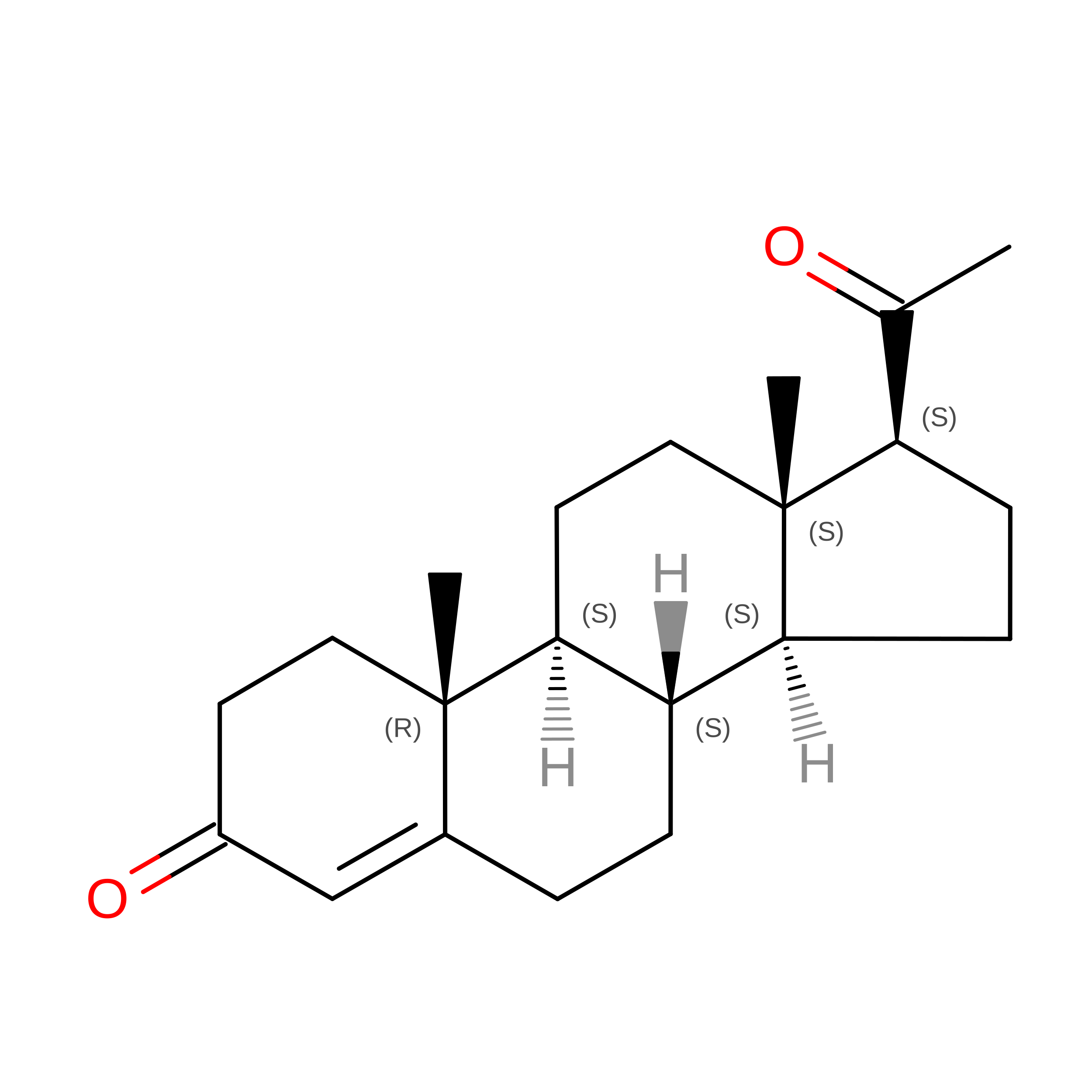
    The monoclonal anti-progesterone antibody DB3 binds progesterone with nanomolar affinity (Ka approximately 10(9) M-1), suggesting high specificity. However, DB3 also cross-reacts with similar affinity with a subgroup of structurally distinct, progesterone-like steroids. Crystals of the unliganded Fab' and various steroid-Fab' complexes are isomorphous and belong to the hexagonal space group, P6(4)22, with unit cell dimensions of a = b = 135 A, c = 124 A. Structures of free and progesterone-bound Fab' have been determined by X-ray crystallography at 2.7 A resolution using molecular replacement techniques. Progesterone is bound in a hydrophobic pocket formed mainly by the interaction of three complementarity determining regions L1, H2 and H3. The orientation of the ligand in the binding site was aided by both crystallographic and biochemical analyses of substituted steroids. The indole side-chain of TrpH100 of the DB3 has two different conformations, inter-converting "open" and "closed" forms of the antibody combining site. The TrpH100 indole thus appears to be acting as an antibody-derived surrogate ligand for its own hydrophobic binding pocket. These structures provide the first atomic view of how a steroid interacts with a protein and offer a structural explanation for the restriction of the anti-progesterone response to the VGAM3.8 family of VH genes.


  • Organizational Affiliation
    • Department of Molecular Biology, Scripps Research Institute, La Jolla, CA 92037.

Macromolecule Content 

  • Total Structure Weight: 47.95 kDa 
  • Atom Count: 3,377 
  • Modeled Residue Count: 435 
  • Deposited Residue Count: 435 
  • Unique protein chains: 2

Macromolecules

Find similar proteins by:|  3D Structure
Entity ID: 1
MoleculeChains  Sequence LengthOrganismDetailsImage
IGG1-KAPPA DB3 FAB (LIGHT CHAIN)A [auth L]216Mus musculusMutation(s): 0 
Find similar proteins by:|  3D Structure
Entity ID: 2
MoleculeChains  Sequence LengthOrganismDetailsImage
IGG1-KAPPA DB3 FAB (HEAVY CHAIN)B [auth H]219Mus musculusMutation(s): 0 
UniProt
Find proteins for P01868 (Mus musculus)
Explore P01868 
Go to UniProtKB:  P01868
Entity Groups
Sequence Clusters30% Identity50% Identity70% Identity90% Identity95% Identity100% Identity
UniProt GroupP01868
Sequence Annotations
Expand
Reference Sequence

Small Molecules

Ligands 1 Unique
IDChains Name / Formula / InChI Key2D Diagram3D Interactions
STR

Query on STR


Download:Ideal Coordinates CCD File
C [auth H]PROGESTERONE
C21 H30 O2
RJKFOVLPORLFTN-LEKSSAKUSA-N

Experimental Data & Validation

Experimental Data

  • Method: X-RAY DIFFRACTION
  • Resolution: 2.70 Å
  • R-Value Work:  0.210 (Depositor) 
  • R-Value Observed: 0.210 (Depositor) 
Space Group: P 64 2 2
Unit Cell:
Length ( Å )Angle ( ˚ )
a = 134.76α = 90
b = 134.76β = 90
c = 124.21γ = 120
Software Package:
Software NamePurpose
X-PLORmodel building
X-PLORrefinement
X-PLORphasing

Structure Validation

View Full Validation Report


Entry History 

Deposition Data

Revision History  (Full details and data files)

  • Version 1.0: 1993-10-31
    Type: Initial release
  • Version 1.1: 2008-03-24
    Changes: Version format compliance
  • Version 1.2: 2011-07-13
    Changes: Version format compliance
  • Version 1.3: 2024-06-05
    Changes: Data collection, Database references, Derived calculations, Other
  • Version 1.4: 2024-10-30
    Changes: Structure summary