1D0M | pdb_00001d0m

THE ESCHERICHIA COLI LYTIC TRANSGLYCOSYLASE SLT35 IN COMPLEX WITH BULGECIN A AND (GLCNAC)2


Experimental Data Snapshot

  • Method: X-RAY DIFFRACTION
  • Resolution: 2.47 Å
  • R-Value Free: 
    0.241 (Depositor) 
  • R-Value Work: 
    0.174 (Depositor), 0.179 (DCC) 
  • R-Value Observed: 
    0.179 (Depositor) 

wwPDB Validation 3D Report Full Report

Validation slider image for 1D0M

Ligand Structure Quality Assessment 


This is version 2.2 of the entry. See complete history

Literature

Crystallographic studies of the interactions of Escherichia coli lytic transglycosylase Slt35 with peptidoglycan.

van Asselt, E.J.Kalk, K.H.Dijkstra, B.W.

(2000) Biochemistry 39: 1924-1934

  • DOI: https://doi.org/10.1021/bi992161p
  • Primary Citation Related Structures: 
    1D0K, 1D0L, 1D0M

  • PubMed Abstract: 

    Lytic transglycosylases catalyze the cleavage of the beta-1, 4-glycosidic bond between N-acetylmuramic acid (MurNAc) and N-acetylglucosamine (GlcNAc) in peptidoglycan with concomitant formation of a 1,6-anhydro bond in the MurNAc residue. To understand the reaction mechanism of Escherichia coli lytic transglycosylase Slt35, three crystal structures have been determined of Slt35 in complex with two different peptidoglycan fragments and with the lytic transglycosylase inhibitor bulgecin A. The complexes define four sugar-binding subsites (-2, -1, +1, and +2) and two peptide-binding sites in a large cleft close to Glu162. The Glu162 side chain is between the -1 and +1 sugar-binding sites, in agreement with a function as catalytic acid/base. The complexes suggest additional contributions to catalysis from Ser216 and Asn339, residues which are conserved among the MltB/Slt35 lytic transglycosylases.


  • Organizational Affiliation
    • BIOSON Research Institute, Laboratory of Biophysical Chemistry, University of Groningen, Nijenborgh 4, 9747 AG Groningen, The Netherlands.

Macromolecule Content 

  • Total Structure Weight: 37.1 kDa 
  • Atom Count: 2,772 
  • Modeled Residue Count: 312 
  • Deposited Residue Count: 322 
  • Unique protein chains: 1

Macromolecules

Find similar proteins by:|  3D Structure
Entity ID: 1
MoleculeChains  Sequence LengthOrganismDetailsImage
35KD SOLUBLE LYTIC TRANSGLYCOSYLASE322Escherichia coliMutation(s): 2 
UniProt
Find proteins for P41052 (Escherichia coli (strain K12))
Explore P41052 
Go to UniProtKB:  P41052
Entity Groups
Sequence Clusters30% Identity50% Identity70% Identity90% Identity95% Identity100% Identity
UniProt GroupP41052
Sequence Annotations
Expand
Reference Sequence

Oligosaccharides

Help  
Entity ID: 2
MoleculeChains Length2D Diagram GlycosylationD Interactions
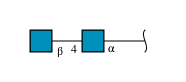
2-acetamido-2-deoxy-beta-D-glucopyranose-(1-4)-2-acetamido-2-deoxy-alpha-D-glucopyranose
B
2N/A
Glycosylation Resources
GlyTouCan: G05026ZL
GlyCosmos: G05026ZL
GlyGen: G05026ZL

Small Molecules

Ligands 2 Unique
IDChains Name / Formula / InChI Key2D Diagram3D Interactions
BLG

Query on BLG


Download:Ideal Coordinates CCD File
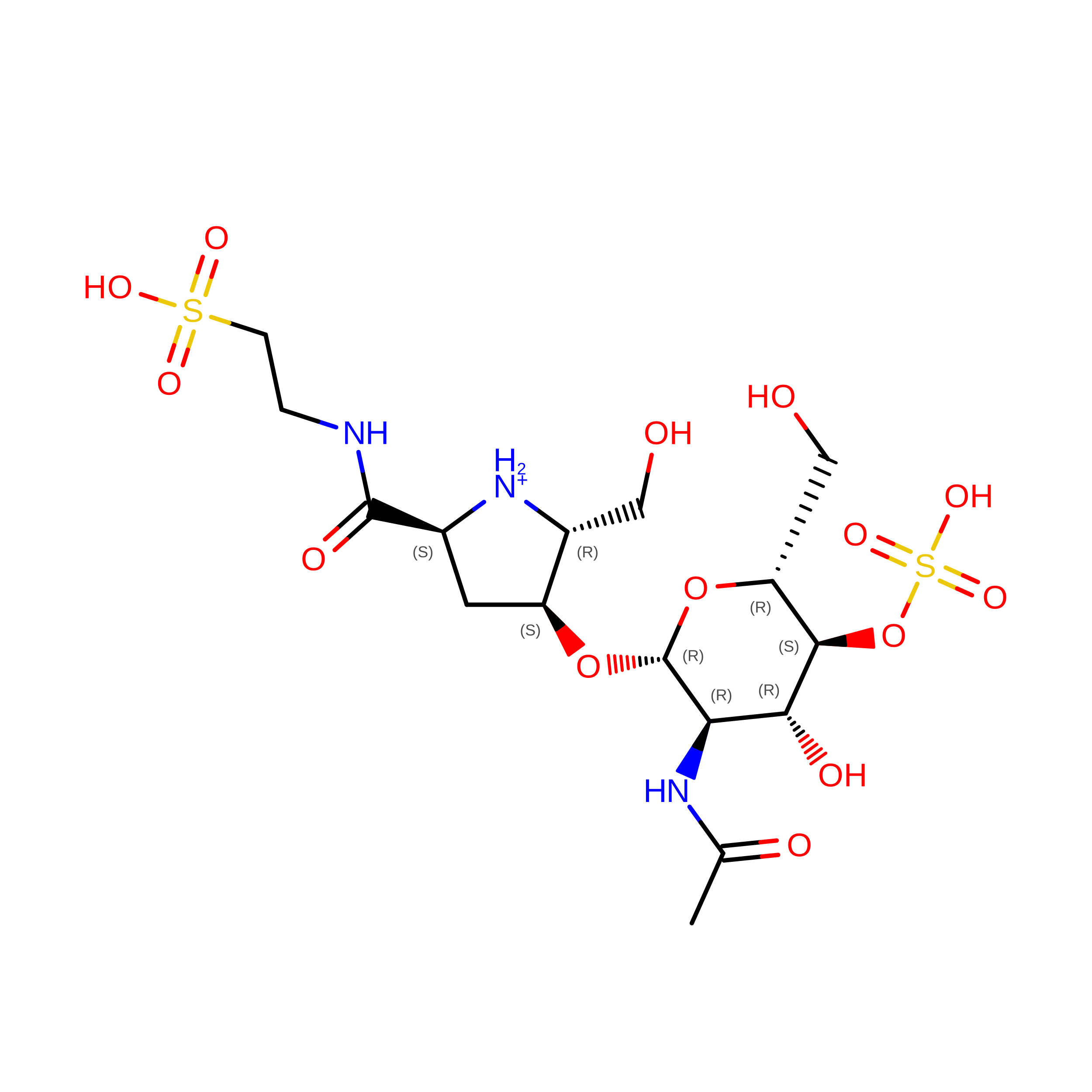
D [auth A]4-O-(4-O-SULFONYL-N-ACETYLGLUCOSAMININYL)-5-METHYLHYDROXY-L-PROLINE-TAURINE
C16 H30 N3 O14 S2
RPNZWZDLNYCCIG-HMMVDTEZSA-O
CA

Query on CA


Download:Ideal Coordinates CCD File
C [auth A]CALCIUM ION
Ca
BHPQYMZQTOCNFJ-UHFFFAOYSA-N

Experimental Data & Validation

Experimental Data

  • Method: X-RAY DIFFRACTION
  • Resolution: 2.47 Å
  • R-Value Free:  0.241 (Depositor) 
  • R-Value Work:  0.174 (Depositor), 0.179 (DCC) 
  • R-Value Observed: 0.179 (Depositor) 
Space Group: P 21 21 21
Unit Cell:
Length ( Å )Angle ( ˚ )
a = 58.631α = 90
b = 67.751β = 90
c = 97.757γ = 90
Software Package:
Software NamePurpose
X-PLORmodel building
X-PLORrefinement
DENZOdata reduction
SCALEPACKdata scaling
X-PLORphasing

Structure Validation

View Full Validation Report


Ligand Structure Quality Assessment 


Entry History 

Deposition Data

Revision History  (Full details and data files)

  • Version 1.0: 2000-03-06
    Type: Initial release
  • Version 1.1: 2008-04-27
    Changes: Version format compliance
  • Version 1.2: 2011-07-13
    Changes: Non-polymer description, Version format compliance
  • Version 2.0: 2020-07-29
    Type: Remediation
    Reason: Carbohydrate remediation
    Changes: Atomic model, Data collection, Derived calculations, Structure summary
  • Version 2.1: 2021-11-03
    Changes: Database references, Structure summary
  • Version 2.2: 2024-02-07
    Changes: Data collection