1CVY | pdb_00001cvy

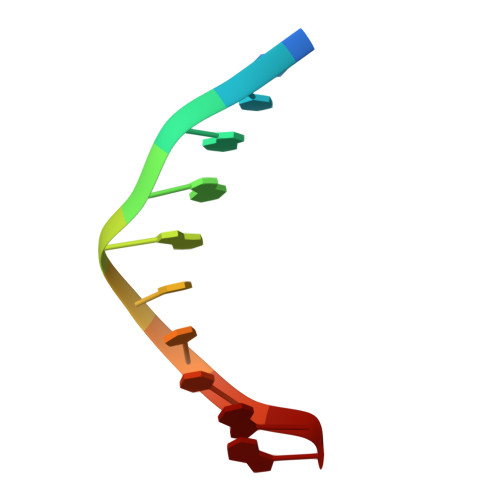
CRYSTAL STRUCTURE OF POLYAMIDE DIMER (IMPYPYPYBETADP)2 BOUND TO CCAGATCTGG


Experimental Data Snapshot

  • Method: X-RAY DIFFRACTION
  • Resolution: 2.15 Å
  • R-Value Free: 
    0.229 (Depositor) 
  • R-Value Work: 
    0.229 (Depositor) 
  • R-Value Observed: 
    0.229 (Depositor) 

wwPDB Validation 3D Report Full Report

Validation slider image for 1CVY

This is version 1.4 of the entry. See complete history

Literature

Structural effects of DNA sequence on T.A recognition by hydroxypyrrole/pyrrole pairs in the minor groove.

Kielkopf, C.L.Bremer, R.E.White, S.Szewczyk, J.W.Turner, J.M.Baird, E.E.Dervan, P.B.Rees, D.C.

(2000) J Mol Biology 295: 557-567

  • DOI: https://doi.org/10.1006/jmbi.1999.3364
  • Primary Citation Related Structures: 
    1CVX, 1CVY

  • PubMed Abstract: 

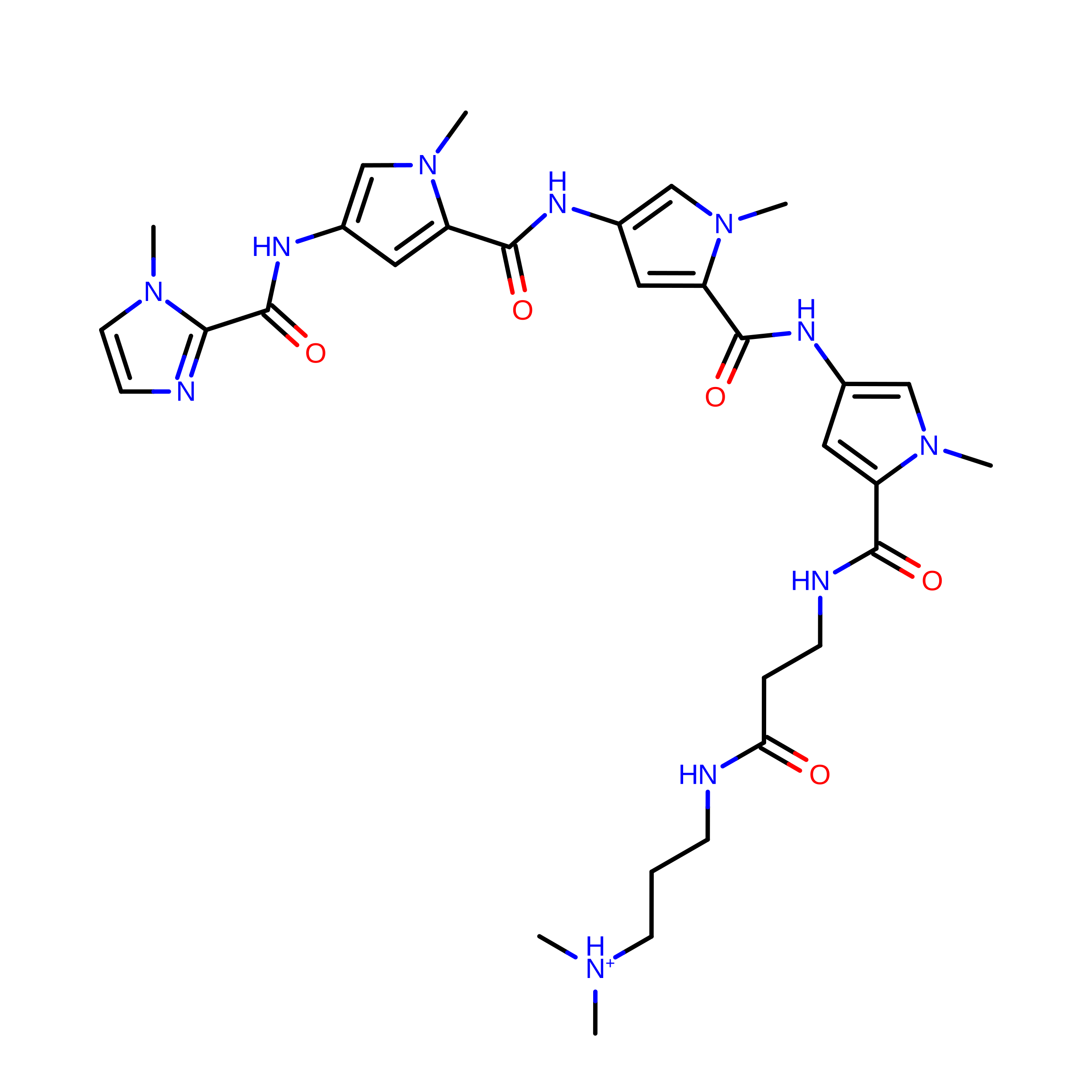
    Synthetic polyamides composed of three types of aromatic amino acids, N-methylimidazole (Im), N-methylpyrrole (Py) and N-methyl-3-hydroxypyrrole (Hp) bind specific DNA sequences as antiparallel dimers in the minor groove. The side-by-side pairings of aromatic rings in the dimer afford a general recognition code that allows all four base-pairs to be distinguished. To examine the structural consequences of changing the DNA sequence context on T.A recognition by Hp/Py pairs in the minor groove, crystal structures of polyamide dimers (ImPyHpPy)(2) and the pyrrole counterpart (ImPyPyPy)(2) bound to the six base-pair target site 5'-AGATCT-3' in a ten base-pair oligonucleotide have been determined to a resolution of 2.27 and 2.15 A, respectively. The structures demonstrate that the principles of Hp/Py recognition of T.A are consistent between different sequence contexts. However, a general structural explanation for the non-additive reduction in binding affinity due to introduction of the hydroxyl group is less clear. Comparison with other polyamide-DNA cocrystal structures reveals structural themes and differences that may relate to sequence preference.


  • Organizational Affiliation
    • Division of Chemistry, California Institute of Technology, Pasadena, CA, 91125, USA.

Macromolecule Content 

  • Total Structure Weight: 7.39 kDa 
  • Atom Count: 550 
  • Modeled Residue Count: 20 
  • Deposited Residue Count: 20 
  • Unique nucleic acid chains: 1

Macromolecules

Find similar nucleic acids by:  Sequence
Entity ID: 1
MoleculeChains LengthOrganismImage
5'-D(*CP*CP*AP*GP*AP*TP*CP*TP*GP*G)-3'
A, B
10N/A
Sequence Annotations
Expand
Reference Sequence

Small Molecules

Ligands 1 Unique
IDChains Name / Formula / InChI Key2D Diagram3D Interactions
IPY

Query on IPY


Download:Ideal Coordinates CCD File
C [auth A],
D [auth B]
IMIDAZOLE-PYRROLE POLYAMIDE
C31 H42 N11 O5
NCFLEKZHRQALKT-UHFFFAOYSA-O

Experimental Data & Validation

Experimental Data

  • Method: X-RAY DIFFRACTION
  • Resolution: 2.15 Å
  • R-Value Free:  0.229 (Depositor) 
  • R-Value Work:  0.229 (Depositor) 
  • R-Value Observed: 0.229 (Depositor) 
Space Group: P 21 21 21
Unit Cell:
Length ( Å )Angle ( ˚ )
a = 34.493α = 90
b = 38.593β = 90
c = 47.112γ = 90
Software Package:
Software NamePurpose
AMoREphasing
CNSrefinement
DENZOdata reduction
SCALEPACKdata scaling

Structure Validation

View Full Validation Report


Entry History 

Deposition Data

Revision History  (Full details and data files)

  • Version 1.0: 2000-01-15
    Type: Initial release
  • Version 1.1: 2008-04-27
    Changes: Version format compliance
  • Version 1.2: 2011-07-13
    Changes: Version format compliance
  • Version 1.3: 2017-02-01
    Changes: Structure summary
  • Version 1.4: 2024-02-07
    Changes: Data collection, Database references, Derived calculations