1CVR | pdb_00001cvr

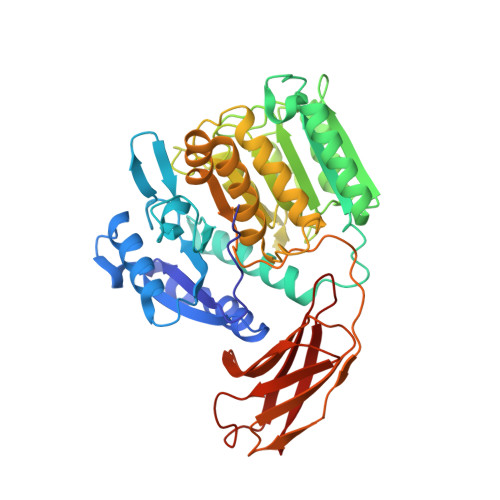
Crystal structure of the Arg specific cysteine proteinase gingipain R (RGPB)


Experimental Data Snapshot

  • Method: X-RAY DIFFRACTION
  • Resolution: 2.00 Å
  • R-Value Free: 
    0.207 (Depositor), 0.200 (DCC) 
  • R-Value Work: 
    0.163 (Depositor), 0.156 (DCC) 

wwPDB Validation 3D Report Full Report

Validation slider image for 1CVR

Ligand Structure Quality Assessment 


This is version 1.5 of the entry. See complete history

Literature

Crystal structure of gingipain R: an Arg-specific bacterial cysteine proteinase with a caspase-like fold.

Eichinger, A.Beisel, H.G.Jacob, U.Huber, R.Medrano, F.J.Banbula, A.Potempa, J.Travis, J.Bode, W.

(1999) EMBO J 18: 5453-5462

  • DOI: https://doi.org/10.1093/emboj/18.20.5453
  • Primary Citation Related Structures: 
    1CVR

  • PubMed Abstract: 

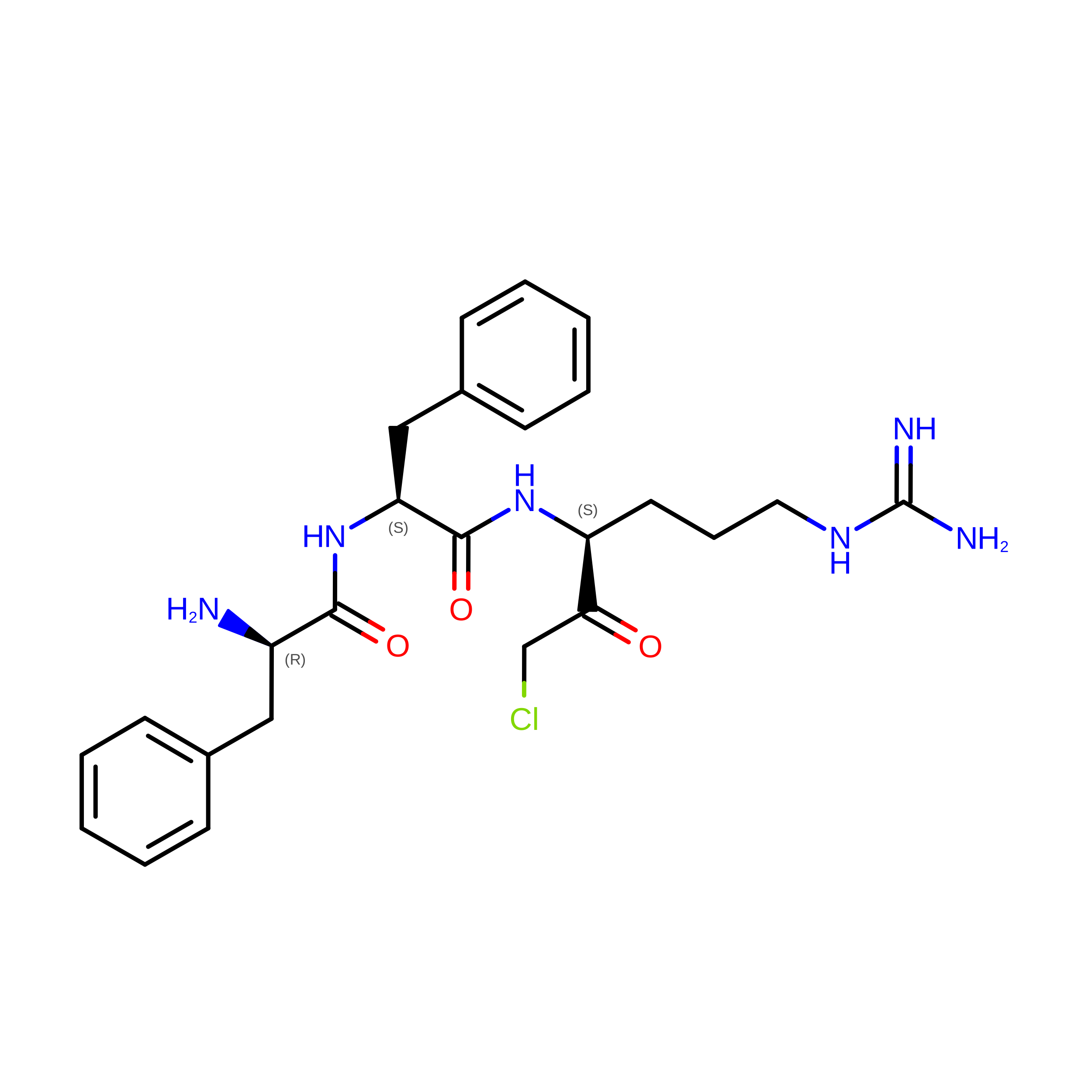
    Gingipains are cysteine proteinases acting as key virulence factors of the bacterium Porphyromonas gingivalis, the major pathogen in periodontal disease. The 1.5 and 2.0 A crystal structures of free and D-Phe-Phe-Arg-chloromethylketone-inhibited gingipain R reveal a 435-residue, single-polypeptide chain organized into a catalytic and an immunoglobulin-like domain. The catalytic domain is subdivided into two subdomains comprising four- and six-stranded beta-sheets sandwiched by alpha-helices. Each subdomain bears topological similarities to the p20-p10 heterodimer of caspase-1. The second subdomain harbours the Cys-His catalytic diad and a nearby Glu arranged around the S1 specificity pocket, which carries an Asp residue to enforce preference for Arg-P1 residues. This gingipain R structure is an excellent template for the rational design of drugs with a potential to cure and prevent periodontitis. Here we show the binding mode of an arginine-containing inhibitor in the active-site, thus identifying major interaction sites defining a suitable pharmacophor.


  • Organizational Affiliation
    • Max-Planck-Institut für Biochemie, Abteilung Strukturforschung, D-82152 Martinsried, Germany.

Macromolecule Content 

  • Total Structure Weight: 48.81 kDa 
  • Atom Count: 3,709 
  • Modeled Residue Count: 432 
  • Deposited Residue Count: 435 
  • Unique protein chains: 1

Macromolecules

Find similar proteins by:|  3D Structure
Entity ID: 1
MoleculeChains  Sequence LengthOrganismDetailsImage
GINGIPAIN R435Porphyromonas gingivalisMutation(s): 0 
EC: 3.4.22.37
UniProt
Find proteins for P95493 (Porphyromonas gingivalis (strain ATCC BAA-308 / W83))
Explore P95493 
Go to UniProtKB:  P95493
Entity Groups
Sequence Clusters30% Identity50% Identity70% Identity90% Identity95% Identity100% Identity
UniProt GroupP95493
Sequence Annotations
Expand
Reference Sequence

Small Molecules

Ligands 3 Unique
IDChains Name / Formula / InChI Key2D Diagram3D Interactions
H37

Query on H37


Download:Ideal Coordinates CCD File
B [auth A]D-phenylalanyl-N-[(3S)-6-carbamimidamido-1-chloro-2-oxohexan-3-yl]-L-phenylalaninamide
C25 H33 Cl N6 O3
PJFSUJMJVYGASC-HKBOAZHASA-N
ZN

Query on ZN


Download:Ideal Coordinates CCD File
H [auth A],
J [auth A]
ZINC ION
Zn
PTFCDOFLOPIGGS-UHFFFAOYSA-N
CA

Query on CA


Download:Ideal Coordinates CCD File
C [auth A]
D [auth A]
E [auth A]
F [auth A]
G [auth A]
C [auth A],
D [auth A],
E [auth A],
F [auth A],
G [auth A],
I [auth A]
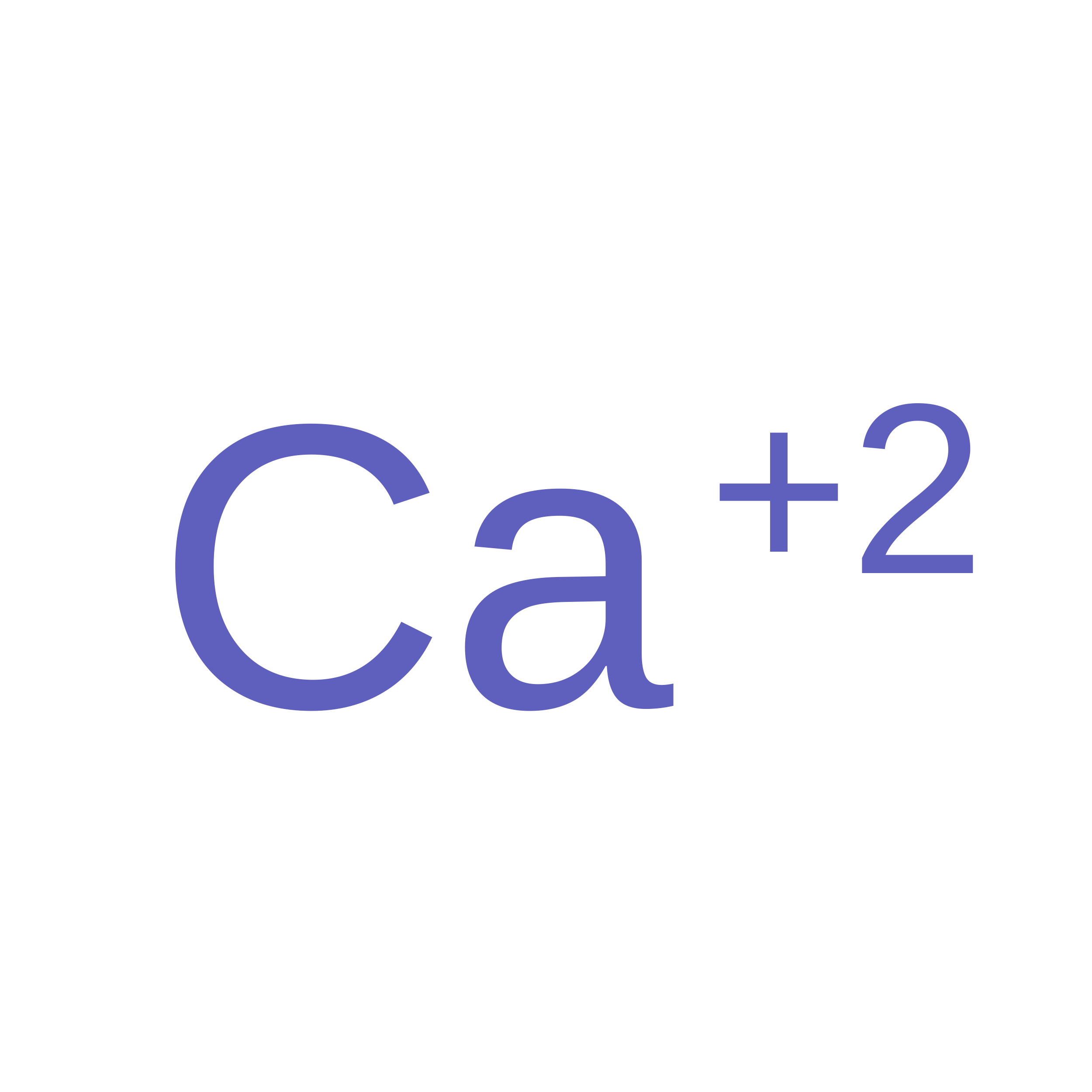
CALCIUM ION
Ca
BHPQYMZQTOCNFJ-UHFFFAOYSA-N

Experimental Data & Validation

Experimental Data

  • Method: X-RAY DIFFRACTION
  • Resolution: 2.00 Å
  • R-Value Free:  0.207 (Depositor), 0.200 (DCC) 
  • R-Value Work:  0.163 (Depositor), 0.156 (DCC) 
Space Group: P 21 21 21
Unit Cell:
Length ( Å )Angle ( ˚ )
a = 51.93α = 90
b = 79.92β = 90
c = 99.82γ = 90
Software Package:
Software NamePurpose
MOLREPphasing
CNSrefinement
MOSFLMdata reduction
CCP4data scaling

Structure Validation

View Full Validation Report


Ligand Structure Quality Assessment 


Entry History 

Deposition Data

Revision History  (Full details and data files)

  • Version 1.0: 2000-03-01
    Type: Initial release
  • Version 1.1: 2008-04-27
    Changes: Version format compliance
  • Version 1.2: 2011-07-13
    Changes: Atomic model, Database references, Derived calculations, Non-polymer description, Structure summary, Version format compliance
  • Version 1.3: 2013-09-11
    Changes: Non-polymer description
  • Version 1.4: 2013-10-16
    Changes: Derived calculations, Non-polymer description
  • Version 1.5: 2024-10-16
    Changes: Data collection, Database references, Derived calculations, Structure summary