1CNU | pdb_00001cnu

PHOSPHORYLATED ACTOPHORIN FROM ACANTAMOEBA POLYPHAGA


Experimental Data Snapshot

  • Method: X-RAY DIFFRACTION
  • Resolution: 2.25 Å
  • R-Value Free: 
    0.304 (Depositor) 
  • R-Value Work: 
    0.204 (Depositor) 

Starting Model: other
View more details

wwPDB Validation 3D Report Full Report

Validation slider image for 1CNU

This is version 1.6 of the entry. See complete history

Literature

Interaction of actin monomers with Acanthamoeba actophorin (ADF/cofilin) and profilin.

Blanchoin, L.Pollard, T.D.

(1998) J Biological Chem 273: 25106-25111

  • DOI: https://doi.org/10.1074/jbc.273.39.25106
  • Primary Citation Related Structures: 
    1CNU

  • PubMed Abstract: 

    Acanthamoeba actophorin is a member of ADF/cofilin family that binds both actin monomers and filaments. We used fluorescence anisotropy to study the interaction of actin monomers with recombinant actophorin labeled with rhodamine on a cysteine substituted for Serine-88. Labeled actophorin retains its affinity for actin and ability to reduce the low shear viscosity of actin filaments. At physiological ionic strength, actophorin binds Mg-ADP-actin monomers (Kd = 0.1 microM) 40 times stronger than Mg-ATP-actin monomers. When bound to actin monomers, actophorin has no effect on elongation at either end of actin filaments by Mg-ATP-actin and slightly increases the rate of elongation at both ends by Mg-ADP-actin. Thus actophorin does not sequester actin monomers. Sedimentation equilibrium ultracentrifugation shows that actophorin and profilin compete for binding actin monomers. Actophorin and profilin have opposite effects on the rate of exchange of nucleotide bound to actin monomers. Despite the high affinity of actophorin for ADP-actin, physiological concentrations of profilin overcome the inhibition of ADP exchange by actophorin. Profilin rapidly recycles ADP-actin back to the profilin-ATP-actin pool ready for elongation of actin filaments.


  • Organizational Affiliation
    • Structural Biology Laboratory, The Salk Institute for Biological Studies, La Jolla, California 92037, USA.

Macromolecule Content 

  • Total Structure Weight: 15.52 kDa 
  • Atom Count: 1,168 
  • Modeled Residue Count: 134 
  • Deposited Residue Count: 137 
  • Unique protein chains: 1

Macromolecules

Find similar proteins by:|  3D Structure
Entity ID: 1
MoleculeChains  Sequence LengthOrganismDetailsImage
ACTOPHORIN137Acanthamoeba polyphagaMutation(s): 0 
UniProt
Find proteins for P37167 (Acanthamoeba castellanii)
Explore P37167 
Go to UniProtKB:  P37167
Entity Groups
Sequence Clusters30% Identity50% Identity70% Identity90% Identity95% Identity100% Identity
UniProt GroupP37167
Sequence Annotations
Expand
Reference Sequence

Small Molecules

Modified Residues  1 Unique
IDChains TypeFormula2D DiagramParent
SEP
Query on SEP
A
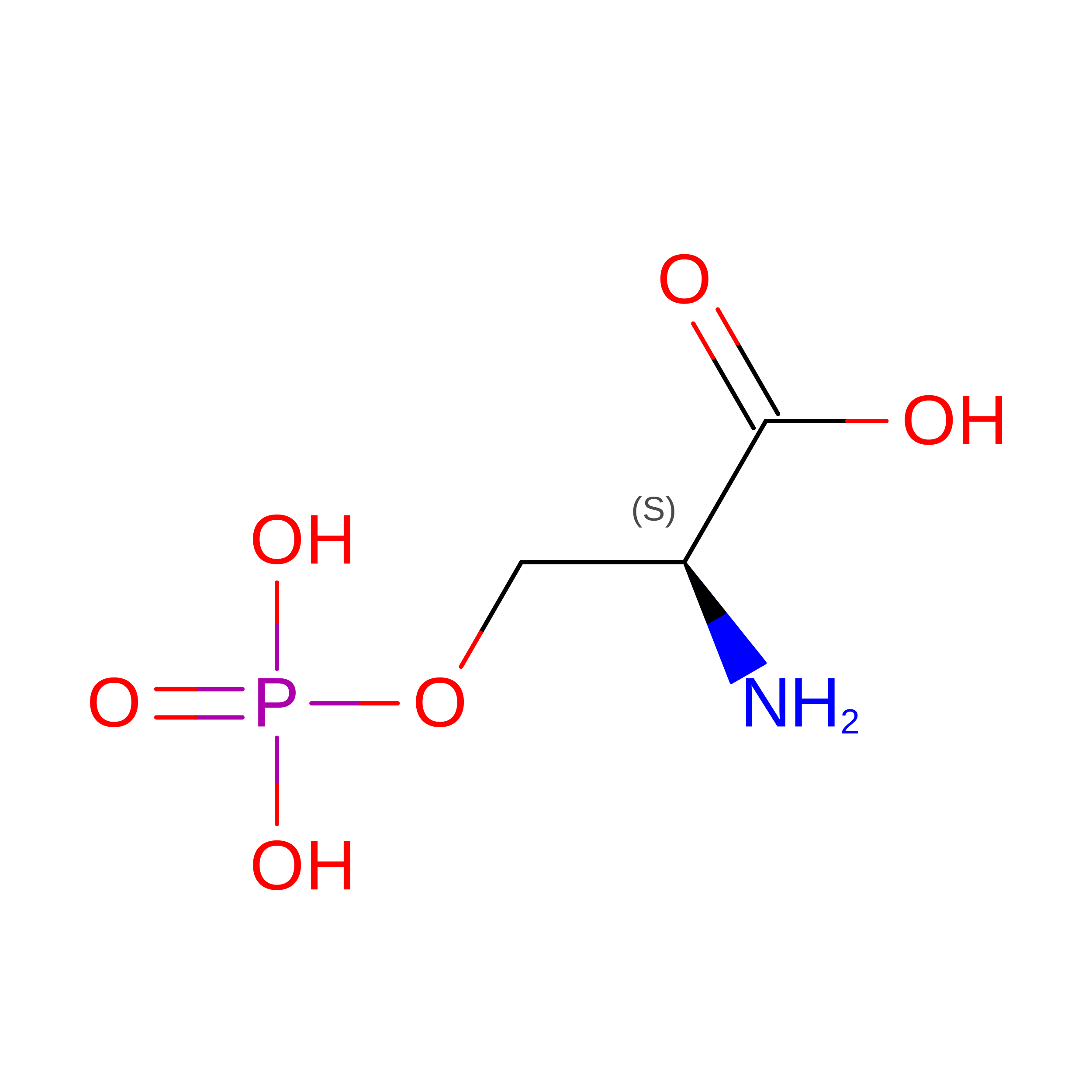
L-PEPTIDE LINKINGC3 H8 N O6 PSER

Experimental Data & Validation

Experimental Data

  • Method: X-RAY DIFFRACTION
  • Resolution: 2.25 Å
  • R-Value Free:  0.304 (Depositor) 
  • R-Value Work:  0.204 (Depositor) 
Space Group: P 21 21 21
Unit Cell:
Length ( Å )Angle ( ˚ )
a = 40.2α = 90
b = 46.5β = 90
c = 68.4γ = 90
Software Package:
Software NamePurpose
EPMRphasing
REFMACrefinement
DENZOdata reduction
SCALEPACKdata scaling

Structure Validation

View Full Validation Report


Entry History 

Deposition Data

Revision History  (Full details and data files)

  • Version 1.0: 1999-06-01
    Type: Initial release
  • Version 1.1: 2008-03-24
    Changes: Version format compliance
  • Version 1.2: 2011-07-13
    Changes: Version format compliance
  • Version 1.3: 2018-04-04
    Changes: Data collection
  • Version 1.4: 2024-02-07
    Changes: Data collection, Database references
  • Version 1.5: 2024-04-03
    Changes: Refinement description
  • Version 1.6: 2024-11-06
    Changes: Structure summary