1CFB | pdb_00001cfb

CRYSTAL STRUCTURE OF TANDEM TYPE III FIBRONECTIN DOMAINS FROM DROSOPHILA NEUROGLIAN AT 2.0 ANGSTROMS


Experimental Data Snapshot

  • Method: X-RAY DIFFRACTION
  • Resolution: 2.00 Å
  • R-Value Work: 
    0.202 (Depositor) 
  • R-Value Observed: 
    0.202 (Depositor) 

wwPDB Validation 3D Report Full Report

Validation slider image for 1CFB

This is version 2.1 of the entry. See complete history

Literature

Crystal structure of tandem type III fibronectin domains from Drosophila neuroglian at 2.0 A.

Huber, A.H.Wang, Y.M.Bieber, A.J.Bjorkman, P.J.

(1994) Neuron 12: 717-731

  • DOI: https://doi.org/10.1016/0896-6273(94)90326-3
  • Primary Citation Related Structures: 
    1CFB

  • PubMed Abstract: 

    We report the crystal structure of two adjacent fibronectin type III repeats from the Drosophila neural cell adhesion molecule neuroglian. Each domain consists of two antiparallel beta sheets and is folded topologically identically to single fibronectin type III domains from the extracellular matrix proteins tenascin and fibronectin. beta bulges and left-handed polyproline II helices disrupt the regular beta sheet structure of both neuroglian domains. The hydrophobic interdomain interface includes a metal-binding site, presumably involved in stabilizing the relative orientation between domains and predicted by sequence comparision to be present in the vertebrate homolog molecule L1. The neuroglian domains are related by a near perfect 2-fold screw axis along the longest molecular dimension. Using this relationship, a model for arrays of tandem fibronectin type III repeats in neuroglian and other molecules is proposed.


  • Organizational Affiliation
    • Division of Biology, California Institute of Technology, Pasadena 91125.

Macromolecule Content 

  • Total Structure Weight: 23.81 kDa 
  • Atom Count: 1,915 
  • Modeled Residue Count: 205 
  • Deposited Residue Count: 205 
  • Unique protein chains: 1

Macromolecules

Find similar proteins by:|  3D Structure
Entity ID: 1
MoleculeChains  Sequence LengthOrganismDetailsImage
DROSOPHILA NEUROGLIAN205Drosophila melanogasterMutation(s): 0 
Gene Names: POTENTIAL
UniProt
Find proteins for P20241 (Drosophila melanogaster)
Explore P20241 
Go to UniProtKB:  P20241
Entity Groups
Sequence Clusters30% Identity50% Identity70% Identity90% Identity95% Identity100% Identity
UniProt GroupP20241
Glycosylation
Glycosylation Sites: 2Go to GlyGen: P20241-1
Sequence Annotations
Expand
Reference Sequence

Oligosaccharides

Help  
Entity ID: 2
MoleculeChains Length2D Diagram GlycosylationD Interactions
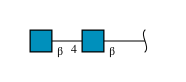
2-acetamido-2-deoxy-beta-D-glucopyranose-(1-4)-2-acetamido-2-deoxy-beta-D-glucopyranose
B
2N-Glycosylation
Glycosylation Resources
GlyTouCan: G42666HT
GlyCosmos: G42666HT
GlyGen: G42666HT

Small Molecules

Ligands 3 Unique
IDChains Name / Formula / InChI Key2D Diagram3D Interactions
NAG

Query on NAG


Download:Ideal Coordinates CCD File
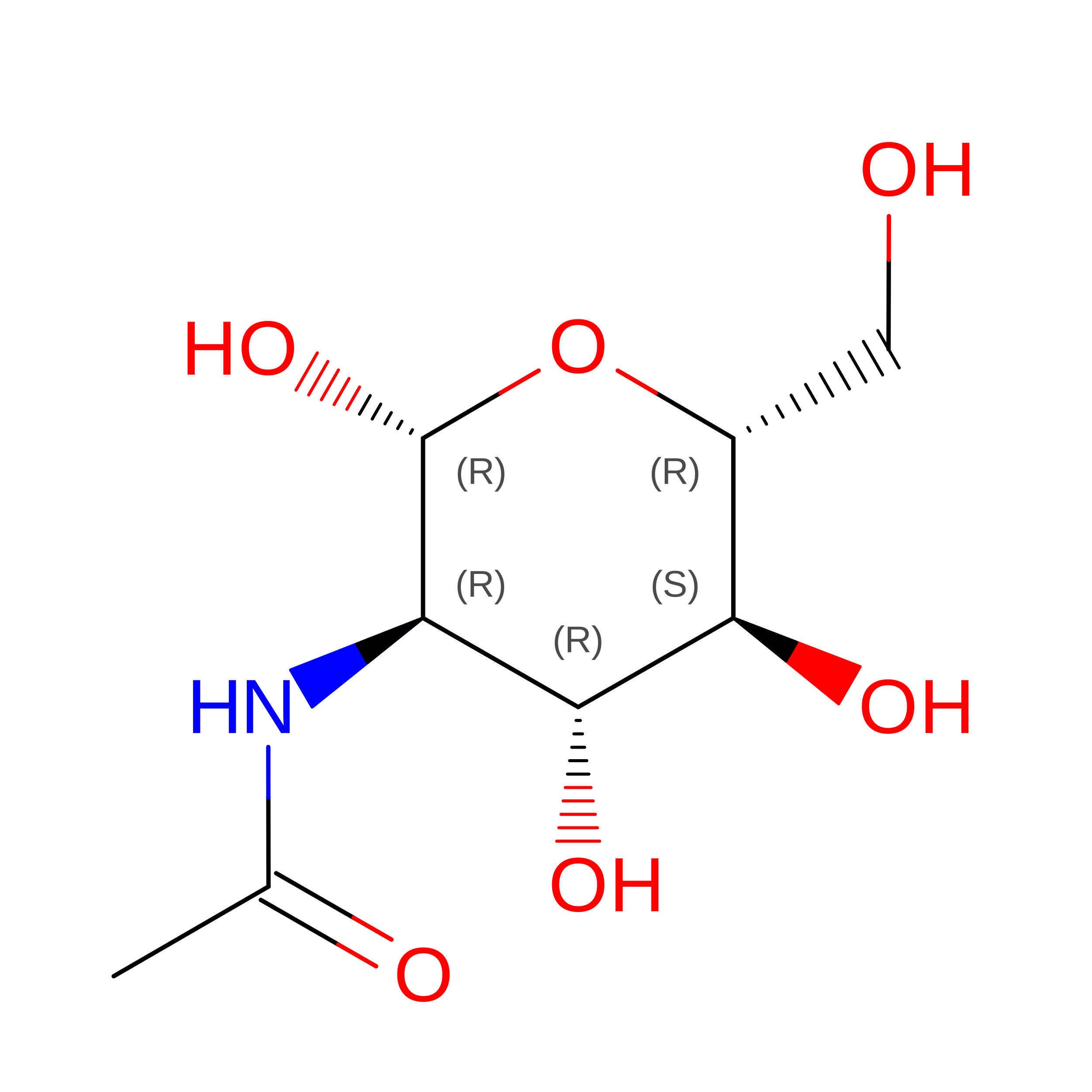
C [auth A]2-acetamido-2-deoxy-beta-D-glucopyranose
C8 H15 N O6
OVRNDRQMDRJTHS-FMDGEEDCSA-N
SO4

Query on SO4


Download:Ideal Coordinates CCD File
D [auth A]SULFATE ION
O4 S
QAOWNCQODCNURD-UHFFFAOYSA-L
NA

Query on NA


Download:Ideal Coordinates CCD File
E [auth A]SODIUM ION
Na
FKNQFGJONOIPTF-UHFFFAOYSA-N

Experimental Data & Validation

Experimental Data

  • Method: X-RAY DIFFRACTION
  • Resolution: 2.00 Å
  • R-Value Work:  0.202 (Depositor) 
  • R-Value Observed: 0.202 (Depositor) 
Space Group: F 4 3 2
Unit Cell:
Length ( Å )Angle ( ˚ )
a = 241.8α = 90
b = 241.8β = 90
c = 241.8γ = 90
Software Package:
Software NamePurpose
X-PLORmodel building
X-PLORrefinement
X-PLORphasing

Structure Validation

View Full Validation Report


Entry History 

Deposition Data

Revision History  (Full details and data files)

  • Version 1.0: 1994-11-30
    Type: Initial release
  • Version 1.1: 2008-03-03
    Changes: Version format compliance
  • Version 1.2: 2011-07-13
    Changes: Derived calculations, Version format compliance
  • Version 1.3: 2017-11-29
    Changes: Advisory, Derived calculations, Other
  • Version 2.0: 2020-07-29
    Type: Remediation
    Reason: Carbohydrate remediation
    Changes: Atomic model, Data collection, Derived calculations, Structure summary
  • Version 2.1: 2024-10-30
    Changes: Advisory, Data collection, Database references, Structure summary