Download Mendeley
Effects of cationic charge on three-dimensional structures of intercalative complexes: structure of a bis-intercalated DNA complex solved by MAD phasing.
Shui, X., Peek, M.E., Lipscomb, L.A., Gao, Q., Ogata, C., Roques, B.P., Garbay-Jaureguiberry, C., Wilkinson, A.P., Williams, L.D.(2000) Curr Med Chem 7: 59-71
- PubMed: 10637357 Search on PubMed
- DOI: https://doi.org/10.2174/0929867003375470
- Primary Citation Related Structures:
1C9Z - PubMed Abstract:
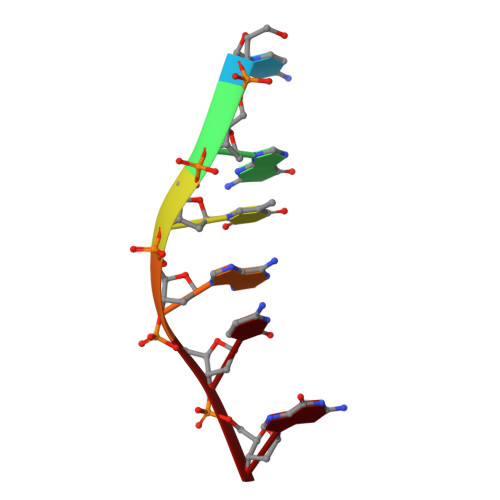
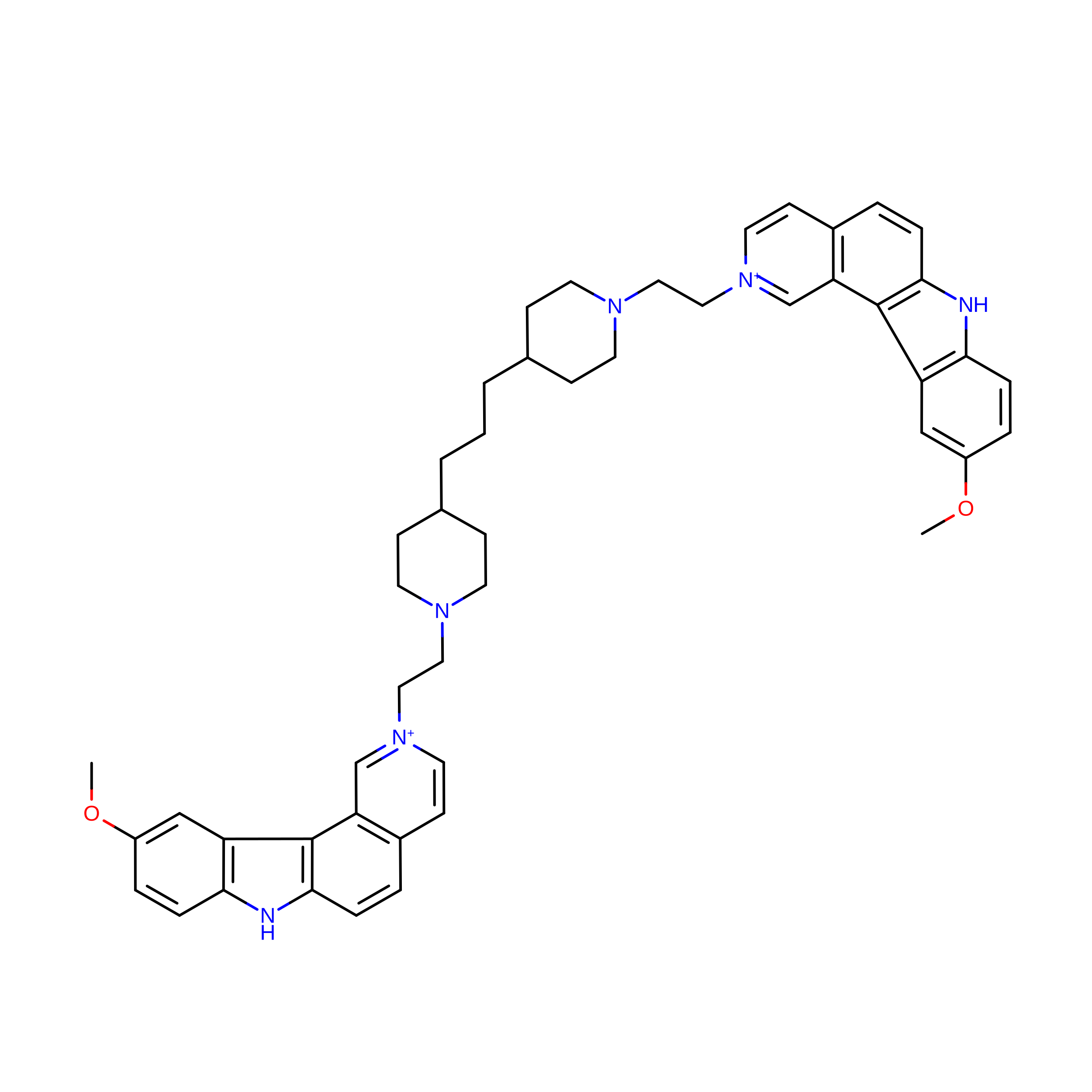
We characterize intercalative complexes as either "high charge" and "low charge". In low charge complexes, stacking interactions appear to dominate stability and structure. The dominance of stacking is evident in structures of daunomycin, nogalamycin, ethidium, and triostin A/echinomycin. By contrast in a DNA complex with the tetracationic metalloporphyrin CuTMPyP4 [copper (II) meso-tetra(N-methyl-4-pyridyl)porphyrin], electrostatic interactions appear to draw the porphyrin into the duplex interior, extending the DNA along its axis, and unstacking the DNA. Similarly, DNA complexes of tetracationic ditercalinium and tetracationic flexi-di show significant unstacking. Here we report x-ray structures of complexes of the tetracationic bis-intercalator D232 bound to DNA fragments d(CGTACG) and d(BrCGTABrCG). D232 is analogous to ditercalinium but with three methylene groups inserted between the piperidinium groups. The extension of the D232 linker allows it to sandwich four base pairs rather than two. In comparison to CuTMPyP4, flexi-di and ditercalinium, stacking interactions of D232 are significantly improved. We conclude that it is not sufficient to characterize intercalators simply by net charge. One anticipates strong electrostatic forces when cationic charge is focused to a small volume or region near DNA and so must consider the extent to which cationic charge is focused or distributed. In sum, ditercalinium, with a relatively short linker, focuses cationic charge more narrowly than does D232. So even though the net charges are equivalent, electrostatic charges are expected to be of greater structural significance in the ditercalinium complex than in the D232 complex.
- School of Chemistry & Biochemistry, Georgia Institute of Technology, Atlanta, GA 30332-0400, USA.
Organizational Affiliation: