1C7S | pdb_00001c7s

BETA-N-ACETYLHEXOSAMINIDASE MUTANT D539A COMPLEXED WITH DI-N-ACETYL-BETA-D-GLUCOSAMINE (CHITOBIASE)


Experimental Data Snapshot

  • Method: X-RAY DIFFRACTION
  • Resolution: 1.80 Å
  • R-Value Free: 
    0.224 (Depositor), 0.220 (DCC) 
  • R-Value Work: 
    0.171 (Depositor), 0.178 (DCC) 
  • R-Value Observed: 
    0.183 (Depositor) 

Starting Model: experimental
View more details

wwPDB Validation 3D Report Full Report

Validation slider image for 1C7S

This is version 2.3 of the entry. See complete history

Literature

Structures of chitobiase mutants complexed with the substrate Di-N-acetyl-d-glucosamine: the catalytic role of the conserved acidic pair, aspartate 539 and glutamate 540.

Prag, G.Papanikolau, Y.Tavlas, G.Vorgias, C.E.Petratos, K.Oppenheim, A.B.

(2000) J Mol Biology 300: 611-617

  • DOI: https://doi.org/10.1006/jmbi.2000.3906
  • Primary Citation Related Structures: 
    1C7S, 1C7T

  • PubMed Abstract: 

    The catalytic domain of chitobiase (beta-N-1-4 acetylhexosaminidase) from Serratia marcescens, is an alpha/beta TIM-barrel. This enzyme belongs to family 20 of glycosyl hydrolases in which a conserved amino acid pair, aspartate-glutamate, is present (Asp539-Glu540). It was proposed that catalysis by this enzyme family is carried out by glutamate 540 acting as a proton donor and by the acetamido group of the substrate as a nucleophile. We investigated the role of Asp539 and Glu540 by site-directed mutagenesis, biochemical characterization and by structural analyses of chitobiase -substrate co-crystals. We found that both residues are essential for chitobiase activity. The mutations, however, led to subtle changes in the catalytic site. Our results support the model that Glu540 acts as the proton donor and that Asp539 acts in several different ways. Asp539 restrains the acetamido group of the substrate in a specific orientation by forming a hydrogen bond with N2 of the non-reduced (-1) sugar. In addition, this residue participates in substrate binding. It is also required for the correct positioning of Glu540 and may provide additional negative charge at the active site. Thus, these biochemical and structural studies provide a molecular explanation for the functional importance and conservation of these residues.


  • Organizational Affiliation
    • The Department of Molecular Genetics and Biotechnology, The Hebrew University-Hadassah Medical School, Jerusalem, 91120, Israel.

Macromolecule Content 

  • Total Structure Weight: 96.75 kDa 
  • Atom Count: 7,656 
  • Modeled Residue Count: 858 
  • Deposited Residue Count: 858 
  • Unique protein chains: 1

Macromolecules

Find similar proteins by:|  3D Structure
Entity ID: 1
MoleculeChains  Sequence LengthOrganismDetailsImage
BETA-N-ACETYLHEXOSAMINIDASE858Serratia marcescensMutation(s): 1 
EC: 3.2.1.52
UniProt
Find proteins for Q54468 (Serratia marcescens)
Explore Q54468 
Go to UniProtKB:  Q54468
Entity Groups
Sequence Clusters30% Identity50% Identity70% Identity90% Identity95% Identity100% Identity
UniProt GroupQ54468
Sequence Annotations
Expand
Reference Sequence

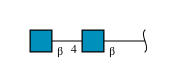
Oligosaccharides

Help  
Entity ID: 2
MoleculeChains Length2D Diagram GlycosylationD Interactions
2-acetamido-2-deoxy-beta-D-glucopyranose-(1-4)-2-acetamido-2-deoxy-beta-D-glucopyranose
B
2N/A
Glycosylation Resources
GlyTouCan: G42666HT
GlyCosmos: G42666HT
GlyGen: G42666HT

Experimental Data & Validation

Experimental Data

  • Method: X-RAY DIFFRACTION
  • Resolution: 1.80 Å
  • R-Value Free:  0.224 (Depositor), 0.220 (DCC) 
  • R-Value Work:  0.171 (Depositor), 0.178 (DCC) 
  • R-Value Observed: 0.183 (Depositor) 
Space Group: P 21 21 2
Unit Cell:
Length ( Å )Angle ( ˚ )
a = 108.794α = 90
b = 99.96β = 90
c = 86.308γ = 90
Software Package:
Software NamePurpose
SCALEPACKdata scaling
AMoREphasing
REFMACrefinement
ARPmodel building

Structure Validation

View Full Validation Report


Entry History 

Deposition Data

Revision History  (Full details and data files)

  • Version 1.0: 2000-09-20
    Type: Initial release
  • Version 1.1: 2008-04-26
    Changes: Version format compliance
  • Version 1.2: 2011-07-13
    Changes: Version format compliance
  • Version 1.3: 2017-10-04
    Changes: Refinement description
  • Version 2.0: 2020-07-29
    Type: Remediation
    Reason: Carbohydrate remediation
    Changes: Atomic model, Data collection, Database references, Derived calculations, Non-polymer description, Structure summary
  • Version 2.1: 2021-11-03
    Changes: Database references, Structure summary
  • Version 2.2: 2023-08-09
    Changes: Data collection, Refinement description
  • Version 2.3: 2024-11-06
    Changes: Structure summary