1BSI | pdb_00001bsi

HUMAN PANCREATIC ALPHA-AMYLASE FROM PICHIA PASTORIS, GLYCOSYLATED PROTEIN


Experimental Data Snapshot

  • Method: X-RAY DIFFRACTION
  • Resolution: 2.00 Å
  • R-Value Work: 
    0.184 (Depositor) 
  • R-Value Observed: 
    0.184 (Depositor) 

wwPDB Validation 3D Report Full Report

Validation slider image for 1BSI

This is version 2.2 of the entry. See complete history

Literature

Cloning, mutagenesis, and structural analysis of human pancreatic alpha-amylase expressed in Pichia pastoris.

Rydberg, E.H.Sidhu, G.Vo, H.C.Hewitt, J.Cote, H.C.Wang, Y.Numao, S.MacGillivray, R.T.Overall, C.M.Brayer, G.D.Withers, S.G.

(1999) Protein Sci 8: 635-643

  • DOI: https://doi.org/10.1110/ps.8.3.635
  • Primary Citation Related Structures: 
    1BSI

  • PubMed Abstract: 

    Human pancreatic alpha-amylase (HPA) was expressed in the methylotrophic yeast Pichia pastoris and two mutants (D197A and D197N) of a completely conserved active site carboxylic acid were generated. All recombinant proteins were shown by electrospray ionization mass spectrometry (ESI-MS) to be glycosylated and the site of attachment was shown to be Asn461 by peptide mapping in conjunction with ESI-MS. Treatment of these proteins with endoglycosidase F demonstrated that they contained a single N-linked oligosaccharide and yielded a protein product with a single N-acetyl glucosamine (GlcNAc), which could be crystallized. Solution of the crystal structure to a resolution of 2.0 A confirmed the location of the glycosyl group as Asn461 and showed that the recombinant protein had essentially the same conformation as the native enzyme. The kinetic parameters of the glycosylated and deglycosylated wild-type proteins were the same while the k(cat)/Km values for D197A and D197N were 10(6)-10(7) times lower than the wild-type enzyme. The decreased k(cat)/Km values for the mutants confirm that D197 plays a crucial role in the hydrolytic activity of HPA, presumably as the catalytic nucleophile.


  • Organizational Affiliation
    • Department of Biochemistry & Molecular Biology, University of British Columbia, Vancouver, Canada.

Macromolecule Content 

  • Total Structure Weight: 56.23 kDa 
  • Atom Count: 4,184 
  • Modeled Residue Count: 496 
  • Deposited Residue Count: 496 
  • Unique protein chains: 1

Macromolecules

Find similar proteins by:|  3D Structure
Entity ID: 1
MoleculeChains  Sequence LengthOrganismDetailsImage
ALPHA-AMYLASE496Homo sapiensMutation(s): 0 
EC: 3.2.1.1
UniProt & NIH Common Fund Data Resources
Find proteins for P04746 (Homo sapiens)
Explore P04746 
Go to UniProtKB:  P04746
PHAROS:  P04746
GTEx:  ENSG00000243480 
Entity Groups
Sequence Clusters30% Identity50% Identity70% Identity90% Identity95% Identity100% Identity
UniProt GroupP04746
Glycosylation
Glycosylation Sites: 1Go to GlyGen: P04746-1
Sequence Annotations
Expand
Reference Sequence

Small Molecules

Ligands 3 Unique
IDChains Name / Formula / InChI Key2D Diagram3D Interactions
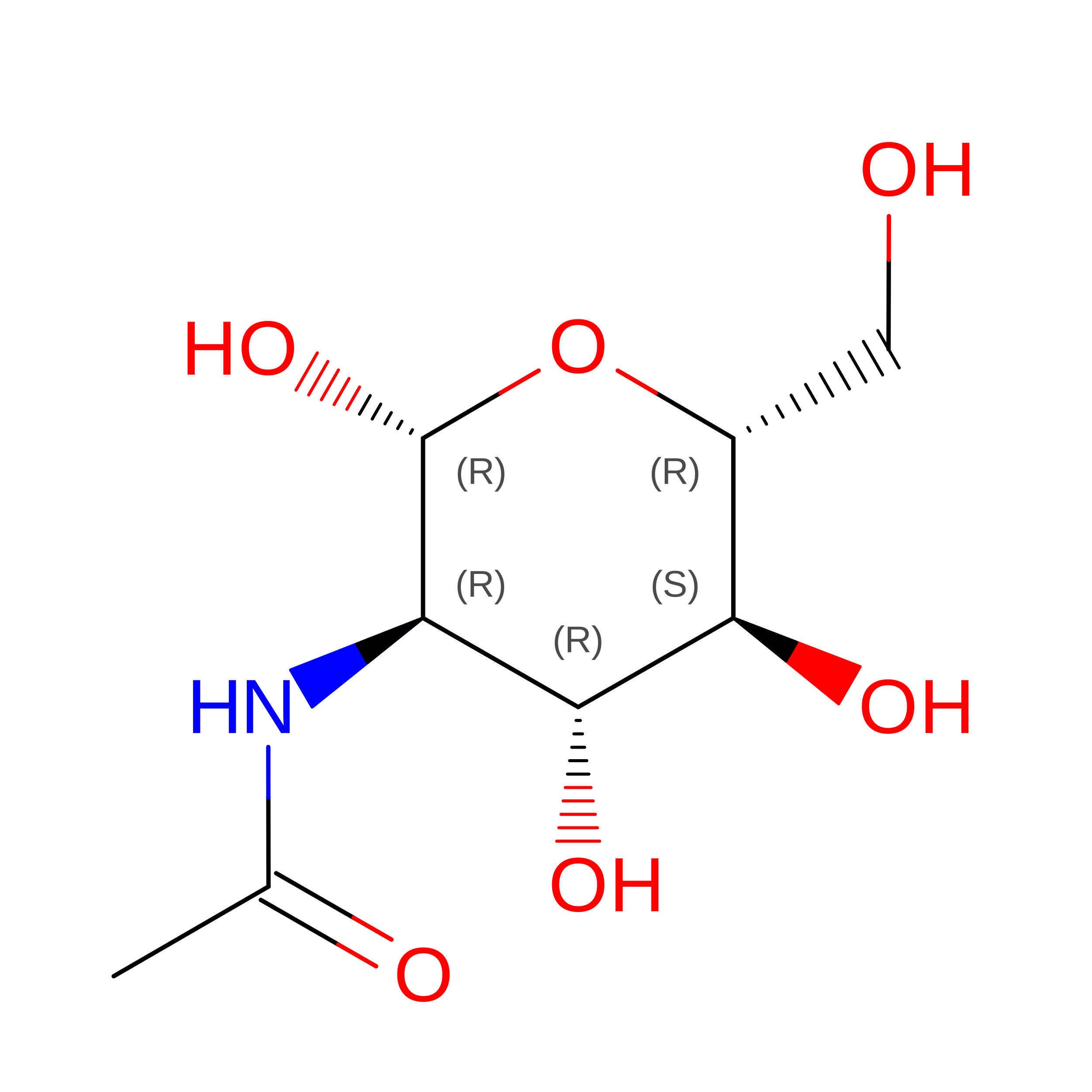
NAG

Query on NAG


Download:Ideal Coordinates CCD File
B [auth A]2-acetamido-2-deoxy-beta-D-glucopyranose
C8 H15 N O6
OVRNDRQMDRJTHS-FMDGEEDCSA-N
CA

Query on CA


Download:Ideal Coordinates CCD File
C [auth A]CALCIUM ION
Ca
BHPQYMZQTOCNFJ-UHFFFAOYSA-N
CL

Query on CL


Download:Ideal Coordinates CCD File
D [auth A]CHLORIDE ION
Cl
VEXZGXHMUGYJMC-UHFFFAOYSA-M
Modified Residues  1 Unique
IDChains TypeFormula2D DiagramParent
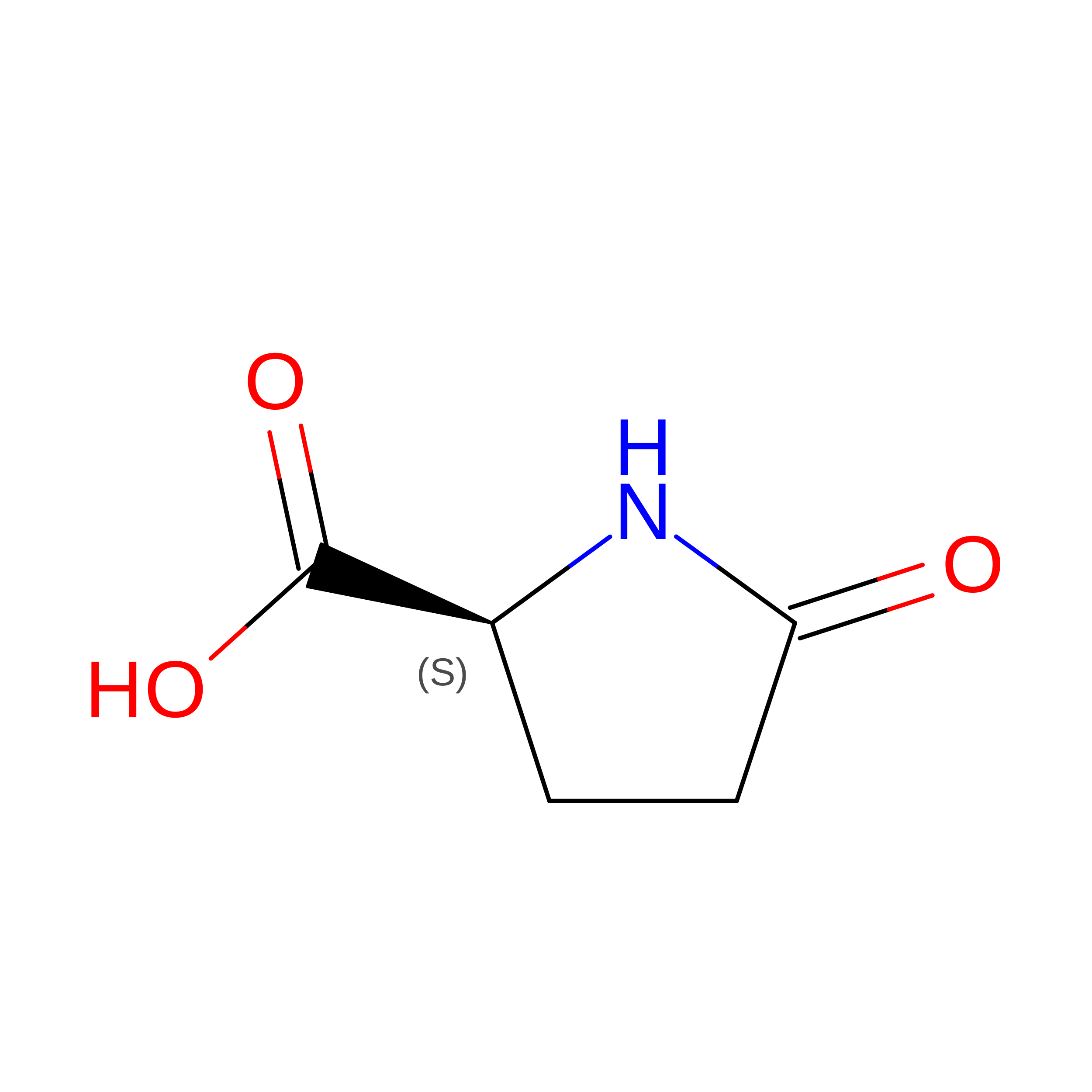
PCA
Query on PCA
A
L-PEPTIDE LINKINGC5 H7 N O3GLN

Experimental Data & Validation

Experimental Data

  • Method: X-RAY DIFFRACTION
  • Resolution: 2.00 Å
  • R-Value Work:  0.184 (Depositor) 
  • R-Value Observed: 0.184 (Depositor) 
Space Group: P 21 21 21
Unit Cell:
Length ( Å )Angle ( ˚ )
a = 52.91α = 90
b = 68.9β = 90
c = 131.77γ = 90
Software Package:
Software NamePurpose
X-PLORrefinement

Structure Validation

View Full Validation Report


Entry History 

Deposition Data

Revision History  (Full details and data files)

  • Version 1.0: 1999-05-18
    Type: Initial release
  • Version 1.1: 2008-03-24
    Changes: Version format compliance
  • Version 1.2: 2011-07-13
    Changes: Non-polymer description, Version format compliance
  • Version 2.0: 2019-12-25
    Changes: Derived calculations, Other, Polymer sequence
  • Version 2.1: 2020-07-29
    Type: Remediation
    Reason: Carbohydrate remediation
    Changes: Data collection, Derived calculations, Structure summary
  • Version 2.2: 2024-11-20
    Changes: Data collection, Database references, Structure summary