Download Mendeley
Crystal structure of the 2[4Fe-4S] ferredoxin from Chromatium vinosum: evolutionary and mechanistic inferences for [3/4Fe-4S] ferredoxins.
Moulis, J.M., Sieker, L.C., Wilson, K.S., Dauter, Z.(1996) Protein Sci 5: 1765-1775
- PubMed: 8880900 Search on PubMedSearch on PubMed Central
- DOI: https://doi.org/10.1002/pro.5560050902
- Primary Citation Related Structures:
1BLU - PubMed Abstract:
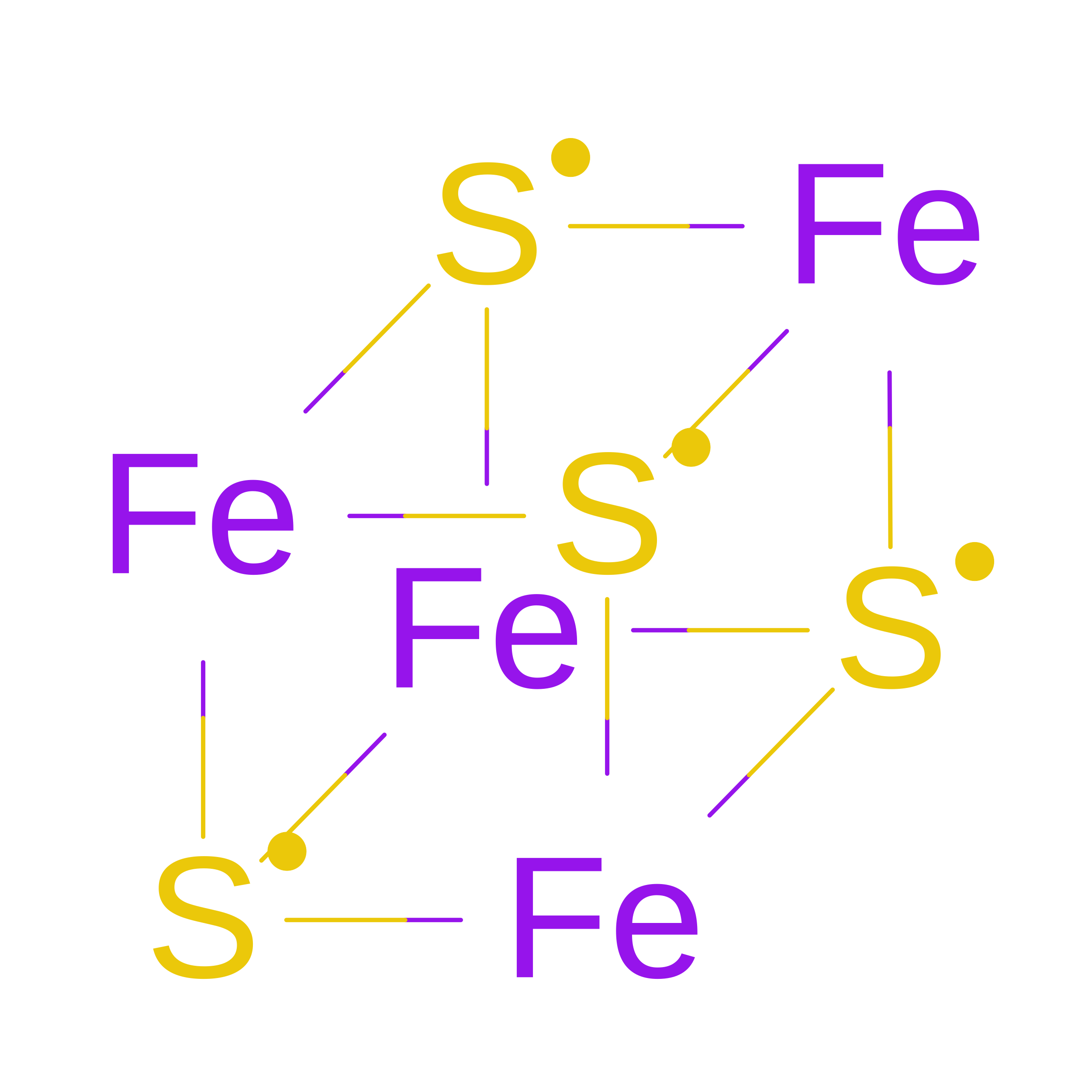
The crystal structure of the 2[4Fe-4S] ferredoxin from Chromatium vinosum has been solved by molecular replacement using data recorded with synchrotron radiation. The crystals were hexagonal prisms that showed a strong tendency to develop into long tubes. The hexagonal prisms diffracted to 2.1 A resolution at best, and a structural model for C. vinosum ferredoxin has been built with a final R of 19.2%. The N-terminal domain coordinates the two [4Fe-4S] clusters in a fold that is almost identical to that of other known ferredoxins. However, the structure has two unique features. One is a six-residue insertion between two ligands of one cluster forming a two-turn external loop; this short loop changes the conformation of the Cys 40 ligand compared to other ferredoxins and hampers the building of one NH...S H-bond to one of the inorganic sulfurs. The other remarkable structural element is a 3.5-turn alpha-helix at the C-terminus that covers one side of the same cluster and is linked to the cluster-binding domain by a six-residue external chain segment. The charge distribution is highly asymmetric over the molecule. The structure of C. vinosum ferredoxin strongly suggests divergent evolution for bacterial [3/4Fe-4S] ferredoxins from a common ancestral cluster-binding core. The unexpected slow intramolecular electron transfer rate between the clusters in C. vinosum ferredoxin, compared to other similar proteins, may be attributed to the unusual electronic properties of one of the clusters arising from localized changes in its vicinity rather than to a global structural rearrangement.
- CEA, Départment de Biologie Moléculaire et Structurale, Laboratoire Métalloprotéines, Grenoble, France. moulis@ebron.ceng.cea.fr
Organizational Affiliation: