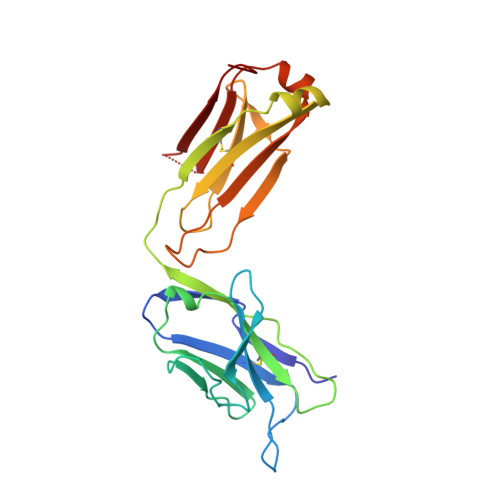
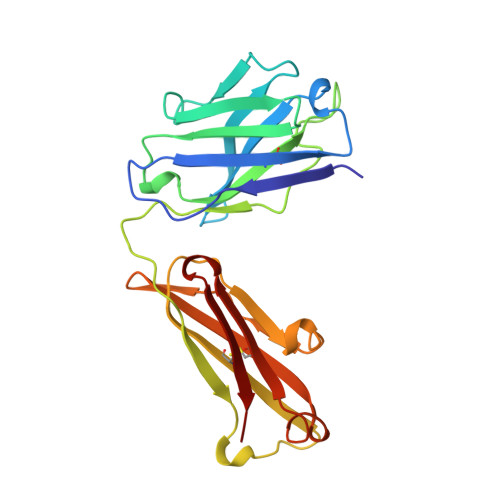
1BLN | pdb_00001bln

ANTI-P-GLYCOPROTEIN FAB MRK-16


Experimental Data Snapshot

  • Method: X-RAY DIFFRACTION
  • Resolution: 2.80 Å
  • R-Value Free: 
    0.287 (Depositor) 
  • R-Value Work: 
    0.209 (Depositor) 
  • R-Value Observed: 
    0.209 (Depositor) 

Starting Model: experimental
View more details

wwPDB Validation 3D Report Full Report

Validation slider image for 1BLN

This is version 1.5 of the entry. See complete history

Literature

Mode of binding of anti-P-glycoprotein antibody MRK-16 to its antigen. A crystallographic and molecular modeling study.

Vasudevan, S.Tsuruo, T.Rose, D.R.

(1998) J Biological Chem 273: 25413-25419

  • DOI: https://doi.org/10.1074/jbc.273.39.25413
  • Primary Citation Related Structures: 
    1BLN

  • PubMed Abstract: 

    Monoclonal antibody MRK-16 recognizes a discontinuous extracellular epitope on the multidrug resistance-associated ATP-binding cassette transporter, P-glycoprotein. The atomic basis for specificity of this antibody is of interest because of its potential as a modulator of P-glycoprotein activity. The crystal structure of Fab MRK-16 is reported to a resolution of 2.8 A. A structure for a portion of the epitope was derived by comparison to regions of solved structures with similar primary sequence. This has permitted a proposal for the mode of binding of the peptide epitope to the antibody, in which the peptide makes specific contacts with complementarity-determining regions H1, H2, and H3 from the heavy chain and L3 from the light chain. These interactions are consistent with epitope mapping studies and with the observation that MRK-16 is specific for human class I P-glycoprotein. This result identifies side chains in MRK-16 that would be amenable to alteration in antibody engineering experiments to derive improved multidrug resistance inhibitors for clinical use during chemotherapy. In particular, Arg-H97 contacts both Glu-746 and Asp-744 of the peptide, Arg-L96 contacts Asp-743, and Thr-H33 interacts with Thr-747. All of these epitope residues were implicated in mediating specificity by epitope mapping studies.


  • Organizational Affiliation
    • Ontario Cancer Institute and Department of Medical Biophysics, University of Toronto, Toronto M5G 2M9, Canada.

Macromolecule Content 

  • Total Structure Weight: 94 kDa 
  • Atom Count: 6,606 
  • Modeled Residue Count: 864 
  • Deposited Residue Count: 864 
  • Unique protein chains: 2

Macromolecules

Find similar proteins by:|  3D Structure
Entity ID: 1
MoleculeChains  Sequence LengthOrganismDetailsImage
PROTEIN (MONOCLONAL ANTIBODY MRK-16 (LIGHT CHAIN))
A, C
214Mus musculusMutation(s): 0 
Find similar proteins by:|  3D Structure
Entity ID: 2
MoleculeChains  Sequence LengthOrganismDetailsImage
PROTEIN (MONOCLONAL ANTIBODY MRK-16 (HEAVY CHAIN))
B, D
218Mus musculusMutation(s): 0 

Experimental Data & Validation

Experimental Data

  • Method: X-RAY DIFFRACTION
  • Resolution: 2.80 Å
  • R-Value Free:  0.287 (Depositor) 
  • R-Value Work:  0.209 (Depositor) 
  • R-Value Observed: 0.209 (Depositor) 
Space Group: P 1 21 1
Unit Cell:
Length ( Å )Angle ( ˚ )
a = 54.49α = 90
b = 67.774β = 97.61
c = 117.186γ = 90
Software Package:
Software NamePurpose
X-PLORmodel building
X-PLORrefinement
X-PLORphasing

Structure Validation

View Full Validation Report


Entry History 

Deposition Data

Revision History  (Full details and data files)

  • Version 1.0: 1998-10-28
    Type: Initial release
  • Version 1.1: 2008-04-27
    Changes: Version format compliance
  • Version 1.2: 2011-07-13
    Changes: Derived calculations, Version format compliance
  • Version 1.3: 2019-10-30
    Changes: Data collection, Derived calculations
  • Version 1.4: 2023-08-09
    Changes: Data collection, Database references, Refinement description
  • Version 1.5: 2024-10-30
    Changes: Structure summary