1BBH | pdb_00001bbh

ATOMIC STRUCTURE OF A CYTOCHROME C' WITH AN UNUSUAL LIGAND-CONTROLLED DIMER DISSOCIATION AT 1.8 ANGSTROMS RESOLUTION


Experimental Data Snapshot

  • Method: X-RAY DIFFRACTION
  • Resolution: 1.80 Å
  • R-Value Work: 
    0.185 (Depositor) 
  • R-Value Observed: 
    0.185 (Depositor) 

wwPDB Validation 3D Report Full Report

Validation slider image for 1BBH

This is version 2.1 of the entry. See complete history

Literature

Atomic structure of a cytochrome c' with an unusual ligand-controlled dimer dissociation at 1.8 A resolution.

Ren, Z.Meyer, T.McRee, D.E.

(1993) J Mol Biology 234: 433-445

  • DOI: https://doi.org/10.1006/jmbi.1993.1597
  • Primary Citation Related Structures: 
    1BBH

  • PubMed Abstract: 

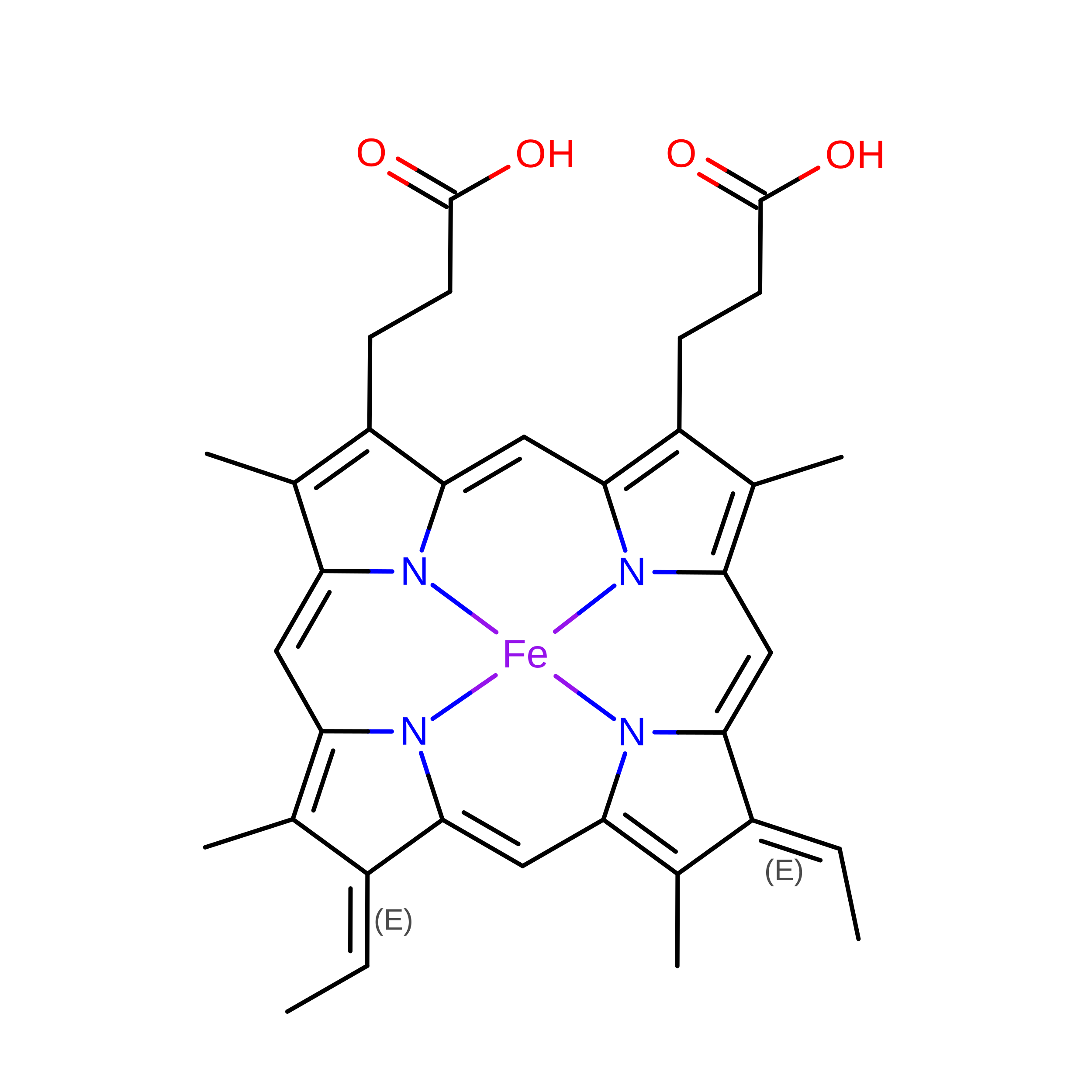
    The crystallographic structure of cytochrome c' from the purple phototrophic bacterium Chromatium vinosum (CVCP) has been determined at 1.8 A resolution using multiple isomorphous replacement. The molecule is a dimer, with each 131-residue chain folding as a four-helical bundle incorporating a covalently bound heme group at the core. This structure is the third of the ubiquitous cytochromes c' to be solved and is similar to the known structures of cytochrome c' from R. molischianum (RMCP) and R. rubrum (RRCP). CVCP is unique in exhibiting ligand-controlled dimer dissociation while RMCP and RRCP do not. The Tyr16 side-chain, which replaced Met16 in RMCP and Leu14 in RRCP, is parallel to the heme plane and located directly above the sixth ligand site of the heme Fe. Any ligand binding to this site, such as CO or CN-, must move the Tyr16 side-chain, which would be expected to cause other conformational changes of helix A, which contributes to the dimer interface, and consequently disrupting the dimer. Thus, the crystallographic structure of CVCP suggests a mechanism for dimer dissociation upon ligand binding. The dimer interface specificity is due to a lock and key shape complementarity of hydrophobic residues and not to any charge complementarity or cross-interface hydrogen bonds as is common in other protein-protein interfaces. The co-ordinates have been deposited in the Brookhaven Data Bank (entry P1BBH).


  • Organizational Affiliation
    • Department of Biochemistry, University of Arizona, Tucson 85721.

Macromolecule Content 

  • Total Structure Weight: 28.85 kDa 
  • Atom Count: 2,241 
  • Modeled Residue Count: 262 
  • Deposited Residue Count: 262 
  • Unique protein chains: 1

Macromolecules

Find similar proteins by:|  3D Structure
Entity ID: 1
MoleculeChains  Sequence LengthOrganismDetailsImage
CYTOCHROME C'
A, B
131Allochromatium vinosumMutation(s): 0 
UniProt
Find proteins for P00154 (Allochromatium vinosum (strain ATCC 17899 / DSM 180 / NBRC 103801 / NCIMB 10441 / D))
Explore P00154 
Go to UniProtKB:  P00154
Entity Groups
Sequence Clusters30% Identity50% Identity70% Identity90% Identity95% Identity100% Identity
UniProt GroupP00154
Sequence Annotations
Expand
Reference Sequence

Small Molecules

Experimental Data & Validation

Experimental Data

  • Method: X-RAY DIFFRACTION
  • Resolution: 1.80 Å
  • R-Value Work:  0.185 (Depositor) 
  • R-Value Observed: 0.185 (Depositor) 
Space Group: P 21 21 21
Unit Cell:
Length ( Å )Angle ( ˚ )
a = 49.2α = 90
b = 56.7β = 90
c = 98.8γ = 90
Software Package:
Software NamePurpose
X-PLORmodel building
X-PLORrefinement
X-PLORphasing

Structure Validation

View Full Validation Report


Entry History 

Deposition Data

Revision History  (Full details and data files)

  • Version 1.0: 1994-01-31
    Type: Initial release
  • Version 1.1: 2008-03-24
    Changes: Version format compliance
  • Version 1.2: 2011-07-13
    Changes: Version format compliance
  • Version 1.3: 2017-11-29
    Changes: Advisory, Derived calculations, Other
  • Version 2.0: 2021-03-03
    Changes: Advisory, Atomic model, Data collection, Derived calculations, Non-polymer description, Structure summary
  • Version 2.1: 2024-10-23
    Changes: Advisory, Data collection, Database references, Structure summary