1B9N | pdb_00001b9n

REGULATOR FROM ESCHERICHIA COLI


Experimental Data Snapshot

  • Method: X-RAY DIFFRACTION
  • Resolution: 2.09 Å
  • R-Value Free: 
    0.286 (Depositor), 0.256 (DCC) 
  • R-Value Work: 
    0.214 (Depositor), 0.199 (DCC) 

wwPDB Validation 3D Report Full Report

Validation slider image for 1B9N

This is version 1.4 of the entry. See complete history

Literature

The high-resolution crystal structure of the molybdate-dependent transcriptional regulator (ModE) from Escherichia coli: a novel combination of domain folds.

Hall, D.R.Gourley, D.G.Leonard, G.A.Duke, E.M.Anderson, L.A.Boxer, D.H.Hunter, W.N.

(1999) EMBO J 18: 1435-1446

  • DOI: https://doi.org/10.1093/emboj/18.6.1435
  • Primary Citation Related Structures: 
    1B9M, 1B9N

  • PubMed Abstract: 

    The molybdate-dependent transcriptional regulator (ModE) from Escherichia coli functions as a sensor of molybdate concentration and a regulator for transcription of operons involved in the uptake and utilization of the essential element, molybdenum. We have determined the structure of ModE using multi-wavelength anomalous dispersion. Selenomethionyl and native ModE models are refined to 1. 75 and 2.1 A, respectively and describe the architecture and structural detail of a complete transcriptional regulator. ModE is a homodimer and each subunit comprises N- and C-terminal domains. The N-terminal domain carries a winged helix-turn-helix motif for binding to DNA and is primarily responsible for ModE dimerization. The C-terminal domain contains the molybdate-binding site and residues implicated in binding the oxyanion are identified. This domain is divided into sub-domains a and b which have similar folds, although the organization of secondary structure elements varies. The sub-domain fold is related to the oligomer binding-fold and similar to that of the subunits of several toxins which are involved in extensive protein-protein interactions. This suggests a role for the C-terminal domain in the formation of the ModE-protein-DNA complexes necessary to regulate transcription. Modelling of ModE interacting with DNA suggests that a large distortion of DNA is not necessary for complex formation.


  • Organizational Affiliation
    • The Wellcome Trust Building, Department of Biochemistry, University of Dundee, Dundee DD1 5EH, UK.

Macromolecule Content 

  • Total Structure Weight: 57.24 kDa 
  • Atom Count: 4,132 
  • Modeled Residue Count: 503 
  • Deposited Residue Count: 530 
  • Unique protein chains: 1

Macromolecules

Find similar proteins by:|  3D Structure
Entity ID: 1
MoleculeChains  Sequence LengthOrganismDetailsImage
PROTEIN (MODE)
A, B
265Escherichia coliMutation(s): 0 
UniProt
Find proteins for P0A9G8 (Escherichia coli (strain K12))
Explore P0A9G8 
Go to UniProtKB:  P0A9G8
Entity Groups
Sequence Clusters30% Identity50% Identity70% Identity90% Identity95% Identity100% Identity
UniProt GroupP0A9G8
Sequence Annotations
Expand
Reference Sequence

Small Molecules

Ligands 1 Unique
IDChains Name / Formula / InChI Key2D Diagram3D Interactions
NI

Query on NI


Download:Ideal Coordinates CCD File
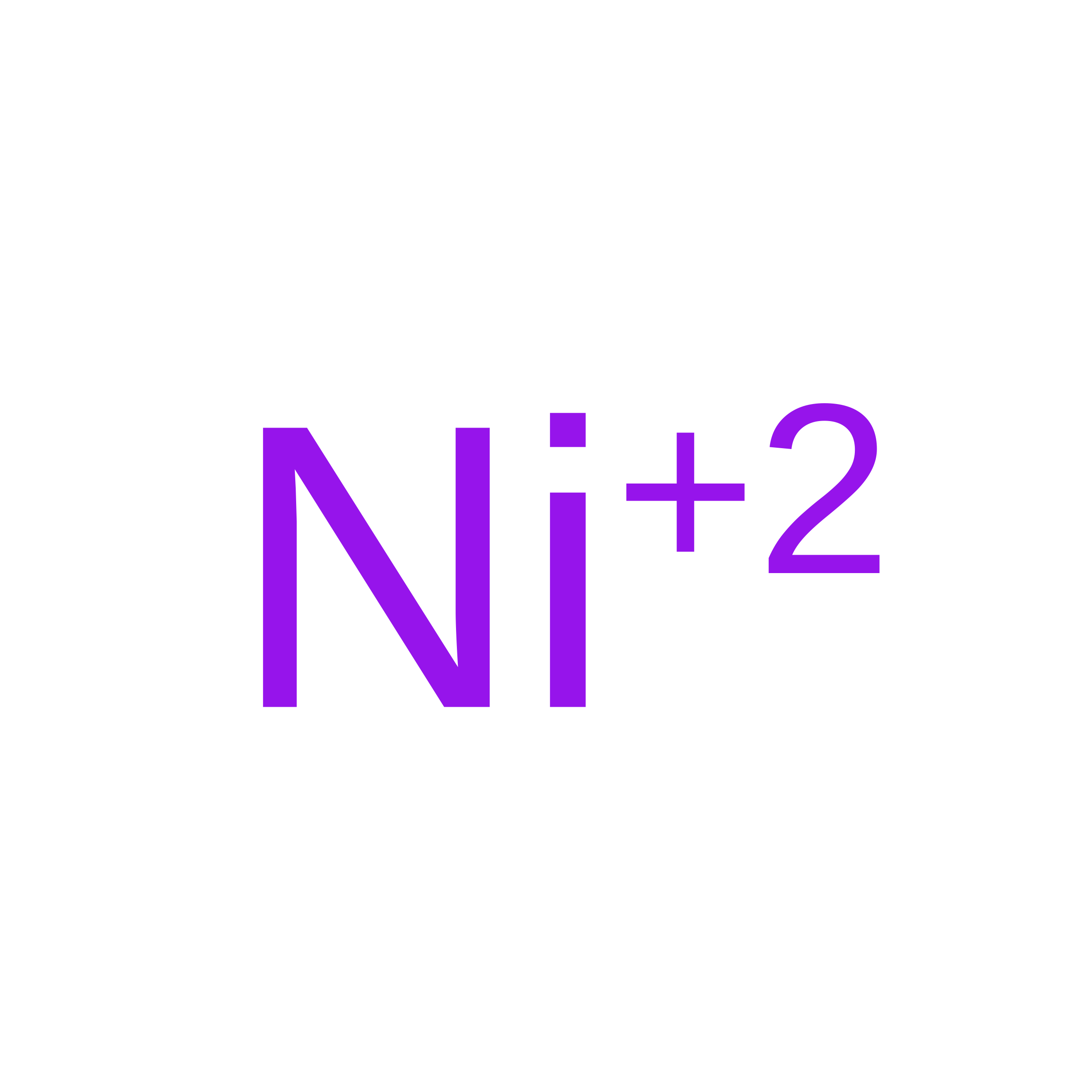
C [auth A]NICKEL (II) ION
Ni
VEQPNABPJHWNSG-UHFFFAOYSA-N

Experimental Data & Validation

Experimental Data

  • Method: X-RAY DIFFRACTION
  • Resolution: 2.09 Å
  • R-Value Free:  0.286 (Depositor), 0.256 (DCC) 
  • R-Value Work:  0.214 (Depositor), 0.199 (DCC) 
Space Group: P 21 21 2
Unit Cell:
Length ( Å )Angle ( ˚ )
a = 81.11α = 90
b = 127.36β = 90
c = 62.95γ = 90
Software Package:
Software NamePurpose
REFMACrefinement
DENZOdata reduction
SCALEPACKdata scaling

Structure Validation

View Full Validation Report


Entry History 

Deposition Data

Revision History  (Full details and data files)

  • Version 1.0: 2000-03-15
    Type: Initial release
  • Version 1.1: 2008-04-26
    Changes: Version format compliance
  • Version 1.2: 2011-07-13
    Changes: Version format compliance
  • Version 1.3: 2019-11-06
    Changes: Data collection, Database references
  • Version 1.4: 2023-12-27
    Changes: Data collection, Database references, Derived calculations