1B25 | pdb_00001b25

FORMALDEHYDE FERREDOXIN OXIDOREDUCTASE FROM PYROCOCCUS FURIOSUS


Experimental Data Snapshot

  • Method: X-RAY DIFFRACTION
  • Resolution: 1.85 Å
  • R-Value Free: 
    0.220 (Depositor) 
  • R-Value Work: 
    0.174 (Depositor) 

Starting Model: experimental
View more details

wwPDB Validation 3D Report Full Report

Validation slider image for 1B25

This is version 1.4 of the entry. See complete history

Literature

Formaldehyde ferredoxin oxidoreductase from Pyrococcus furiosus: the 1.85 A resolution crystal structure and its mechanistic implications.

Hu, Y.Faham, S.Roy, R.Adams, M.W.Rees, D.C.

(1999) J Mol Biology 286: 899-914

  • DOI: https://doi.org/10.1006/jmbi.1998.2488
  • Primary Citation Related Structures: 
    1B25, 1B4N

  • PubMed Abstract: 

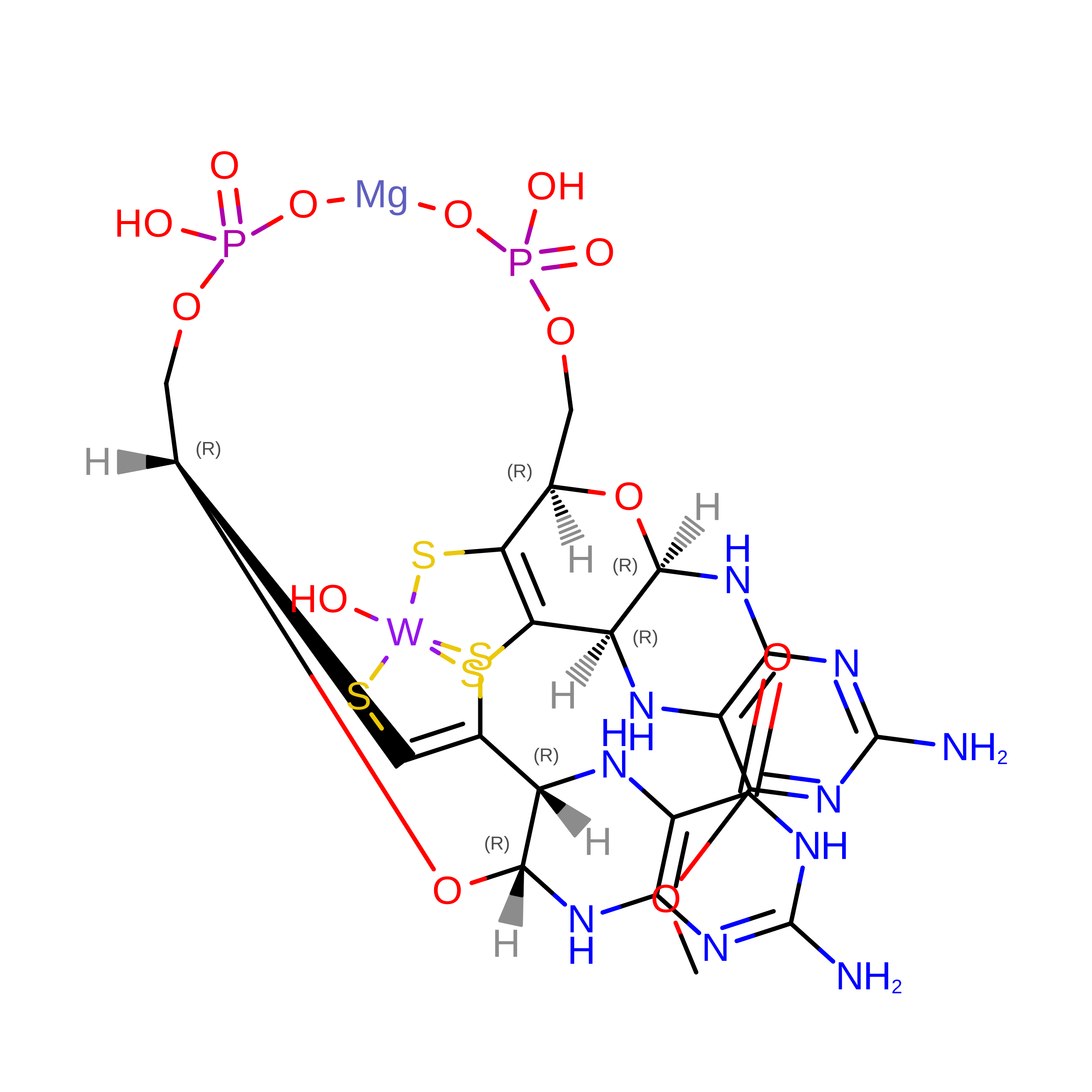
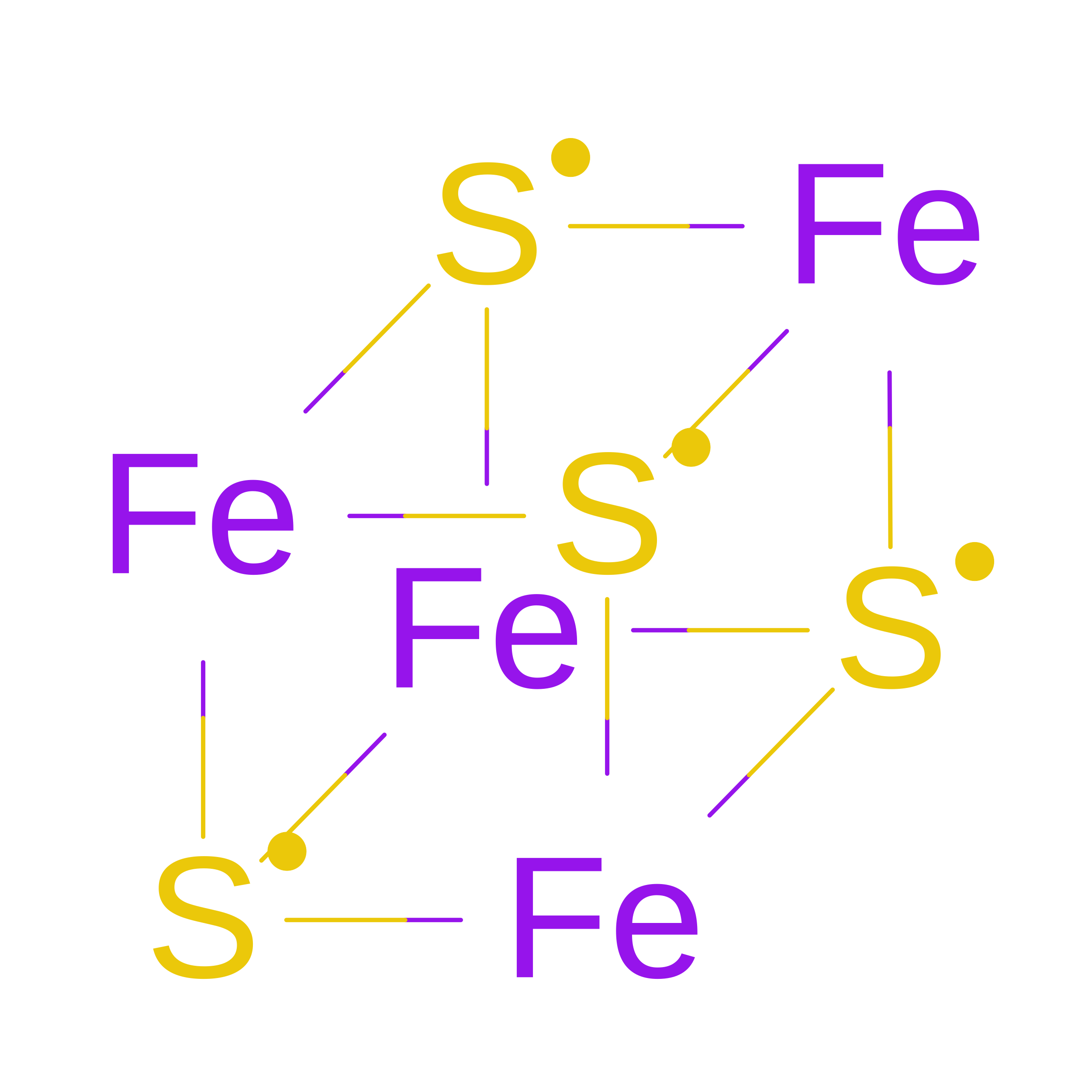
    Crystal structures of formaldehyde ferredoxin oxidoreductase (FOR), a tungstopterin-containing protein from the hyperthermophilic archaeon Pyrococcus furiosus, have been determined in the native state and as a complex with the inhibitor glutarate at 1.85 A and 2. 4 A resolution, respectively. The native structure was solved by molecular replacement using the structure of the homologous P. furiosus aldehyde ferredoxin oxidoreductase (AOR) as the initial model. Residues are identified in FOR that may be involved in either the catalytic mechanism or in determining substrate specificity. The binding site on FOR for the physiological electron acceptor, P. furiosus ferredoxin (Fd), has been established from an FOR-Fd cocrystal structure. Based on the arrangement of redox centers in this structure, an electron transfer pathway is proposed that begins at the tungsten center, leads to the (4Fe:4S) cluster of FOR via one of the two pterins that coordinate the tungsten, and ends at the (4Fe:4S) cluster of ferredoxin. This pathway includes two residues that coordinate the (4Fe:4S) clusters, Cys287 of FOR and Asp14 of ferredoxin. Similarities in the active site structures between FOR and the unrelated molybdoenzyme aldehyde oxidoreductase from Desulfovibrio gigas suggest that both enzymes utilize a common mechanism for aldehyde oxidation.


  • Organizational Affiliation
    • Division of Chemistry and Chemical Engineering 147-75CH, California Institute of Technology, Pasadena, CA, 91125, USA.

Macromolecule Content 

  • Total Structure Weight: 280.94 kDa 
  • Atom Count: 20,733 
  • Modeled Residue Count: 2,444 
  • Deposited Residue Count: 2,476 
  • Unique protein chains: 1

Macromolecules

Find similar proteins by:|  3D Structure
Entity ID: 1
MoleculeChains  Sequence LengthOrganismDetailsImage
PROTEIN (FORMALDEHYDE FERREDOXIN OXIDOREDUCTASE)
A, B, C, D
619Pyrococcus furiosusMutation(s): 0 
UniProt
Find proteins for Q8U1K3 (Pyrococcus furiosus (strain ATCC 43587 / DSM 3638 / JCM 8422 / Vc1))
Explore Q8U1K3 
Go to UniProtKB:  Q8U1K3
Entity Groups
Sequence Clusters30% Identity50% Identity70% Identity90% Identity95% Identity100% Identity
UniProt GroupQ8U1K3
Sequence Annotations
Expand
Reference Sequence

Experimental Data & Validation

Experimental Data

  • Method: X-RAY DIFFRACTION
  • Resolution: 1.85 Å
  • R-Value Free:  0.220 (Depositor) 
  • R-Value Work:  0.174 (Depositor) 
Space Group: P 21 21 21
Unit Cell:
Length ( Å )Angle ( ˚ )
a = 100.34α = 90
b = 170.85β = 90
c = 180.64γ = 90
Software Package:
Software NamePurpose
AMoREphasing
X-PLORrefinement
DENZOdata reduction
SCALEPACKdata scaling

Structure Validation

View Full Validation Report


Entry History 

Deposition Data

Revision History  (Full details and data files)

  • Version 1.0: 1999-03-24
    Type: Initial release
  • Version 1.1: 2007-10-16
    Changes: Version format compliance
  • Version 1.2: 2011-07-13
    Changes: Version format compliance
  • Version 1.3: 2011-12-07
    Changes: Database references
  • Version 1.4: 2023-08-09
    Changes: Data collection, Database references, Derived calculations, Refinement description