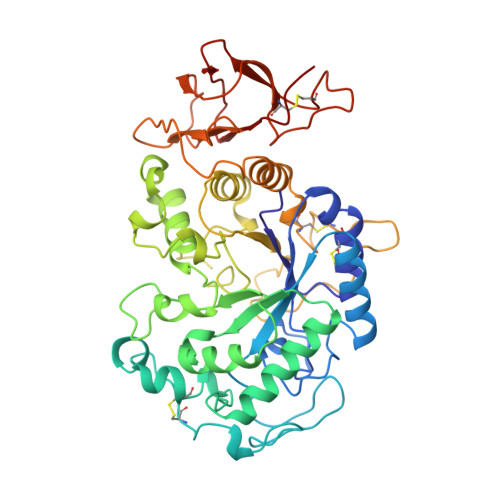
1B0I | pdb_00001b0i

ALPHA-AMYLASE FROM ALTEROMONAS HALOPLANCTIS


Experimental Data Snapshot

  • Method: X-RAY DIFFRACTION
  • Resolution: 2.40 Å
  • R-Value Free: 
    0.217 (Depositor) 
  • R-Value Work: 
    0.180 (Depositor), 0.194 (DCC) 

Starting Model: experimental
View more details

wwPDB Validation 3D Report Full Report

Validation slider image for 1B0I

This is version 1.5 of the entry. See complete history

Literature

Structures of the psychrophilic Alteromonas haloplanctis alpha-amylase give insights into cold adaptation at a molecular level.

Aghajari, N.Feller, G.Gerday, C.Haser, R.

(1998) Structure 6: 1503-1506

  • DOI: https://doi.org/10.1016/s0969-2126(98)00149-x
  • Primary Citation Related Structures: 
    1B0I

  • PubMed Abstract: 

    . Enzymes from psychrophilic (cold-adapted) microorganisms operate at temperatures close to 0 degreesC, where the activity of their mesophilic and thermophilic counterparts is drastically reduced. It has generally been assumed that thermophily is associated with rigid proteins, whereas psychrophilic enzymes have a tendency to be more flexible. . Insights into the cold adaptation of proteins are gained on the basis of a psychrophilic protein's molecular structure. To this end, we have determined the structure of the recombinant form of a psychrophilic alpha-amylase from Alteromonas haloplanctis at 2.4 A resolution. We have compared this with the structure of the wild-type enzyme, recently solved at 2.0 A resolution, and with available structures of their mesophilic counterparts. These comparative studies have enabled us to identify possible determinants of cold adaptation. . We propose that an increased resilience of the molecular surface and a less rigid protein core, with less interdomain interactions, are determining factors of the conformational flexibility that allows efficient enzyme catalysis in cold environments.


  • Organizational Affiliation
    • Institut de Biologie et Chimie des Protéines UPR 412, CNRS 7 Passage du Vercors 69367 Lyon cedex 07 France.

Macromolecule Content 

  • Total Structure Weight: 49.46 kDa 
  • Atom Count: 3,541 
  • Modeled Residue Count: 448 
  • Deposited Residue Count: 453 
  • Unique protein chains: 1

Macromolecules

Find similar proteins by:|  3D Structure
Entity ID: 1
MoleculeChains  Sequence LengthOrganismDetailsImage
PROTEIN (ALPHA-AMYLASE)453Pseudoalteromonas haloplanktisMutation(s): 0 
Gene Names: AMY
EC: 3.2.1.1
UniProt
Find proteins for P29957 (Pseudoalteromonas haloplanktis)
Explore P29957 
Go to UniProtKB:  P29957
Entity Groups
Sequence Clusters30% Identity50% Identity70% Identity90% Identity95% Identity100% Identity
UniProt GroupP29957
Sequence Annotations
Expand
Reference Sequence

Experimental Data & Validation

Experimental Data

  • Method: X-RAY DIFFRACTION
  • Resolution: 2.40 Å
  • R-Value Free:  0.217 (Depositor) 
  • R-Value Work:  0.180 (Depositor), 0.194 (DCC) 
Space Group: P 21 21 21
Unit Cell:
Length ( Å )Angle ( ˚ )
a = 56.8α = 90
b = 80.3β = 90
c = 120.1γ = 90
Software Package:
Software NamePurpose
DENZOdata reduction
ROTAVATAdata reduction
AMoREphasing
X-PLORrefinement
CCP4data scaling
ROTAVATAdata scaling

Structure Validation

View Full Validation Report


Entry History 

Deposition Data

Revision History  (Full details and data files)

  • Version 1.0: 1999-11-17
    Type: Initial release
  • Version 1.1: 2008-04-26
    Changes: Version format compliance
  • Version 1.2: 2011-07-13
    Changes: Version format compliance
  • Version 1.3: 2017-10-04
    Changes: Refinement description
  • Version 1.4: 2023-08-09
    Changes: Data collection, Database references, Derived calculations, Refinement description
  • Version 1.5: 2024-11-13
    Changes: Structure summary