1AMK | pdb_00001amk

LEISHMANIA MEXICANA TRIOSE PHOSPHATE ISOMERASE


Experimental Data Snapshot

  • Method: X-RAY DIFFRACTION
  • Resolution: 1.83 Å
  • R-Value Work: 
    0.107 (Depositor), 0.207 (DCC) 

Starting Model: experimental
View more details

wwPDB Validation 3D Report Full Report

Validation slider image for 1AMK

Ligand Structure Quality Assessment 


This is version 1.6 of the entry. See complete history

Literature

Structural and mutagenesis studies of leishmania triosephosphate isomerase: a point mutation can convert a mesophilic enzyme into a superstable enzyme without losing catalytic power.

Williams, J.C.Zeelen, J.P.Neubauer, G.Vriend, G.Backmann, J.Michels, P.A.Lambeir, A.M.Wierenga, R.K.

(1999) Protein Eng 12: 243-250

  • DOI: https://doi.org/10.1093/protein/12.3.243
  • Primary Citation Related Structures: 
    1AMK

  • PubMed Abstract: 

    The dimeric enzyme triosephosphate isomerase (TIM) has a very tight and rigid dimer interface. At this interface a critical hydrogen bond is formed between the main chain oxygen atom of the catalytic residue Lys13 and the completely buried side chain of Gln65 (of the same subunit). The sequence of Leishmania mexicana TIM, closely related to Trypanosoma brucei TIM (68% sequence identity), shows that this highly conserved glutamine has been replaced by a glutamate. Therefore, the 1.8 A crystal structure of leishmania TIM (at pH 5.9) was determined. The comparison with the structure of trypanosomal TIM shows no rearrangements in the vicinity of Glu65, suggesting that its side chain is protonated and is hydrogen bonded to the main chain oxygen of Lys13. Ionization of this glutamic acid side chain causes a pH-dependent decrease in the thermal stability of leishmania TIM. The presence of this glutamate, also in its protonated state, disrupts to some extent the conserved hydrogen bond network, as seen in all other TIMs. Restoration of the hydrogen bonding network by its mutation to glutamine in the E65Q variant of leishmania TIM results in much higher stability; for example, at pH 7, the apparent melting temperature increases by 26 degrees C (57 degrees C for leishmania TIM to 83 degrees C for the E65Q variant). This mutation does not affect the kinetic properties, showing that even point mutations can convert a mesophilic enzyme into a superstable enzyme without losing catalytic power at the mesophilic temperature.


  • Organizational Affiliation
    • European Molecular Biology Laboratory, Heidelberg, Germany.

Macromolecule Content 

  • Total Structure Weight: 27.37 kDa 
  • Atom Count: 2,027 
  • Modeled Residue Count: 250 
  • Deposited Residue Count: 251 
  • Unique protein chains: 1

Macromolecules

Find similar proteins by:|  3D Structure
Entity ID: 1
MoleculeChains  Sequence LengthOrganismDetailsImage
TRIOSE PHOSPHATE ISOMERASE251Leishmania mexicanaMutation(s): 0 
EC: 5.3.1.1
UniProt
Find proteins for P48499 (Leishmania mexicana)
Explore P48499 
Go to UniProtKB:  P48499
Entity Groups
Sequence Clusters30% Identity50% Identity70% Identity90% Identity95% Identity100% Identity
UniProt GroupP48499
Sequence Annotations
Expand
Reference Sequence

Small Molecules

Ligands 1 Unique
IDChains Name / Formula / InChI Key2D Diagram3D Interactions
PGA

Query on PGA


Download:Ideal Coordinates CCD File
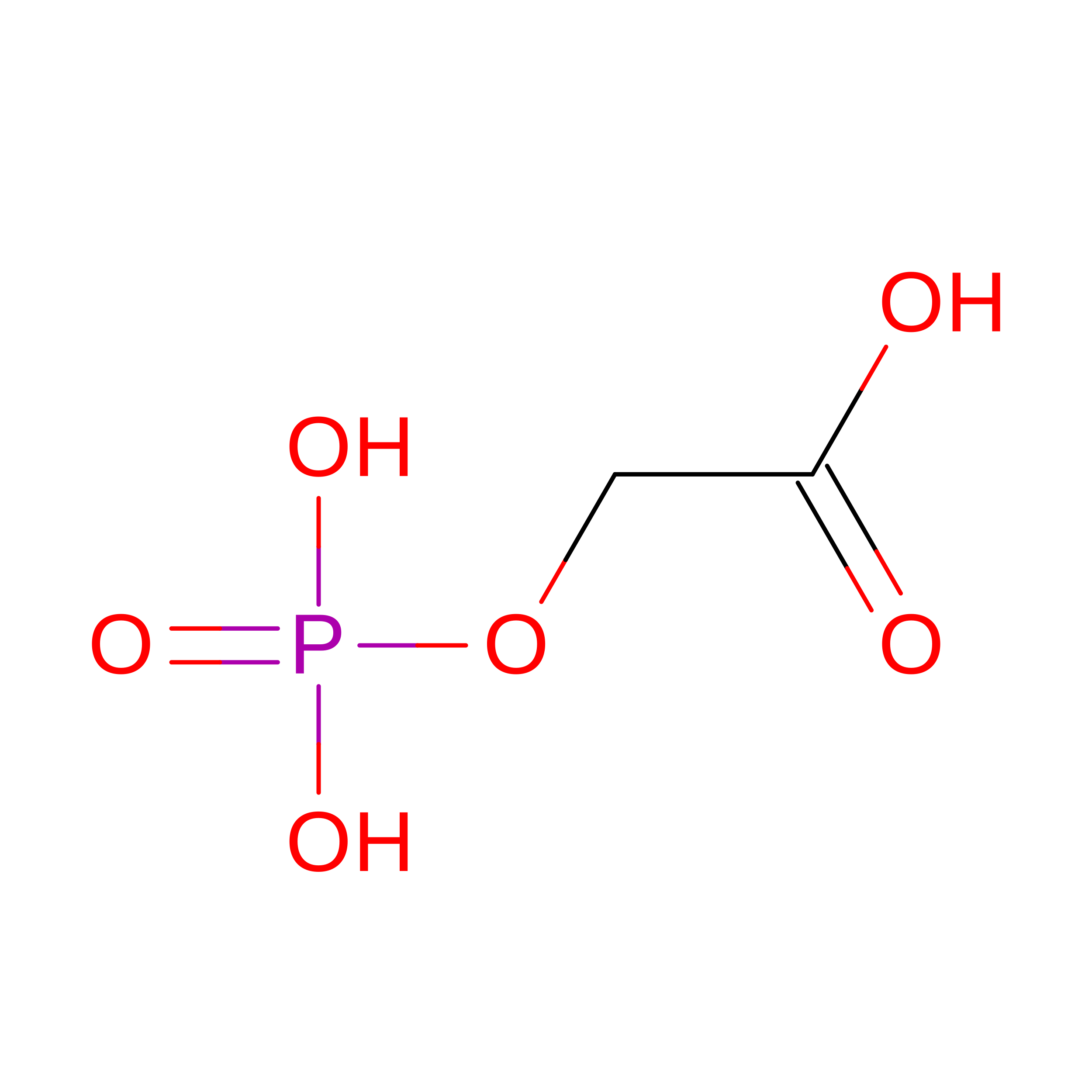
B [auth A]2-PHOSPHOGLYCOLIC ACID
C2 H5 O6 P
ASCFNMCAHFUBCO-UHFFFAOYSA-N

Experimental Data & Validation

Experimental Data

  • Method: X-RAY DIFFRACTION
  • Resolution: 1.83 Å
  • R-Value Work:  0.107 (Depositor), 0.207 (DCC) 
Space Group: C 1 2 1
Unit Cell:
Length ( Å )Angle ( ˚ )
a = 99.09α = 90
b = 52.94β = 118.13
c = 58.85γ = 90
Software Package:
Software NamePurpose
AMoREphasing
TNTrefinement
DENZOdata reduction
SCALEPACKdata scaling

Structure Validation

View Full Validation Report


Ligand Structure Quality Assessment 


Entry History 

Deposition Data

Revision History  (Full details and data files)

  • Version 1.0: 1997-12-17
    Type: Initial release
  • Version 1.1: 2008-03-24
    Changes: Version format compliance
  • Version 1.2: 2011-07-13
    Changes: Derived calculations, Version format compliance
  • Version 1.3: 2011-11-16
    Changes: Atomic model
  • Version 1.4: 2018-04-18
    Changes: Data collection
  • Version 1.5: 2023-08-02
    Changes: Database references, Derived calculations, Refinement description
  • Version 1.6: 2024-05-22
    Changes: Data collection