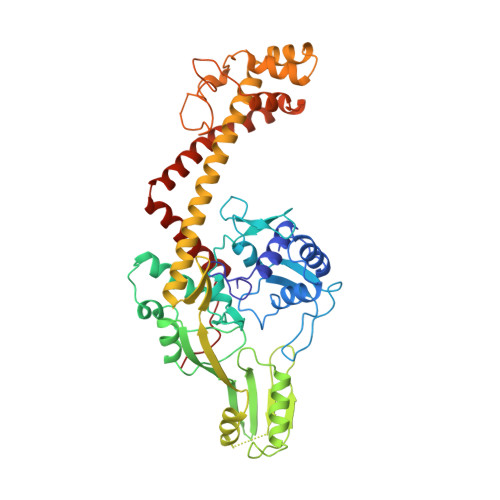
1AB4 | pdb_00001ab4

59KDA FRAGMENT OF GYRASE A FROM E. COLI


Experimental Data Snapshot

  • Method: X-RAY DIFFRACTION
  • Resolution: 2.80 Å
  • R-Value Free: 
    0.310 (Depositor), 0.308 (DCC) 
  • R-Value Work: 
    0.226 (Depositor), 0.224 (DCC) 
  • R-Value Observed: 
    0.226 (Depositor) 

wwPDB Validation 3D Report Full Report

Validation slider image for 1AB4

This is version 1.3 of the entry. See complete history

Literature

Crystal structure of the breakage-reunion domain of DNA gyrase.

Cabral, J.H.Jackson, A.P.Smith, C.V.Shikotra, N.Maxwell, A.Liddington, R.C.

(1997) Nature 388: 903-906

  • DOI: https://doi.org/10.1038/42294
  • Primary Citation Related Structures: 
    1AB4

  • PubMed Abstract: 

    DNA gyrase is a type II DNA topoisomerase from bacteria that introduces supercoils into DNA. It catalyses the breakage of a DNA duplex (the G segment), the passage of another segment (the T segment) through the break, and then the reunification of the break. This activity involves the opening and dosing of a series of molecular 'gates' which is coupled to ATP hydrolysis. Here we present the crystal structure of the 'breakage-reunion' domain of the gyrase at 2.8 A resolution. Comparison of the structure of this 59K (relative molecular mass, 59,000) domain with that of a 92K fragment of yeast topoisomerase II reveals a very different quaternary organization, and we propose that the two structures represent two principal conformations that participate in the enzymatic pathway. The gyrase structure reveals a new dimer contact with a grooved concave surface for binding the G segment and a cluster of conserved charged residues surrounding the active-site tyrosines. It also shows how breakage of the G segment can occur and, together with the topoisomerase II structure, suggests a pathway by which the T segment can be released through the second gate of the enzyme. Mutations that confer resistance to the quinolone antibacterial agents cluster at the new dimer interface, indicating how these drugs might interact with the gyrase-DNA complex.


  • Organizational Affiliation
    • Department of Biochemistry, University of Leicester, UK.

Macromolecule Content 

  • Total Structure Weight: 55.38 kDa 
  • Atom Count: 3,786 
  • Modeled Residue Count: 477 
  • Deposited Residue Count: 493 
  • Unique protein chains: 1

Macromolecules

Find similar proteins by:|  3D Structure
Entity ID: 1
MoleculeChains  Sequence LengthOrganismDetailsImage
GYRASE A493Escherichia coliMutation(s): 0 
EC: 5.99.1.3 (PDB Primary Data), 5.6.2.2 (UniProt)
UniProt
Find proteins for P0AES4 (Escherichia coli (strain K12))
Explore P0AES4 
Go to UniProtKB:  P0AES4
Entity Groups
Sequence Clusters30% Identity50% Identity70% Identity90% Identity95% Identity100% Identity
UniProt GroupP0AES4
Sequence Annotations
Expand
Reference Sequence

Experimental Data & Validation

Experimental Data

  • Method: X-RAY DIFFRACTION
  • Resolution: 2.80 Å
  • R-Value Free:  0.310 (Depositor), 0.308 (DCC) 
  • R-Value Work:  0.226 (Depositor), 0.224 (DCC) 
  • R-Value Observed: 0.226 (Depositor) 
Space Group: I 41
Unit Cell:
Length ( Å )Angle ( ˚ )
a = 119.63α = 90
b = 119.63β = 90
c = 94.98γ = 90
Software Package:
Software NamePurpose
X-PLORmodel building
X-PLORrefinement
DENZOdata reduction
SCALEPACKdata scaling
X-PLORphasing

Structure Validation

View Full Validation Report


Entry History 

Deposition Data

Revision History  (Full details and data files)

  • Version 1.0: 1998-10-14
    Type: Initial release
  • Version 1.1: 2008-03-24
    Changes: Version format compliance
  • Version 1.2: 2011-07-13
    Changes: Derived calculations, Version format compliance
  • Version 1.3: 2024-02-07
    Changes: Data collection, Database references, Other