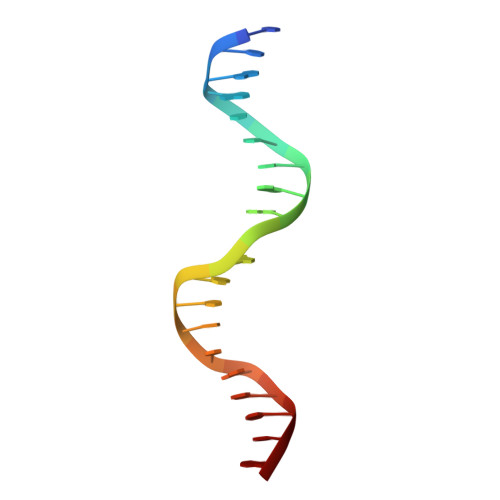
1A6Y | pdb_00001a6y

REVERBA ORPHAN NUCLEAR RECEPTOR/DNA COMPLEX


Experimental Data Snapshot

  • Method: X-RAY DIFFRACTION
  • Resolution: 2.30 Å
  • R-Value Free: 
    0.288 (Depositor), 0.259 (DCC) 
  • R-Value Work: 
    0.192 (Depositor), 0.215 (DCC) 

Starting Model: experimental
View more details

wwPDB Validation 3D Report Full Report

Validation slider image for 1A6Y

This is version 1.3 of the entry. See complete history

Literature

Structural elements of an orphan nuclear receptor-DNA complex.

Zhao, Q.Khorasanizadeh, S.Miyoshi, Y.Lazar, M.A.Rastinejad, F.

(1998) Mol Cell 1: 849-861

  • DOI: https://doi.org/10.1016/s1097-2765(00)80084-2
  • Primary Citation Related Structures: 
    1A6Y

  • PubMed Abstract: 

    The nuclear hormone receptors form the largest known family of transcription factors. The current notion of receptor DNA discrimination, based solely on one major type of hexameric half-site and a highly conserved 66-residue core DNA-binding domain (DBD), does not adequately describe how more than 150 nonsteroid receptors differentiate among response elements. Here, we describe the 2.3 A crystal structure of the DNA-binding region of the orphan receptor RevErb arranged as a tandem homodimer on its optimal response element. The structure reveals the presence of a second major protein-DNA interface adjacent to the classical one involving the half-sites. A sequence comparison of orphan receptors suggests that unique minor-groove interactions involving the receptor hinge regions impart the necessary DNA and dimerization specificity.


  • Organizational Affiliation
    • Department of Pharmacology, School of Medicine, University of Virginia, Charlottesville 22908, USA.

Macromolecule Content 

  • Total Structure Weight: 34.45 kDa 
  • Atom Count: 2,334 
  • Modeled Residue Count: 202 
  • Deposited Residue Count: 228 
  • Unique protein chains: 1
  • Unique nucleic acid chains: 2

Macromolecules


Find similar proteins by:|  3D Structure
Entity ID: 3
MoleculeChains  Sequence LengthOrganismDetailsImage
ORPHAN NUCLEAR RECEPTOR NR1D1C [auth A],
D [auth B]
94Homo sapiensMutation(s): 0 
UniProt & NIH Common Fund Data Resources
Find proteins for P20393 (Homo sapiens)
Explore P20393 
Go to UniProtKB:  P20393
PHAROS:  P20393
GTEx:  ENSG00000126368 
Entity Groups
Sequence Clusters30% Identity50% Identity70% Identity90% Identity95% Identity100% Identity
UniProt GroupP20393
Sequence Annotations
Expand
Reference Sequence
Find similar nucleic acids by:  Sequence
Entity ID: 1
MoleculeChains LengthOrganismImage
DNA (5'-D(*CP*AP*AP*CP*TP*AP*GP*GP*TP*CP*AP*CP*(5IT)P*AP*GP*GP*TP*CP*AP*G)-3')A [auth C]20N/A
Sequence Annotations
Expand
Reference Sequence
Find similar nucleic acids by:  Sequence
Entity ID: 2
MoleculeChains LengthOrganismImage
DNA (5'-D(*CP*TP*GP*AP*CP*CP*TP*AP*GP*TP*GP*AP*CP*CP*TP*AP*GP*TP*TP*G)-3')B [auth D]20N/A
Sequence Annotations
Expand
Reference Sequence

Experimental Data & Validation

Experimental Data

  • Method: X-RAY DIFFRACTION
  • Resolution: 2.30 Å
  • R-Value Free:  0.288 (Depositor), 0.259 (DCC) 
  • R-Value Work:  0.192 (Depositor), 0.215 (DCC) 
Space Group: P 1
Unit Cell:
Length ( Å )Angle ( ˚ )
a = 38.67α = 75.16
b = 45.69β = 80.64
c = 47.95γ = 85.58
Software Package:
Software NamePurpose
AMoREphasing
X-PLORrefinement
DENZOdata reduction
SCALEPACKdata scaling

Structure Validation

View Full Validation Report


Entry History 

Deposition Data

Revision History  (Full details and data files)

  • Version 1.0: 1998-10-21
    Type: Initial release
  • Version 1.1: 2008-05-22
    Changes: Version format compliance
  • Version 1.2: 2011-07-13
    Changes: Version format compliance
  • Version 1.3: 2023-08-02
    Changes: Data collection, Database references, Derived calculations, Refinement description