12DK | pdb_000012dk

structure of human KCNQ1-CaM-PIP2 intermediate state

  • Classification: MEMBRANE PROTEIN
  • Organism(s): Homo sapiens
  • Expression System: Homo sapiens
  • Mutation(s): Yes 

  • Deposited: 2026-03-28 Released: 2026-05-06 
  • Deposition Author(s): Cui, C., Kermani, A., Sun, J.
  • Funding Organization(s): National Institutes of Health/National Heart, Lung, and Blood Institute (NIH/NHLBI), National Institutes of Health/National Institute of General Medical Sciences (NIH/NIGMS), Ministry of Education (MoE, Singapore)

Experimental Data Snapshot

  • Method: ELECTRON MICROSCOPY
  • Resolution: 3.47 Å
  • Aggregation State: PARTICLE 
  • Reconstruction Method: SINGLE PARTICLE 

wwPDB Validation 3D Report Full Report

Validation slider image for 12DK

This is version 1.1 of the entry. See complete history

Literature

PIP 2 activation of the cardiac I Ks potassium channel.

Cui, J.Zhao, L.Xu, X.Cui, C.Duan, R.Kermani, A.Shi, J.Han, L.Sun, J.Zou, X.

(2025) Res Sq 

  • DOI: https://doi.org/10.21203/rs.3.rs-7609003/v1
  • Primary Citation Related Structures: 
    12DK

  • PubMed Abstract: 

    The I Ks channel complex, composed of the voltage-gated potassium channel KCNQ1 and its regulatory subunit KCNE1, is essential for the termination of cardiac action potentials. The function of KCNQ1 and I Ks requires PIP 2 , and its depletion abolishes channel opening. Previous studies revealed that KCNQ1 adopts both bent and straight conformations and can bind two PIP 2 molecules: one adjacent to VSD (V-PIP 2 ), and the other at the VSD-pore interface (C-PIP 2 ). Here we show that the two PIP 2 perform essential yet distinct roles: V-PIP 2 enables the bent-to-straight transition, whereas C-PIP 2 mediates VSD-pore coupling and stabilizes the straight conformation. Structure-function analysis and molecular dynamic simulations show that VSD activation elevates the V-PIP 2 site and weakens the CaM-VSD interaction, permitting the conformational shift from the bent, intermediate open (IO) state associated with KCNQ1 to the straight, I Ks -exclusive activated open (AO) state, which is further stabilized by C-PIP 2 . Leveraging this mechanism, we developed a compound CA1, which selectively targets the V-PIP 2 site and modulates I Ks channel activity without affecting KCNQ1, offering a novel and promising conceptional path for specific and safe antiarrhythmic therapeutics.


  • Organizational Affiliation
    • Washington University in Saint Louis.

Macromolecule Content 

  • Total Structure Weight: 319.7 kDa 
  • Atom Count: 15,464 
  • Modeled Residue Count: 1,924 
  • Deposited Residue Count: 2,776 
  • Unique protein chains: 2

Macromolecules

Find similar proteins by:|  3D Structure
Entity ID: 1
MoleculeChains  Sequence LengthOrganismDetailsImage
Potassium voltage-gated channel subfamily KQT member 1A,
F [auth C],
G [auth E],
H [auth G]
545Homo sapiensMutation(s): 3 
Gene Names: KCNQ1KCNA8KCNA9KVLQT1
UniProt & NIH Common Fund Data Resources
Find proteins for P51787 (Homo sapiens)
Explore P51787 
Go to UniProtKB:  P51787
PHAROS:  P51787
GTEx:  ENSG00000053918 
Entity Groups
Sequence Clusters30% Identity50% Identity70% Identity90% Identity95% Identity100% Identity
UniProt GroupP51787
Sequence Annotations
Expand
Reference Sequence
Find similar proteins by:|  3D Structure
Entity ID: 2
MoleculeChains  Sequence LengthOrganismDetailsImage
Calmodulin-1B,
C [auth D],
D [auth F],
E [auth H]
149Homo sapiensMutation(s): 0 
Gene Names: CALM1CALMCAMCAM1
UniProt & NIH Common Fund Data Resources
Find proteins for P0DP23 (Homo sapiens)
Explore P0DP23 
Go to UniProtKB:  P0DP23
Entity Groups
Sequence Clusters30% Identity50% Identity70% Identity90% Identity95% Identity100% Identity
UniProt GroupP0DP23
Sequence Annotations
Expand
Reference Sequence

Small Molecules

Ligands 2 Unique
IDChains Name / Formula / InChI Key2D Diagram3D Interactions
PT5
(Subject of Investigation/LOI)

Query on PT5


Download:Ideal Coordinates CCD File
I [auth A],
R [auth C],
S [auth E],
T [auth G]
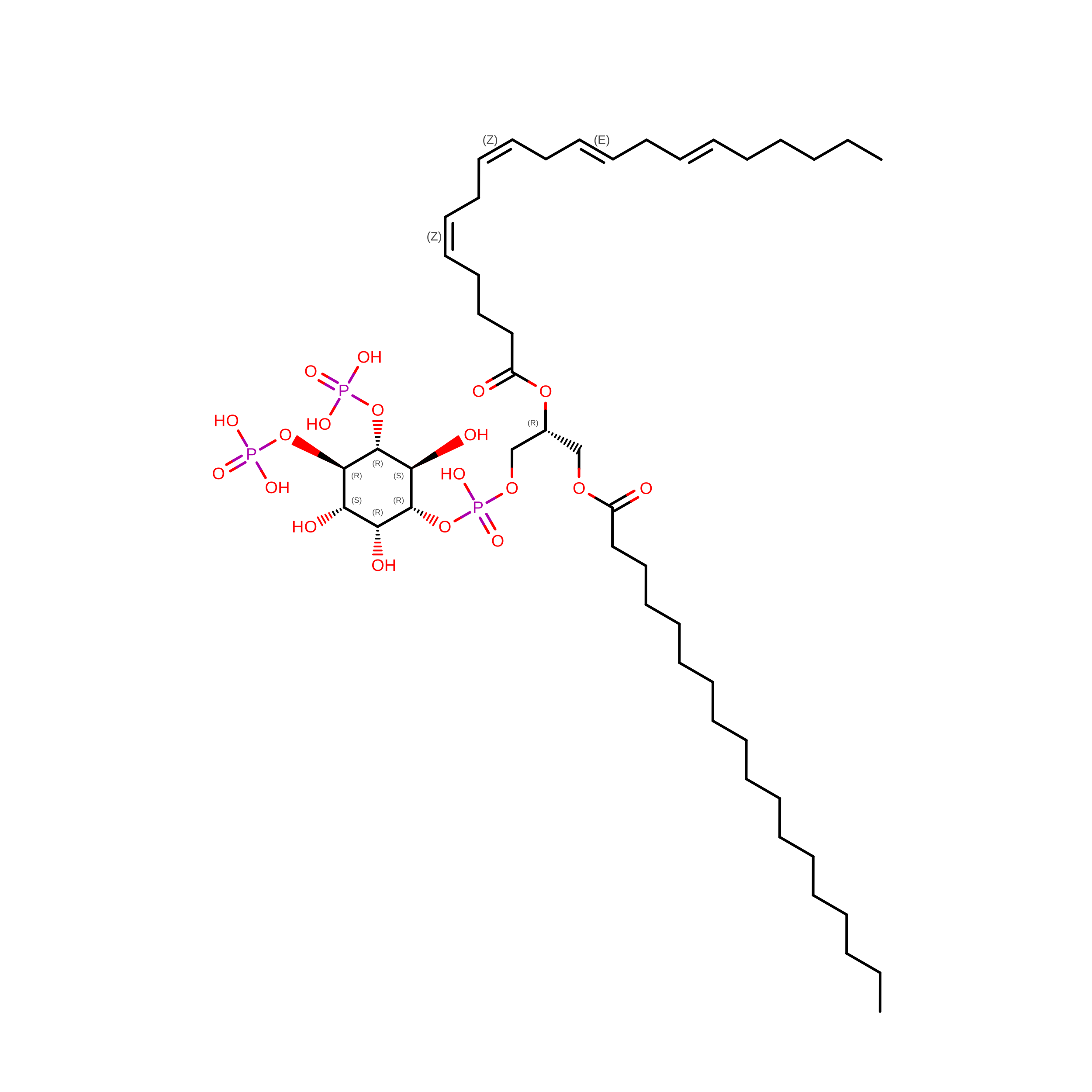
[(2R)-1-octadecanoyloxy-3-[oxidanyl-[(1R,2R,3S,4R,5R,6S)-2,3,6-tris(oxidanyl)-4,5-diphosphonooxy-cyclohexyl]oxy-phospho ryl]oxy-propan-2-yl] (8Z)-icosa-5,8,11,14-tetraenoate
C47 H85 O19 P3
CNWINRVXAYPOMW-HJBQCNPJSA-N
CA
(Subject of Investigation/LOI)

Query on CA


Download:Ideal Coordinates CCD File
J [auth B]
K [auth B]
L [auth D]
M [auth D]
N [auth F]
J [auth B],
K [auth B],
L [auth D],
M [auth D],
N [auth F],
O [auth F],
P [auth H],
Q [auth H]
CALCIUM ION
Ca
BHPQYMZQTOCNFJ-UHFFFAOYSA-N

Experimental Data & Validation

Experimental Data

  • Method: ELECTRON MICROSCOPY
  • Resolution: 3.47 Å
  • Aggregation State: PARTICLE 
  • Reconstruction Method: SINGLE PARTICLE 
EM Software:
TaskSoftware PackageVersion
RECONSTRUCTIONcryoSPARC
MODEL REFINEMENTPHENIX

Structure Validation

View Full Validation Report


Entry History 

& Funding Information

Deposition Data


Funding OrganizationLocationGrant Number
National Institutes of Health/National Heart, Lung, and Blood Institute (NIH/NHLBI)United StatesR01HL155398
National Institutes of Health/National Heart, Lung, and Blood Institute (NIH/NHLBI)United StatesR01HL166628
National Institutes of Health/National Institute of General Medical Sciences (NIH/NIGMS)United States1R35GM136409
National Institutes of Health/National Institute of General Medical Sciences (NIH/NIGMS)United States2R35GM136409
Ministry of Education (MoE, Singapore)SingaporeA-8002958-00-00
National Institutes of Health/National Heart, Lung, and Blood Institute (NIH/NHLBI)United StatesR00HL143037

Revision History  (Full details and data files)

  • Version 1.0: 2026-05-06
    Type: Initial release
  • Version 1.1: 2026-06-17
    Changes: Data collection, Database references