Download Mendeley
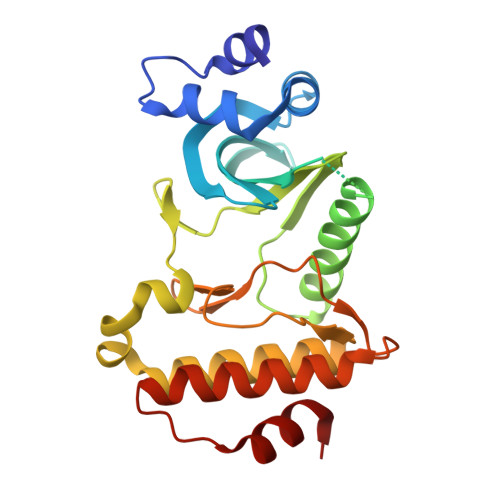
Structure of an inhibitor bound to the catalytically important divalent metal ion site of afRioK1.
Hunter, D.A., Yu, W., Puranik, P., Bannerjee, A., Pozharski, E., Seraj, N., Chang, M., Cooper, J., Strickland, D., Dave, V., LaRonde, N., MacKerell Jr., A.D., Weber, D.J.(2026) J Struct Biol : 108355-108355
- PubMed: 42595235 Search on PubMed
- DOI: https://doi.org/10.1016/j.jsb.2026.108355
- Primary Citation Related Structures:
12EZ - PubMed Abstract:
Rio Kinase 1 (RioK1) is an anti-cancer target for colorectal cancer. In pursuit of selective inhibitors of RioK1, small drug-like molecules were identified using computer-aided drug design (CADD). CADD made use of a 3D crystal structure of human RioK1 bound to ADP/Mg 2+ and a fragment-based computational method termed Site-Identification by Ligand Competitive Saturation (SILCS). Compounds identified via SILCS were selected based on predicted binding affinities and were experimentally confirmed to bind a RioK1 homolog from Archaeoglobus fulgidus via biophysical methods. One newly designed scaffold molecule, KPSH02, had its X-ray crystal structure determined in complex with afRioK1. The structure confirmed that KPSH02 occupies the adenine binding region seen in the Toyocamycin-afRioK1 structure, while also occupying the divalent metal-ion site observed in the hsRioK1-ADP structure. This structure thereby provides novel insights that may be exploited for the design of selective RioK1 inhibitors that may be useful in the future for targeting RioK1 in cancer.
- Department of Chemistry and Biochemistry, University of Maryland, Biomolecular Science Building, Paint Branch Drive, College Park, MD, USA; Center for Biomolecular Therapeutics (CBT), University of Maryland School of Medicine, Baltimore, MD 21201, USA; Lead Contact. Electronic address: Daniel.Hunter@som.umaryland.edu.
Organizational Affiliation: