Download Mendeley
Structure-Based Drug Design of Quinoline CYP8B1 Inhibitors for the Potential Treatment of Metabolic Disease.
McCracken, A.B., Li, D., Caldwell, J.P., Lankin, C., Tagat, J., Khan, T., Rao, A., Zhang, T., Caplen, M.A., Verras, A., Orth, P., Hruza, A., Ho, T., Allen, S., Elsen, N.L., Dingley, K., Duffy, R., Wisniewski, T., Murphy, B., Castro-Perez, J., Wong, K., Streckfuss, E., Liu, J., Tong, W., McKittrick, B.(2026) ACS Med Chem Lett 17: 2245-2250
- PubMed: 42866422 Search on PubMedSearch on PubMed Central
- DOI: https://doi.org/10.1021/acsmedchemlett.6c00387
- Primary Citation Related Structures:
11IH, 11IR - PubMed Abstract:
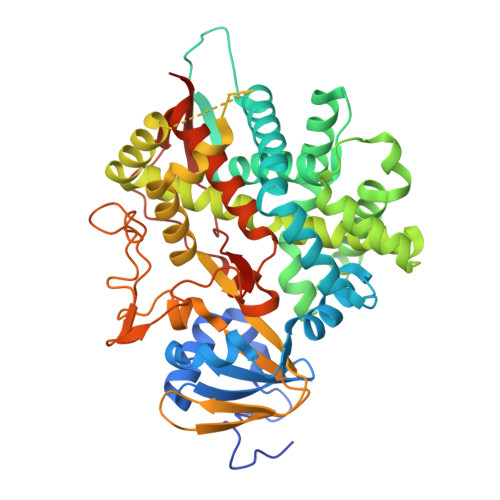
CYP8B1 has been identified as a potential target for the treatment of metabolic diseases, such as nonalcoholic fatty liver disease (NAFLD) and type 2 diabetes (T2D). CYP8B1 enzyme inhibitor 1 was discovered from a high-throughput screen of our compound collection; however, its poor metabolic stability prevented further in vivo evaluation. Leveraging structure-based drug design, metabolite identification and metabolic stability-guided DMPK optimization, and library synthesis to rapidly expand SAR, we identified compound 9 with substantially improved DMPK properties. Compound 9 showed robust in vivo CYP8B1 inhibition in mice and provided the foundation for further optimization of this class of CYP8B1 inhibitors.
- Merck & Co., Inc., Rahway, New Jersey 07065, United States.
Organizational Affiliation: