Download Mendeley
Oligomeric assemblies of plant biotin carboxylase revealed by cryo-EM and cross-linking.
Madison, H.J., Dunn, L., You, Y., Lemes Jorge, G., Pasa-Tolic, L., Thelen, J.J., Van Doren, S.R., Yokom, A.L.(2026) Biochem J 483: 803-817
- PubMed: 41879669 Search on PubMedSearch on PubMed Central
- DOI: https://doi.org/10.1042/BCJ20250372
- Primary Citation Related Structures:
9ZVM - PubMed Abstract:
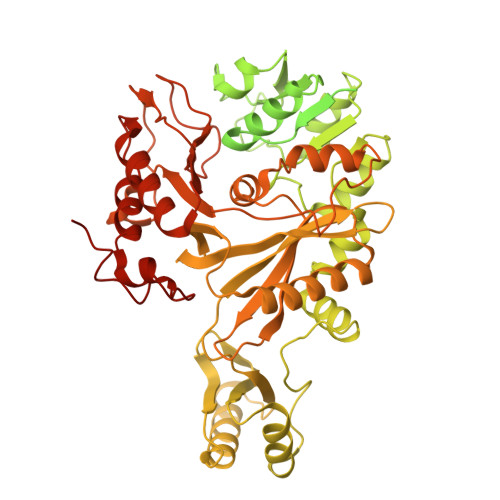
Due to the interest in fatty acid synthesis by oilseed crops, we conducted structural studies of the biotin carboxylase (BC) subunit of the plastid acetyl-CoA carboxylase (ACCase). ACCase catalyzes the first committed step in the fatty acid synthesis pathway and is highly regulated. Cryo-electron microscopy revealed that Thlaspi arvense (pennycress) BC forms a symmetric dimer and contains a subpopulation of a dimer-of-dimers. The domain of BC that closes over the catalytic cleft (the B-domain) appears to be dynamic, judging from the B-factors, normal mode analysis of BC structures, and its high susceptibility to acetylation. An increase in the BC concentration decreased the reactivity of the B-domain, however, suggesting structural hindrance. The partial protection of the B-domain was consistent with cross-links that formed between dimers of BC using a cross-linker cleavable in the mass spectrometer. Cross-links guided HADDOCK docking calculations suggesting a dimer of dimers of BC that is asymmetric, staggered, and tilted between dimers, with conservation in the interface. In contrast, a minimal population of a symmetric dimer of dimers with a small, non-conserved interface was observed by cryo-electron microscopy. Taken together, our structural models are the first for Brassicaceae family BC homologs and are the first from plants. These models suggest dimer interactions that might contribute to larger oligomers of BC and influence associations with other subunits of the heteromeric ACCase.
- Department of Biochemistry, University of Missouri, Columbia, MO 65211, U.S.A.
Organizational Affiliation: