9ZJZ | pdb_00009zjz

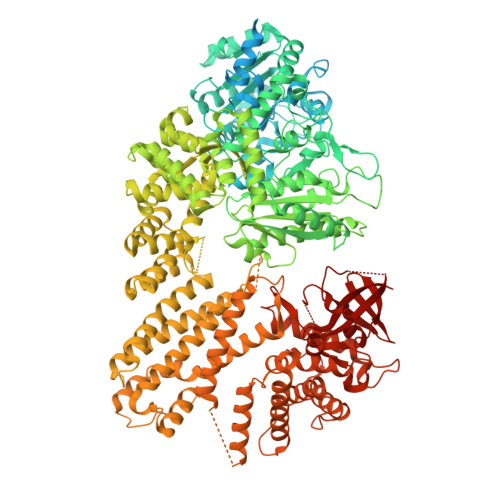
Human sterile alpha motif domain-containing protein 9 (SAMD9), loss-of-function mutant R685Q/G686C/I968C

  • Classification: ANTIVIRAL PROTEIN
  • Organism(s): Homo sapiens
  • Expression System: Homo sapiens
  • Mutation(s): Yes 

  • Deposited: 2025-12-05 Released: 2026-02-25 
  • Deposition Author(s): Mou, Z., Zhang, F., Dai, X., Xiang, Y.
  • Funding Organization(s): National Institutes of Health/National Institute Of Allergy and Infectious Diseases (NIH/NIAID), National Institutes of Health/National Institute of General Medical Sciences (NIH/NIGMS)

Experimental Data Snapshot

  • Method: ELECTRON MICROSCOPY
  • Resolution: 2.87 Å
  • Aggregation State: PARTICLE 
  • Reconstruction Method: SINGLE PARTICLE 

wwPDB Validation 3D Report Full Report

Validation slider image for 9ZJZ

This is version 1.1 of the entry. See complete history. 

Literature

Structural mechanisms of SAMD9 autoinhibition and pathogenic dysregulation.

Mou, Z., Zhang, F., Morales, M., Sahoo, B., Dai, X., Xiang, Y.

(2026) Sci Adv 12: eaeg3967-eaeg3967

  • DOI: https://doi.org/10.1126/sciadv.aeg3967
  • Primary Citation Related Structures: 
    37HT, 37IB, 37ID, 9ZJR, 9ZJS, 9ZJU, 9ZJV, 9ZJW, 9ZJZ

  • PubMed Abstract: 

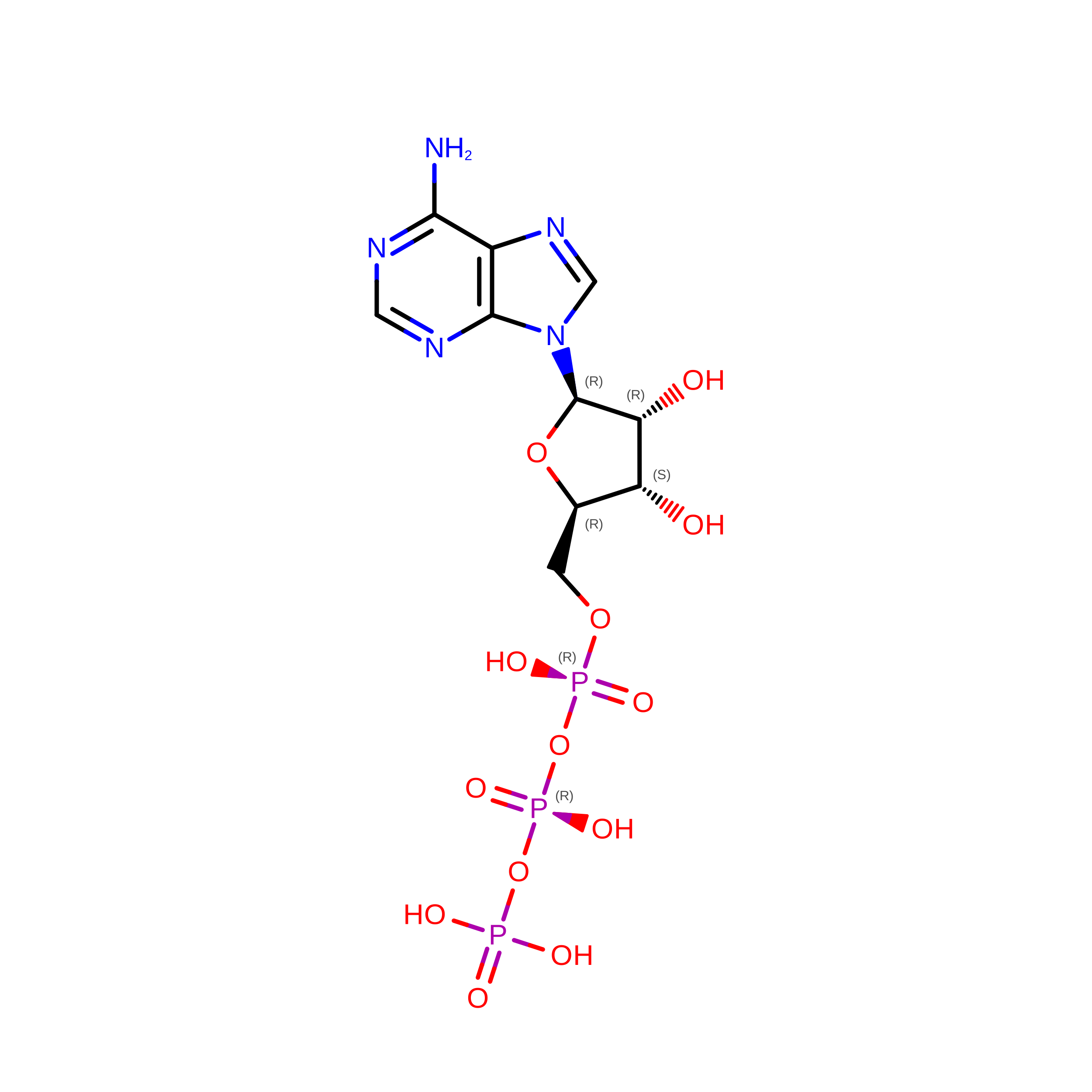
    SAMD9 and SAMD9L (SAMD9/9L) are large cytosolic proteins essential for hematopoietic homeostasis and antiviral defense ( 1 - 3 ). Germline gain-of-function (GoF) mutations in SAMD9/9L cause severe multisystem disorders and predispose to leukemia, but the mechanisms that regulate SAMD9/9L activity and how pathogenic mutations disrupt these processes remain poorly understood. Here, we report cryo-electron microscopy structures of human SAMD9 in multiple conformational and oligomeric states. SAMD9 predominantly adopts a closed, autoinhibited conformation stabilized by a central ATP-bound nucleotide-binding oligomerization domain (NOD) and an extensive network of intramolecular interactions. Recurrent patient-derived GoF mutations localize to and destabilize these intramolecular interfaces, whereas structure-guided compensatory mutations that restabilize these interfaces restore autoinhibition. We further identify low-abundance asymmetric SAMD9 dimers in which one protomer undergoes large conformational changes and establishes intermolecular interactions that are essential for SAMD9 activation. Together, these findings define the structural basis of SAMD9 autoinhibition and reveal how human GoF mutations disrupt this regulatory mechanism to drive disease.


  • Organizational Affiliation: 
    • Department of Physiology and Biophysics, School of Medicine, Case Western Reserve University, Cleveland, OH 44106, USA.

Macromolecule Content 

  • Total Structure Weight: 169.24 kDa 
  • Atom Count: 9,211 
  • Modeled Residue Count: 1,121 
  • Deposited Residue Count: 1,450 
  • Unique protein chains: 1

Macromolecules

Find similar proteins by:|  3D Structure
Entity ID: 1
MoleculeChains  Sequence LengthOrganismDetailsImage
Sterile alpha motif domain-containing protein 91,450Homo sapiensMutation(s): 3 
Gene Names: SAMD9, C7orf5, DRIF1, KIAA2004, OEF1
UniProt & NIH Common Fund Data Resources
Find proteins for Q5K651 (Homo sapiens)
Explore Q5K651 
Go to UniProtKB:  Q5K651
PHAROS:  Q5K651
GTEx:  ENSG00000205413 
Entity Groups
Sequence Clusters30% Identity50% Identity70% Identity90% Identity95% Identity100% Identity
UniProt GroupQ5K651
Sequence Annotations
Expand
Reference Sequence

Experimental Data & Validation

Experimental Data

  • Method: ELECTRON MICROSCOPY
  • Resolution: 2.87 Å
  • Aggregation State: PARTICLE 
  • Reconstruction Method: SINGLE PARTICLE 
EM Software:
TaskSoftware PackageVersion
MODEL REFINEMENTPHENIX
RECONSTRUCTIONcryoSPARC

Structure Validation

View Full Validation Report


Entry History 

& Funding Information

Deposition Data


Funding OrganizationLocationGrant Number
National Institutes of Health/National Institute Of Allergy and Infectious Diseases (NIH/NIAID)United StatesAI151638
National Institutes of Health/National Institute of General Medical Sciences (NIH/NIGMS)United StatesR35GM151043

Revision History  (Full details and data files)

  • Version 1.0: 2026-02-25
    Type: Initial release
  • Version 1.1: 2026-10-07
    Changes: Data collection, Database references