9ZEE | pdb_00009zee

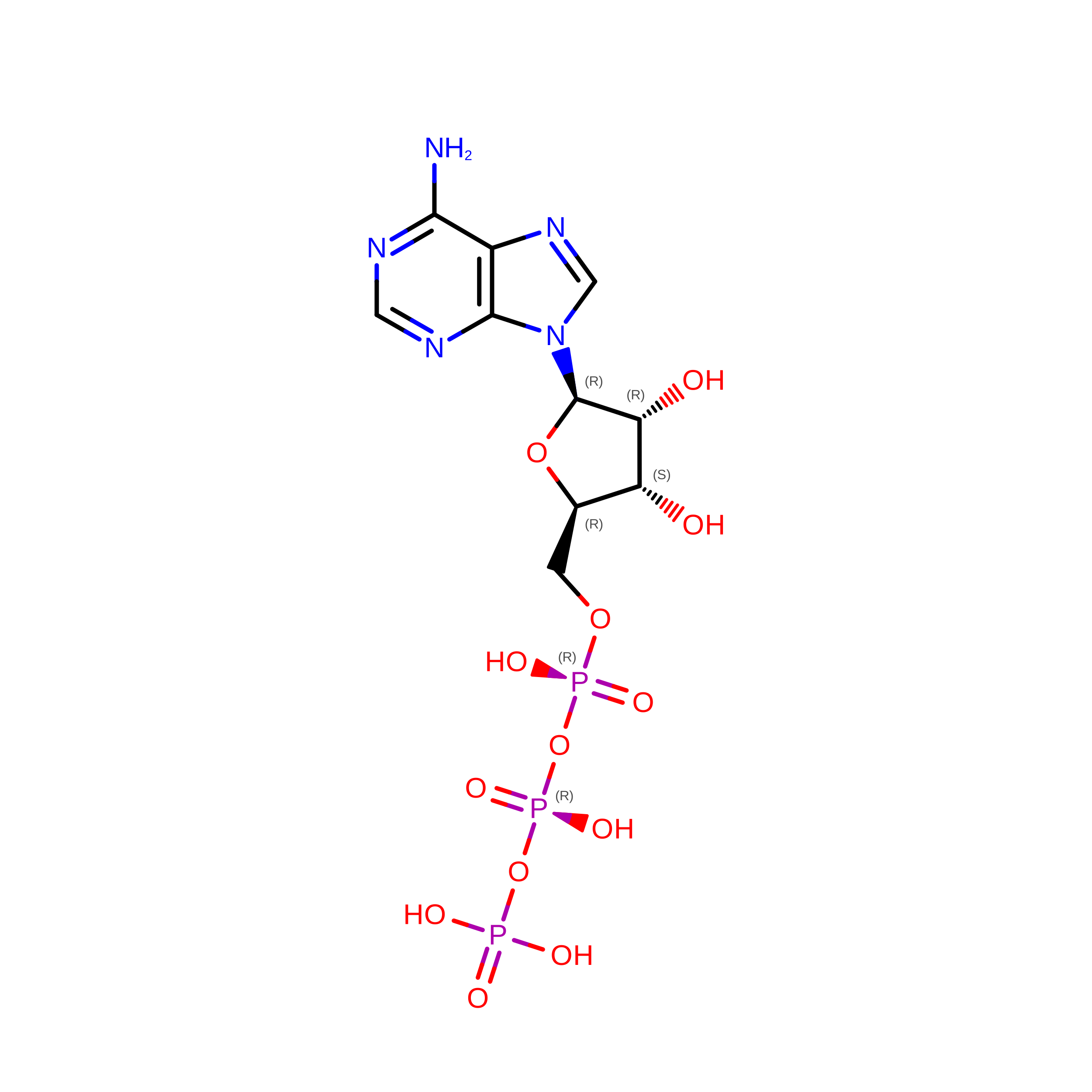
QatB-QatC complex in qatABCD anti-phage defense with ATP


Experimental Data Snapshot

  • Method: X-RAY DIFFRACTION
  • Resolution: 1.81 Å
  • R-Value Free: 
    0.203 (Depositor), 0.203 (DCC) 
  • R-Value Work: 
    0.181 (Depositor), 0.181 (DCC) 
  • R-Value Observed: 
    0.182 (Depositor) 

Starting Model: experimental
View more details

wwPDB Validation 3D Report Full Report

Validation slider image for 9ZEE

Ligand Structure Quality Assessment 


This is version 1.1 of the entry. See complete history

Literature

Structural basis of QueC-family protein function in qatABCD anti-phage defense.

Gao, A.Wassarman, D.R.Kranzusch, P.J.

(2026) Nat Commun 

  • DOI: https://doi.org/10.1038/s41467-026-72155-8
  • Primary Citation Related Structures: 
    9ZEE, 9ZEF

  • PubMed Abstract: 

    QueC proteins are nucleoside biosynthesis enzymes required for production of the 7-deazaguanine derivative queuosine. Recently, QueC-family proteins were also shown to catalyze a deazaguanylation protein-nucleobase conjugation reaction in type IV CBASS bacterial anti-phage defense. Here we determine the structural basis of QueC-family protein function in a distinct bacterial immunity system named qatABCD. We demonstrate that the Pseudomonas aeruginosa QueC-family protein QatC forms a specific complex with the immunity protein QatB and that this complex is minimally required for qatABCD defense. Crystal structures of the QatBC complex enable direct comparison of qatABCD and type IV CBASS defense and support a shared role for QueC-family proteins in targeting protein substrates for N-terminal modification. We show that the QatB unstructured N-terminus and N-terminal glycine motif are essential for qatABCD defense in vivo, suggesting a modification occurs analogous to CBASS deazaguanylation. These findings highlight broad roles of QueC proteins beyond nucleoside biosynthesis and suggest that adaptation of QueC-like proteins for specialized biochemical functions is a common strategy in bacterial anti-phage immunity.


  • Organizational Affiliation
    • Department of Microbiology, Harvard Medical School, Boston, MA, USA.

Macromolecule Content 

  • Total Structure Weight: 82 kDa 
  • Atom Count: 5,488 
  • Modeled Residue Count: 638 
  • Deposited Residue Count: 753 
  • Unique protein chains: 2

Macromolecules

Find similar proteins by:|  3D Structure
Entity ID: 1
MoleculeChains  Sequence LengthOrganismDetailsImage
QatB287Pseudomonas aeruginosaMutation(s): 0 
Find similar proteins by:|  3D Structure
Entity ID: 2
MoleculeChains  Sequence LengthOrganismDetailsImage
QatC466Pseudomonas aeruginosaMutation(s): 0 

Experimental Data & Validation

Experimental Data

  • Method: X-RAY DIFFRACTION
  • Resolution: 1.81 Å
  • R-Value Free:  0.203 (Depositor), 0.203 (DCC) 
  • R-Value Work:  0.181 (Depositor), 0.181 (DCC) 
  • R-Value Observed: 0.182 (Depositor) 
Space Group: P 21 21 21
Unit Cell:
Length ( Å )Angle ( ˚ )
a = 70.704α = 90
b = 74.366β = 90
c = 134.304γ = 90
Software Package:
Software NamePurpose
PHENIXrefinement
XDSdata reduction
Aimlessdata scaling
PHASERphasing

Structure Validation

View Full Validation Report


Ligand Structure Quality Assessment 


Entry History 

& Funding Information

Deposition Data


Funding OrganizationLocationGrant Number
National Institutes of Health/National Institute of General Medical Sciences (NIH/NIGMS)United States1DP2GM146250-01

Revision History  (Full details and data files)

  • Version 1.0: 2026-04-29
    Type: Initial release
  • Version 1.1: 2026-05-06
    Changes: Database references