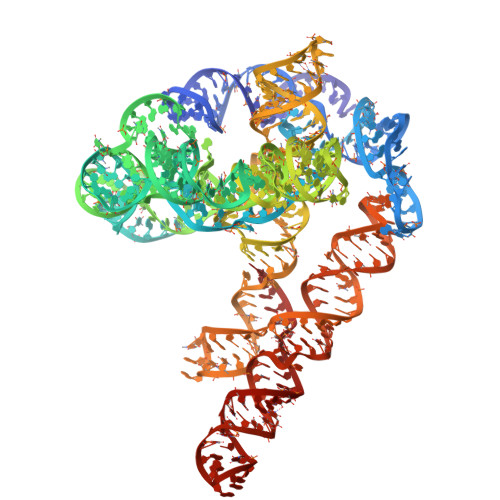
9ZBR | pdb_00009zbr

1-methyl-pseudouridine L-21 ScaI Tetrahymena Ribozyme - extended conformation

  • Classification: RNA
  • Organism(s): Tetrahymena thermophila
  • Mutation(s): No 

  • Deposited: 2025-11-21 Released: 2025-12-03 
  • Deposition Author(s): McRae, E.K.S., Yang, H.
  • Funding Organization(s): Cancer Prevention and Research Institute of Texas (CPRIT)

Experimental Data Snapshot

  • Method: ELECTRON MICROSCOPY
  • Resolution: 7.50 Å
  • Aggregation State: PARTICLE 
  • Reconstruction Method: SINGLE PARTICLE 

Starting Model: experimental
View more details

wwPDB Validation 3D Report Full Report

Validation slider image for 9ZBR

This is version 1.1 of the entry. See complete history

Literature

Base modifications shift tertiary structure and activity in synthetic RNA origami and a natural ribozyme.

Yadav, D.K.Yang, H.Lee, S.McRae, E.K.S.

(2026) Nat Commun 

  • DOI: https://doi.org/10.1038/s41467-026-72891-x
  • Primary Citation Related Structures: 
    9ZBQ, 9ZBR, 9ZC6, 9ZC7, 9ZC8, 9ZC9, 9ZCA, 9ZCB, 9ZCC

  • PubMed Abstract: 

    Modified nucleotide bases like 5-methylcytosine (m5C) and N1-methyl-pseudouridine (m1Ψ) are widely used to enhance stability and reduce immunogenicity in therapeutic RNAs, yet their impact on RNA tertiary structure remains unclear. Here we investigate how these modifications influence folding and function in both a synthetic RNA origami nanostructure and the natural Tetrahymena ribozyme. Using cryo-EM, FRET, and biochemical assays, we find that modified bases impede proper maturation of RNA origami by stabilizing alternative coaxial stacking at key junctions, leading to dimerization. In the ribozyme, modifications shift the equilibrium between open and closed conformations, altering catalytic activity in a temperature-dependent manner. These effects arise primarily from changes in base-stacking energetics rather than base pairing. Our findings reveal that base modifications reshape RNA folding landscapes and structure-function relationships, underscoring the need to consider structural consequences when designing modified RNAs for synthetic biology and therapeutic applications.


  • Organizational Affiliation
    • Houston Methodist Research Institute (HMRI), Houston, TX, USA.

Macromolecule Content 

  • Total Structure Weight: 126.46 kDa 
  • Atom Count: 8,380 
  • Modeled Residue Count: 387 
  • Deposited Residue Count: 387 
  • Unique nucleic acid chains: 1

Macromolecules

Find similar nucleic acids by:  (by identity cutoff) 
Entity ID: 1
MoleculeChains LengthOrganismImage
1-methyl-pseudouridine L-21 ScaI Tetrahymena Ribozyme387Tetrahymena thermophila
Sequence Annotations
Expand
Reference Sequence

Experimental Data & Validation

Experimental Data

  • Method: ELECTRON MICROSCOPY
  • Resolution: 7.50 Å
  • Aggregation State: PARTICLE 
  • Reconstruction Method: SINGLE PARTICLE 
EM Software:
TaskSoftware PackageVersion
MODEL REFINEMENTISOLDE
MODEL REFINEMENTPHENIX
MODEL REFINEMENTCoot
RECONSTRUCTIONcryoSPARC

Structure Validation

View Full Validation Report


Entry History 

& Funding Information

Deposition Data


Funding OrganizationLocationGrant Number
Cancer Prevention and Research Institute of Texas (CPRIT)United StatesRR230015

Revision History  (Full details and data files)

  • Version 1.0: 2025-12-03
    Type: Initial release
  • Version 1.1: 2026-06-17
    Changes: Data collection, Database references