9Z6T | pdb_00009z6t

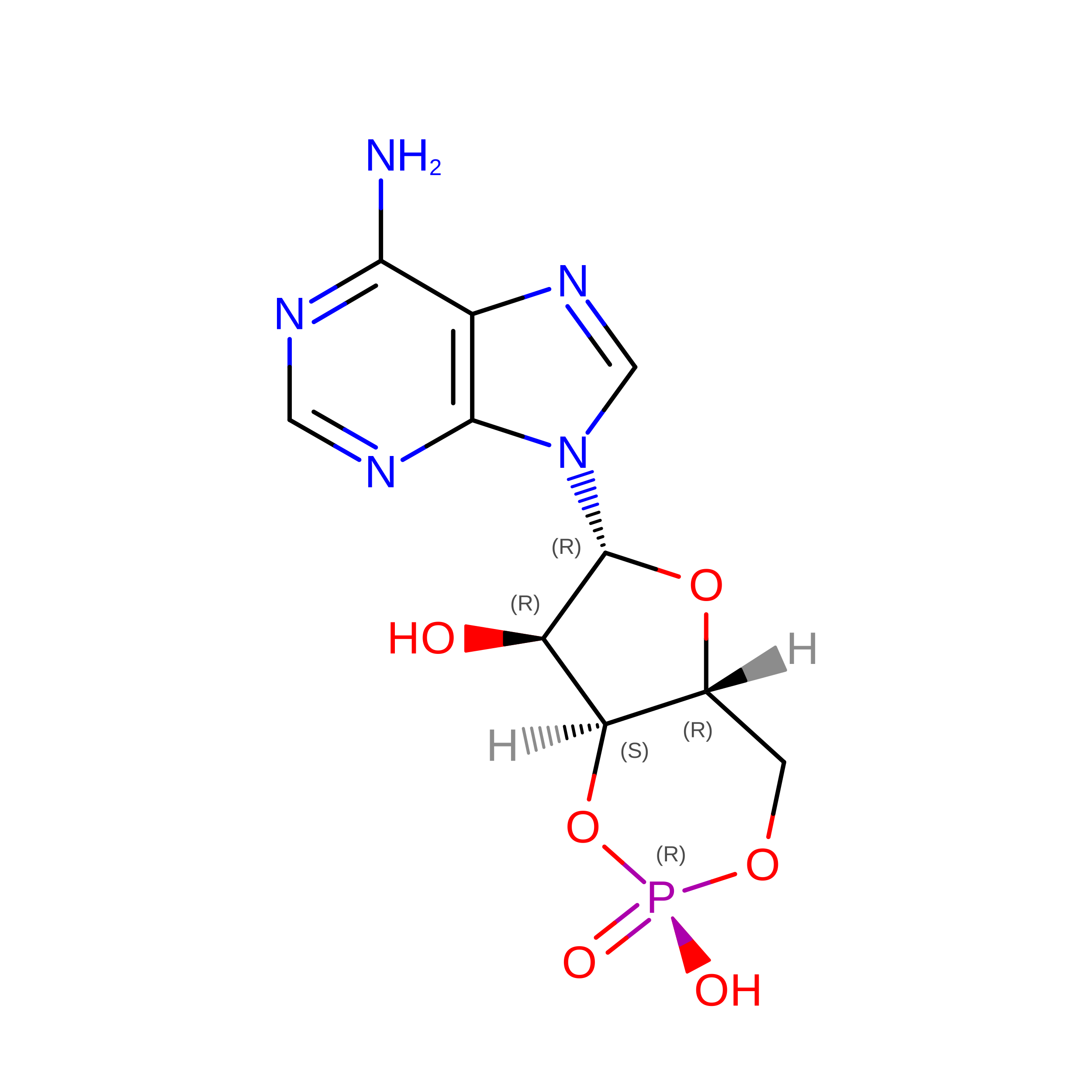
Human HCN1 in complex with cAMP in nanodisc

  • Classification: MEMBRANE PROTEIN
  • Organism(s): Homo sapiens
  • Expression System: Komagataella pastoris
  • Mutation(s): No 

  • Deposited: 2025-11-14 Released: 2026-05-20 
  • Deposition Author(s): Chinn, A., Chanda, B.
  • Funding Organization(s): National Institutes of Health/National Institute of Neurological Disorders and Stroke (NIH/NINDS), National Institutes of Health/National Institute of General Medical Sciences (NIH/NIGMS), National Science Foundation (NSF, United States)

Experimental Data Snapshot

  • Method: ELECTRON MICROSCOPY
  • Resolution: 2.60 Å
  • Aggregation State: PARTICLE 
  • Reconstruction Method: SINGLE PARTICLE 

wwPDB Validation 3D Report Full Report

Validation slider image for 9Z6T

This is version 1.0 of the entry. See complete history

Literature

Lipid bilayers determine allostery but not intrinsic affinity of cAMP to pacemaker channels.

Idikuda, V.Roy Chowdhury, S.Chinn, A.Chang, Y.Rahman, S.Ren, Q.Bao, H.Fu, Z.Goldsmith, R.H.Chanda, B.

(2026) Nat Commun 

  • DOI: https://doi.org/10.1038/s41467-026-72591-6
  • Primary Citation Related Structures: 
    9PXN, 9Z6T

  • PubMed Abstract: 

    The binding of cyclic adenosine monophosphate (cAMP) to hyperpolarization-activated cyclic nucleotide-gated (HCN) ion channels regulates cardiac pacemaking but key aspects of the mechanism of ligand-dependent regulation remain unresolved. Here, we examine the role of the lipid environment by reconstituting purified human HCN channels into lipid nanodiscs and measuring successive cAMP binding to single HCN channels using nanophotonic waveguides. Regardless of nanodisc size or lipid composition, cAMP molecules bind cooperatively to HCN channels in lipid bilayers, unlike channels solubilized in detergents. The affinity of the first ligand remains unchanged across conditions, indicating that the bilayer selectively alters higher-order ligation states. Cryo-EM structures of apo- and holo-HCN channels reveal additional lipid densities that are weak or absent in detergent-solubilized preparations. Together, these findings show that the lipid bilayer is both necessary and sufficient to induce cooperative ligand binding in HCN channels, thereby enhancing their sensitivity to gating stimuli.


  • Organizational Affiliation
    • Department of Anesthesiology, Washington University, Saint Louis, MO, USA.

Macromolecule Content 

  • Total Structure Weight: 413.46 kDa 
  • Atom Count: 16,192 
  • Modeled Residue Count: 1,992 
  • Deposited Residue Count: 3,624 
  • Unique protein chains: 1

Macromolecules

Find similar proteins by:|  3D Structure
Entity ID: 1
MoleculeChains  Sequence LengthOrganismDetailsImage
Potassium/sodium hyperpolarization-activated cyclic nucleotide-gated channel 1,Thermostable Green Protein
A, B, C, D
906Homo sapiensMutation(s): 0 
Gene Names: HCN1
UniProt & NIH Common Fund Data Resources
Find proteins for O60741 (Homo sapiens)
Explore O60741 
Go to UniProtKB:  O60741
PHAROS:  O60741
GTEx:  ENSG00000164588 
Entity Groups
Sequence Clusters30% Identity50% Identity70% Identity90% Identity95% Identity100% Identity
UniProt GroupO60741
Sequence Annotations
Expand
Reference Sequence

Experimental Data & Validation

Experimental Data

  • Method: ELECTRON MICROSCOPY
  • Resolution: 2.60 Å
  • Aggregation State: PARTICLE 
  • Reconstruction Method: SINGLE PARTICLE 
EM Software:
TaskSoftware PackageVersion
MODEL REFINEMENTPHENIX1.21.2_5419
RECONSTRUCTIONcryoSPARC

Structure Validation

View Full Validation Report


Entry History 

& Funding Information

Deposition Data


Funding OrganizationLocationGrant Number
National Institutes of Health/National Institute of Neurological Disorders and Stroke (NIH/NINDS)United StatesNS116850
National Institutes of Health/National Institute of General Medical Sciences (NIH/NIGMS)United StatesDP2GM140920
National Science Foundation (NSF, United States)United StatesCHE-1856518

Revision History  (Full details and data files)

  • Version 1.0: 2026-05-20
    Type: Initial release