Download Mendeley
Chemoproteomic discovery of a brain-penetrant, covalent NLRP3 inhibitor that binds a novel allosteric pocket.
Rogness, D.C., Sievert, E.P., Vartabedian, V.F., Bernard, S.M., Aitchison, E., Tao, W., Lindvall, M., Qian, J., Eissler, C.L., Nordin, B.E., Horning, B.D., Kingston, C., Lamb, K.N., Bell, J.C., Lu, B., Pollock, J., Shi, J., Khattri, R., Weinstein, D.S., Patricelli, M.P., Cook, B.N., Simon, G.M.(2026) Br J Pharmacol
- PubMed: 42569816 Search on PubMed
- DOI: https://doi.org/10.1111/bph.70626
- Primary Citation Related Structures:
9Z03 - PubMed Abstract:
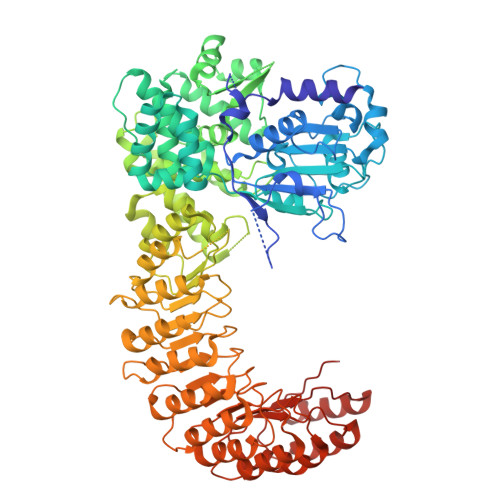
The NLRP3 inflammasome is an attractive therapeutic target for multiple inflammatory conditions. Although inhibitors have been developed, their chemical diversity is limited, and their properties are not ideal for brain penetrance, which is desirable for treating neuroinflammatory disorders. We applied our chemoproteomics platform to survey our electrophilic fragment collection to identify inhibitors of NLRP3. We focused our attention on compounds that bind Cys463, as this residue was identified as an allosteric sensor of NLRP3 function. A novel inhibitor series was identified bearing a butynamide electrophile and a unique spirocyclic lactam core. Compounds from this series displayed mid-nanomolar potency and were found to inhibit IL-1β secretion in a Cys463-dependent manner. Cryo-EM structures revealed that ligand binding to Cys463 stabilizes an inactive conformation, thereby preventing structural rearrangements required for inflammasome activation. These compounds displayed attractive pharmacokinetic properties and, notably, Kp,uu values >0.5, suggesting the potential to address neuroinflammatory disorders. Administration of a representative compound to humanized mice resulted in clear NLRP3 Cys463 target-engagement and profound suppression of LPS- and ATP-induced IL-1β secretion, demonstrating clear proof-of-concept in vivo. Chemoproteomics-based ligand discovery is intrinsically function-agnostic and has the potential to identify novel pockets on even well-characterized protein targets. Here, optimization of ligands targeting Cys463 of NLRP3 within a previously uncharacterized allosteric pocket led to a unique and potent inhibitor series with attractive physicochemical and pharmacokinetic properties for the potential treatment of diseases involving aberrant innate immune activation in both central and peripheral tissues.
- Vividion Therapeutics, San Diego, California, USA.
Organizational Affiliation: