Download Mendeley
Molecular and Structural Basis of Pan-Resistance to BTK Degraders and Inhibitors.
Sievers, Q., Lu, H., Cool, A., Gajewski, S., Kong, T., Noviski, M.A., Whelan, S., Wang, Y., Mendoza Navarrete, L., Mi, X., Ficici, E., Mukerji, R., Iuliano, J.N., Ye, J., Sanchez Garcia De Los Rios, M., Bousquet, H., Tan, M., Brathaban, N., Narasappa, N., Lu, Y.W., Elechko, J., Maron, M.I., Phelps, C.B., Rahman, J., Notti, R.Q., Sekeres, S., Lamkin, E.N., Bravo, E., Alencar, A., Ewalt, M.D., Islam, P., Mato, A.R., Roeker, L., Bhatt, S., Taylor, J., Thompson, M.C., Hansen, G.M., Abdel-Wahab, O.(2026) Cancer Discov
- PubMed: 42484277 Search on PubMed
- DOI: https://doi.org/10.1158/2159-8290.CD-26-0251
- Primary Citation Related Structures:
9YT9, 9ZQV - PubMed Abstract:
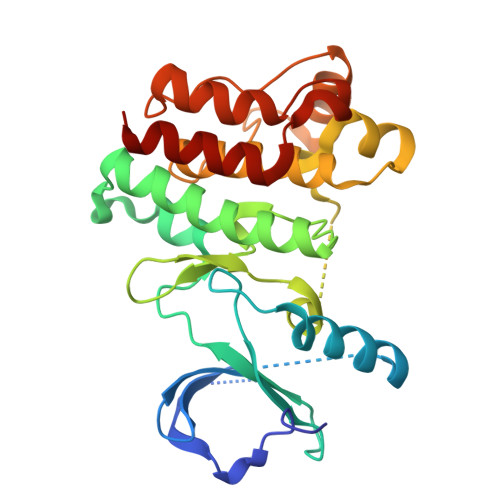
Early-phase clinical trials of Bruton's tyrosine kinase (BTK) degraders have demonstrated efficacy in patients with BTK inhibitor-resistant chronic lymphocytic leukemia (CLL). How clinical resistance to BTK degraders arises is unknown. Here we sequenced serial CLL samples from patients enrolled in the phase I trials of zelebrudomide and bexobrutideg and observed recurrent expansion of preexisting BTK A428D mutations at relapse. Unlike previously studied BTK inhibitor resistance mutations, BTK A428D conferred pan-resistance to BTK inhibitors and degraders. In the absence of BTK-directed therapies, however, cells bearing BTK A428D exhibited a competitive disadvantage. A crystal structure of BTK A428D revealed that the mutant aspartate clashes with the adenine ring of ATP and the adenine-mimetic moiety of BTK inhibitors and degraders. Combining BTK degraders with venetoclax mitigated the expansion of BTK A428D. These results provide the molecular basis for clinical resistance to BTK degraders and will inform the development of next-generation BTK degrader therapies.
- Memorial Sloan Kettering Cancer Center New York, NY United States.
Organizational Affiliation: