Download Mendeley
Delineation of the active site of MtgB, a cobalamin-dependent glycine betaine methyltransferase.
Picking, J., Li, Y., Ticak, T., Ferguson, D.J., Hao, B., Krzycki, J.A.(2026) J Biol Chem 302: 111216-111216
- PubMed: 41617030 Search on PubMedSearch on PubMed Central
- DOI: https://doi.org/10.1016/j.jbc.2026.111216
- Primary Citation Related Structures:
9YCE - PubMed Abstract:
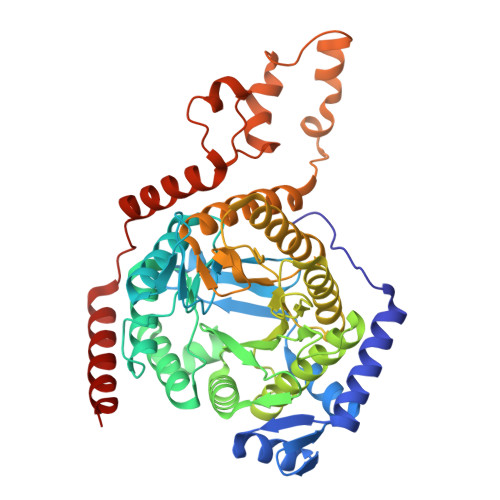
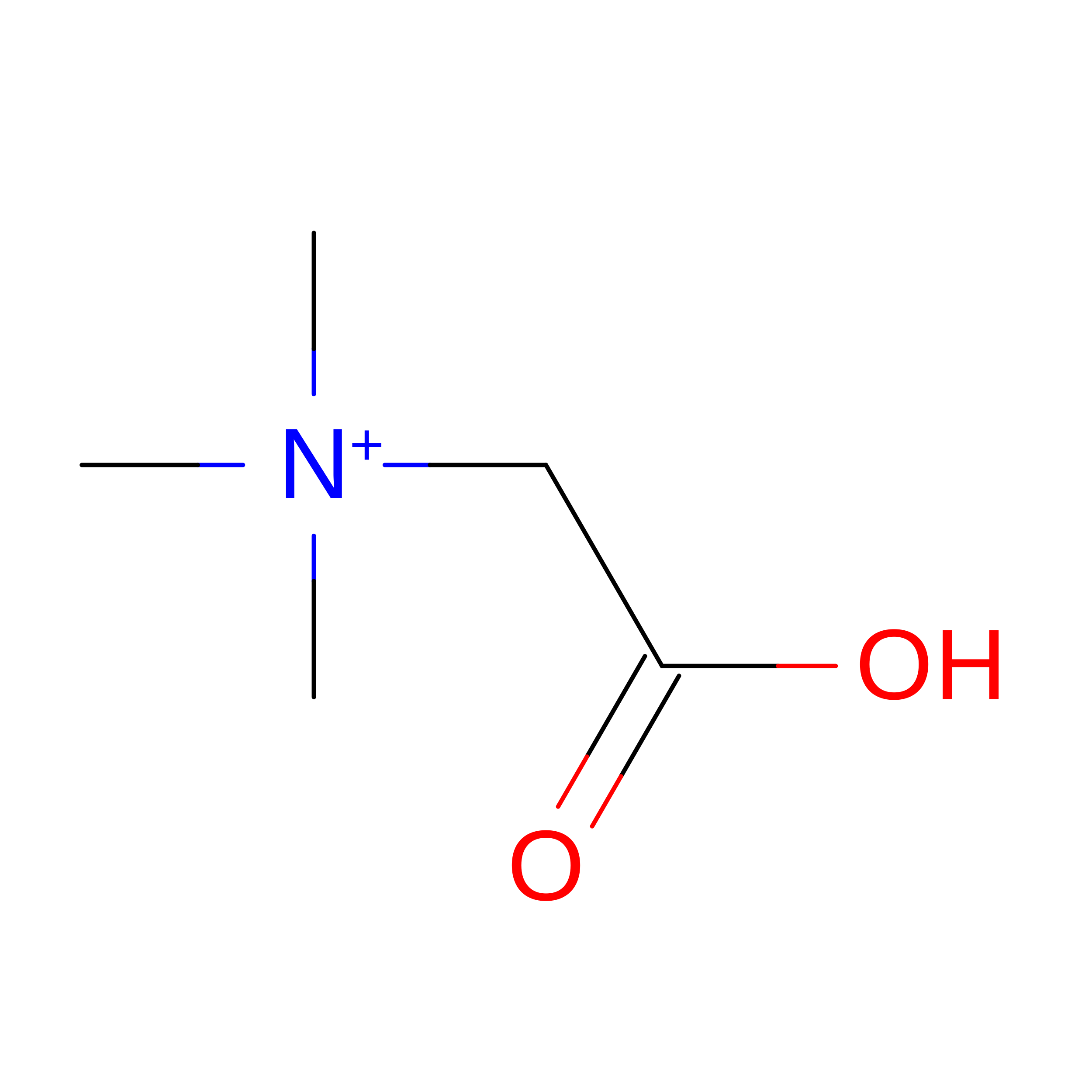
The MttB superfamily member MtgB catalyzes the methylation of a cognate corrinoid protein with glycine betaine, and representatives have been described from both bacteria and archaea. Here, we focused on MtgB from Desulfitobacterium hafniense, a protein for which a crystal structure had been previously obtained. We employed different programs to predict the binding of glycine betaine and identified a consensus binding site. The modelled binding site consisted of two aromatic residues, Y97 and F356, which are both proposed to interact with the quaternary amine portion of glycine betaine via pi:cation interactions. Additionally, two basic residues, H348 and R312, were proposed to interact with the carboxylate group. We carried out site-directed substitutions and subsequently tested the necessity of these residues for glycine betaine:cob(I)alamin methyltransferase activity. These experiments supported a role in catalysis for each residue, presumably in the placement of glycine betaine at the proper position for nucleophilic attack by the Co(I) ion of cobalamin. Subsequently, the structure of the glycine betaine-bound enzyme was obtained, confirming the interaction of these residues with glycine betaine. Other MttB superfamily members with specificity for different quaternary amines were modeled and compared with the glycine betaine-bound structure of MtgB. The nitrogen of each quaternary amine was brought within an average value of 1.8 Å to each other, suggesting that members of the superfamily bring their methyl groups into nearly the same space within the TIM barrel prior to methyl group transfer to cob(I)alamin.
- Department of Microbiology, The Ohio State University, Columbus, Ohio, USA; The Ohio State Biochemistry Program, The Ohio State University, Columbus, Ohio, USA.
Organizational Affiliation: