9YAH | pdb_00009yah

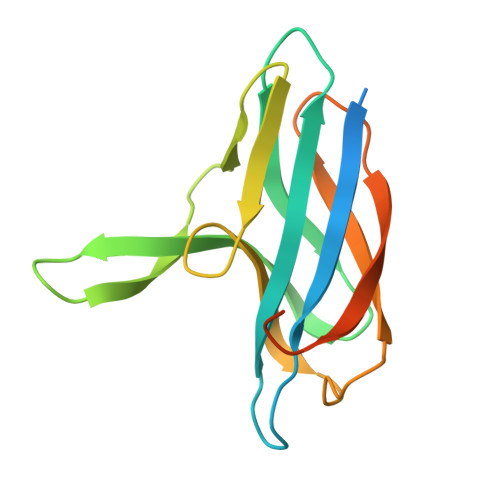
Crystal structure of metallochaperone AccA from Neisseria gonorrhoeae


Experimental Data Snapshot

  • Method: X-RAY DIFFRACTION
  • Resolution: 2.90 Å
  • R-Value Free: 
    0.271 (Depositor), 0.273 (DCC) 
  • R-Value Work: 
    0.217 (Depositor), 0.222 (DCC) 
  • R-Value Observed: 
    0.223 (Depositor) 

wwPDB Validation 3D Report Full Report

Validation slider image for 9YAH

This is version 1.2 of the entry. See complete history

Literature

AccA from Neisseria gonorrhoeae provides a new framework for understanding periplasmic copper metallochaperones.

Firth, S.Earl, W.Thaqi, D.Hong, Y.O'Hern, C.Luscombe, G.Ngu, D.H.Y.Luo, Z.Jobichen, C.Kobe, B.McEwan, A.Djoko, K.

(2026) Chem Sci 17: 9270-9284

  • DOI: https://doi.org/10.1039/d5sc08738d
  • Primary Citation Related Structures: 
    9YAH

  • PubMed Abstract: 

    Many bacteria use copper (Cu) to drive key redox reactions and energy metabolism, and they often rely on metallochaperones to deliver Cu to Cu-dependent enzymes. However, why delivery by metallochaperones is needed, and why Cu cannot transfer directly from cellular pools to the target enzymes, is not well understood. Here, we show that the PCu A C-family metallochaperone AccA from the periplasm of Neisseria gonorrhoeae delivers Cu to the Cu-dependent nitrite reductase AniA, enabling growth and nitrite respiration in O 2 -limiting conditions. Although purified AccA binds both Cu(i) and Cu(ii) ions, only the Cu(i)-binding site is essential for activating AniA in N. gonorrhoeae cells. Unexpectedly, the Cu(i)-binding affinity of AniA is >50 times weaker than that of AccA, suggesting that Cu delivery occurs against a favourable affinity gradient. We propose that AccA is needed because AniA cannot compete with the periplasmic milieu for binding Cu, providing a new framework to understand why some Cu-dependent enzymes need metallochaperones to deliver Cu.


  • Organizational Affiliation
    • Department of Biosciences, Durham University Durham DH1 3LE UK samantha.j.firth@durham.ac.uk karrera.djoko@durham.ac.uk.

Macromolecule Content 

  • Total Structure Weight: 17.23 kDa 
  • Atom Count: 938 
  • Modeled Residue Count: 121 
  • Deposited Residue Count: 157 
  • Unique protein chains: 1

Macromolecules

Find similar proteins by:|  3D Structure
Entity ID: 1
MoleculeChains  Sequence LengthOrganismDetailsImage
Copper chaperone PCu(A)C157Neisseria meningitidis serogroup AMutation(s): 0 
Gene Names: NMB1557
UniProt
Find proteins for Q9JYJ5 (Neisseria meningitidis serogroup B (strain ATCC BAA-335 / MC58))
Explore Q9JYJ5 
Go to UniProtKB:  Q9JYJ5
Entity Groups
Sequence Clusters30% Identity50% Identity70% Identity90% Identity95% Identity100% Identity
UniProt GroupQ9JYJ5
Sequence Annotations
Expand
Reference Sequence

Experimental Data & Validation

Experimental Data

  • Method: X-RAY DIFFRACTION
  • Resolution: 2.90 Å
  • R-Value Free:  0.271 (Depositor), 0.273 (DCC) 
  • R-Value Work:  0.217 (Depositor), 0.222 (DCC) 
  • R-Value Observed: 0.223 (Depositor) 
Space Group: P 32 2 1
Unit Cell:
Length ( Å )Angle ( ˚ )
a = 103.863α = 90
b = 103.863β = 90
c = 31.609γ = 120
Software Package:
Software NamePurpose
PHENIXrefinement
XDSdata reduction
XDSdata scaling
PHENIXphasing

Structure Validation

View Full Validation Report


Entry History 

& Funding Information

Deposition Data


Funding OrganizationLocationGrant Number
Australian Research Council (ARC)AustraliaFL180100109
National Health and Medical Research Council (NHMRC, Australia)Australia2025931

Revision History  (Full details and data files)

  • Version 1.0: 2026-03-25
    Type: Initial release
  • Version 1.1: 2026-04-08
    Changes: Database references
  • Version 1.2: 2026-05-20
    Changes: Database references