Download Mendeley
Asymmetric isopeptide bond steers directional genomic RNA egress from icosahedral virus.
Braet, S.M., Venkatakrishnan, V., Ramesh, R., Clawson, M.A., Laremore, T.N., Wong, S.M., Anand, G.S.(2025) Sci Adv 11: eady4104-eady4104
- PubMed: 41385643 Search on PubMedSearch on PubMed Central
- DOI: https://doi.org/10.1126/sciadv.ady4104
- Primary Citation Related Structures:
9Y2Z, 9Y31 - PubMed Abstract:
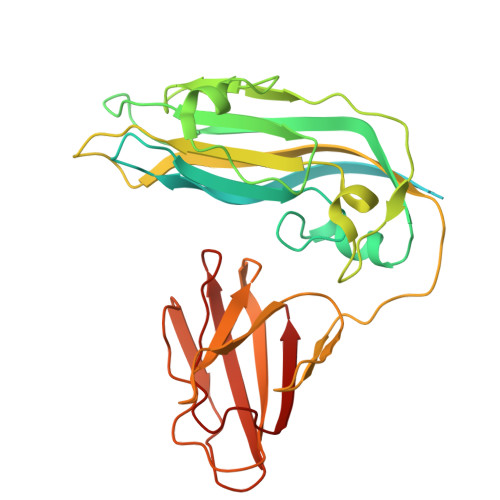
Icosahedral RNA viruses rely upon essential asymmetries for directional genome egress into the host cell. How these asymmetric egress points are built into the quaternary assembly of the virion is unknown. Here, we capture the structure and dynamics of a partially expanded virus disassembly intermediate, poised to release its spring-loaded genomic RNA. The structure shows highly localized density of RNA underneath surface fivefold axes on one-half of the viral particle. This polarity in RNA distribution is associated with a unique interchain isopeptide bond (glutamic acid-lysine), which flanks conserved high-affinity RNA binding sites. This singular isopeptide bond at the asymmetric egress site confers an essential "loaded-die" feature that is critical for steering genomic RNA egress into the host cell for virus propagation.
- Department of Chemistry, Penn State University, University Park, PA 16802, USA.
Organizational Affiliation: