Download Mendeley
A universal cis-proline lock defines catalysis in thioredoxin-fold enzymes.
Cunliffe, T., Wang, G., Penning, S., Subedi, P., Totsika, M., Paxman, J.J., Heras, B.(2026) Commun Biol
- PubMed: 41981106 Search on PubMed
- DOI: https://doi.org/10.1038/s42003-026-10010-8
- Primary Citation Related Structures:
9Y0M, 9Y0N, 9Y0O, 9Y0P, 9Y0Q - PubMed Abstract:
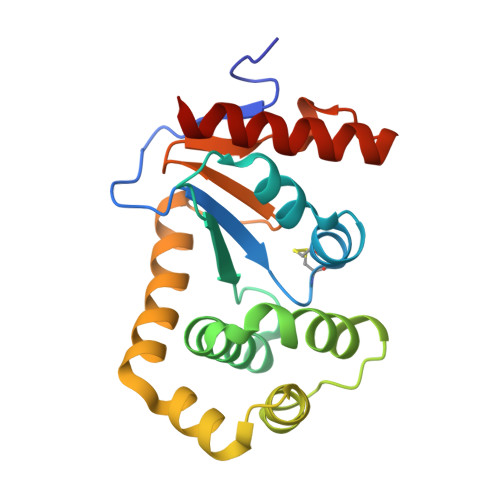
Thioredoxin-fold oxidoreductases drive oxidative protein folding and redox homeostasis across all domains of life. They catalyse thiol-disulfide exchange in diverse substrates, yet how they reconcile catalytic precision with substrate diversity remains unclear. Here we show, using high-resolution structures and functional analyses of the Escherichia coli oxidoreductase DsbA, that a conserved cis-proline loop adjacent to the catalytic Cys-Pro-His-Cys motif serves as a universal catalytic lock. The loop positions the substrate cysteine in a right-handed disulfide geometry optimal for exchange, while surrounding surfaces accommodate sequence variation. Substitution of the cis-proline abolishes turnover, whereas mutation of the preceding glycine preserves geometry but reduces efficiency. Comparative structural analyses demonstrate that this cis-proline-dependent hydrogen-bonding scaffold is conserved across thioredoxins, protein disulfide isomerases, peroxiredoxins and bacterial Dsb proteins. This conserved mechanism explains how catalytic fidelity is maintained while enabling substrate versatility and provides a foundation for enzyme engineering and therapeutic development.
- Department of Biochemistry and Chemistry, School of Agriculture, Biomedicine and Environment, La Trobe Institute for Molecular Science, La Trobe University, Melbourne, VIC, Australia.
Organizational Affiliation: