Download Mendeley
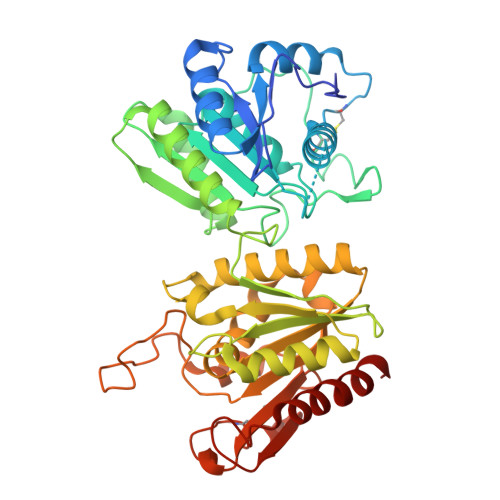
Structural basis of substrate recognition and membrane association by the bacterial lysyl-phosphatidylglycerol hydrolase AcvB.
Hoshi, M., Matsumoto, D., Watanabe, Y.(2026) Commun Biol 9
- PubMed: 42174249 Search on PubMedSearch on PubMed Central
- DOI: https://doi.org/10.1038/s42003-026-10087-1
- Primary Citation Related Structures:
9XHM, 9XHN - PubMed Abstract:
Bacteria adapt to environmental stresses via membrane phospholipid remodeling; however, the underlying molecular mechanism remains largely elusive. In Agrobacterium tumefaciens, the lysyl-phosphatidylglycerol (Lys-PG) synthase lpiA and periplasmic hydrolase acvB genes form an operon that controls Lys-PG levels. We determined the crystal structures of mature AcvB and its C-terminal catalytic domain at 3.1 Å and 1.8 Å resolution, respectively. The catalytic domain forms a negatively charged cavity that recognizes the positively charged Lys-PG head group through multiple acidic residues, including Asp271, Asp340, and Asp370. A hydrophobic protruding loop containing Trp378 and Leu379 mediates membrane association and contributes to Lys-PG hydrolysis. Further, AcvB interacts with LpiA via its C-terminal domain, suggesting a cooperative module for Lys-PG turnover. These findings reveal the structural basis of Lys-PG hydrolysis and provide mechanistic insight into adaptive lipid modification at the bacterial membrane interface, and may guide future development of antibacterial agents against plant-pathogenic bacteria.
- Graduate School of Science and Engineering, Yamagata University, Yamagata, Japan.
Organizational Affiliation: