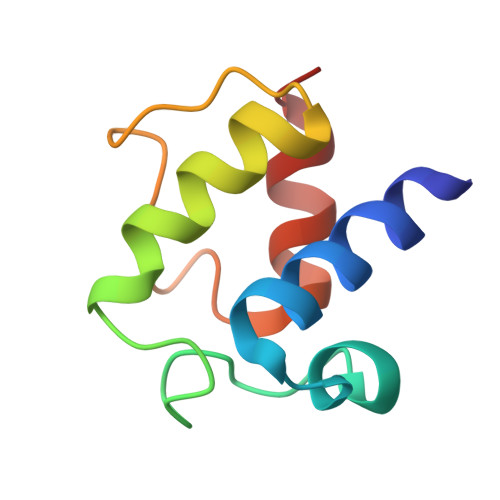
9XGL | pdb_00009xgl

D-alanyl carrier protein


Experimental Data Snapshot

  • Method: X-RAY DIFFRACTION
  • Resolution: 2.28 Å
  • R-Value Free: 
    0.255 (Depositor), 0.252 (DCC) 
  • R-Value Work: 
    0.200 (Depositor), 0.202 (DCC) 
  • R-Value Observed: 
    0.203 (Depositor) 

Starting Model: experimental
View more details

wwPDB Validation 3D Report Full Report

Validation slider image for 9XGL

This is version 1.1 of the entry. See complete history

Literature

Structural Insights into the Staphylococcus aureus DltC-Mediated D-Alanine Transfer.

Jeon, H.Lee, H.Song, C.Lee, I.G.

(2025) Biomolecules 16

  • DOI: https://doi.org/10.3390/biom16010044
  • Primary Citation Related Structures: 
    9XGL, 9XGM

  • PubMed Abstract: 

    Staphylococcus aureus ( S. aureus ) is a major Gram-positive pathogen, and treatment of S. aureus infections is often challenging due to widespread antibiotic resistance. In Gram-positive bacteria such as S. aureus , D-alanylation of teichoic acids (TA) reduces the net negative charge of the cell envelope and contributes to resistance to diverse antibiotics, particularly cationic antimicrobial peptides. D-alanylation is mediated by the dlt ABCD operon, which encodes four proteins (DltA, DltB, DltC, and DltD), all of which is essential for the multistep transfer of D-alanine to teichoic acids. Here, we present the first crystal structure of the S. aureus D-alanyl carrier protein DltC and analyze its interaction with DltA using AlphaFold3 and all-atom molecular dynamics simulations. We further show that single substitutions of Sa DltA- Sa DltC interface residues abolish Sa DltC mediated enhancement of Sa DltA catalysis. Together, these findings define a catalytically critical S. aureus DltA-DltC interface and provide a structural insight for targeting the D-alanylation pathway as a potential anti- Staphylococcus strategy.


  • Organizational Affiliation
    • College of Pharmacy, Research Institute of Pharmaceutical Sciences, Seoul National University, Seoul 08826, Republic of Korea.

Macromolecule Content 

  • Total Structure Weight: 36.28 kDa 
  • Atom Count: 2,620 
  • Modeled Residue Count: 312 
  • Deposited Residue Count: 312 
  • Unique protein chains: 1

Macromolecules

Find similar proteins by:|  3D Structure
Entity ID: 1
MoleculeChains  Sequence LengthOrganismDetailsImage
D-alanyl carrier protein
A, B, C, D
78Staphylococcus aureus subsp. aureus Mu50Mutation(s): 0 
Gene Names: dltCSAV0934
UniProt
Find proteins for P0A018 (Staphylococcus aureus (strain Mu50 / ATCC 700699))
Explore P0A018 
Go to UniProtKB:  P0A018
Entity Groups
Sequence Clusters30% Identity50% Identity70% Identity90% Identity95% Identity100% Identity
UniProt GroupP0A018
Sequence Annotations
Expand
Reference Sequence

Experimental Data & Validation

Experimental Data

  • Method: X-RAY DIFFRACTION
  • Resolution: 2.28 Å
  • R-Value Free:  0.255 (Depositor), 0.252 (DCC) 
  • R-Value Work:  0.200 (Depositor), 0.202 (DCC) 
  • R-Value Observed: 0.203 (Depositor) 
Space Group: P 1 21 1
Unit Cell:
Length ( Å )Angle ( ˚ )
a = 33.137α = 90
b = 63.968β = 93.95
c = 77.145γ = 90
Software Package:
Software NamePurpose
PHENIXrefinement
HKL-2000data reduction
HKL-2000data scaling
PHENIXphasing

Structure Validation

View Full Validation Report


Entry History 

& Funding Information

Deposition Data


Funding OrganizationLocationGrant Number
National Research Foundation (NRF, Korea)Korea, Republic Of--

Revision History  (Full details and data files)

  • Version 1.0: 2026-01-21
    Type: Initial release
  • Version 1.1: 2026-02-11
    Changes: Database references