Download Mendeley
Molecular basis of host ATP level modulation by actin-dependent secreted bacterial ATPase and its metaeffector.
Guan, H., Li, Y., Zhang, L., Xie, S., Jiang, Y., He, C., Li, F., Jiao, Y.D., Gan, M., Sha, Y., Zheng, F., Zhang, K., Luo, Z.Q., Lai, Q., Su, J., Xia, N., Zheng, Q., Li, J., Li, S., Ouyang, S.(2026) Nat Commun 17
- PubMed: 42331848 Search on PubMedSearch on PubMed Central
- DOI: https://doi.org/10.1038/s41467-026-74513-y
- Primary Citation Related Structures:
9XCH, 9XCM, 9XFH - PubMed Abstract:
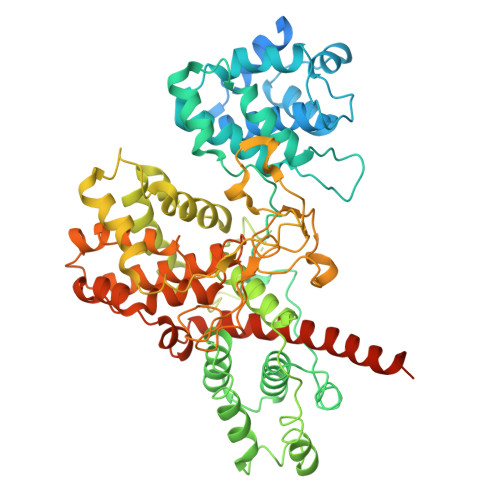
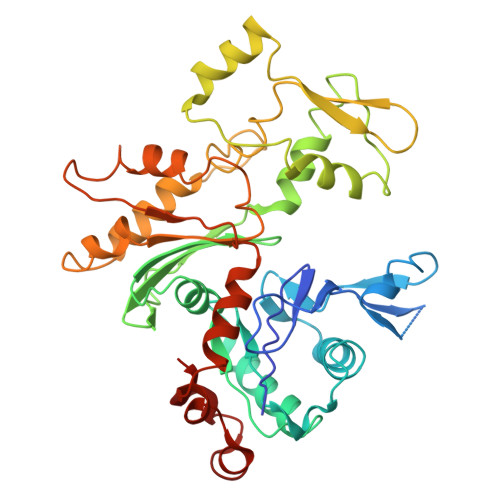
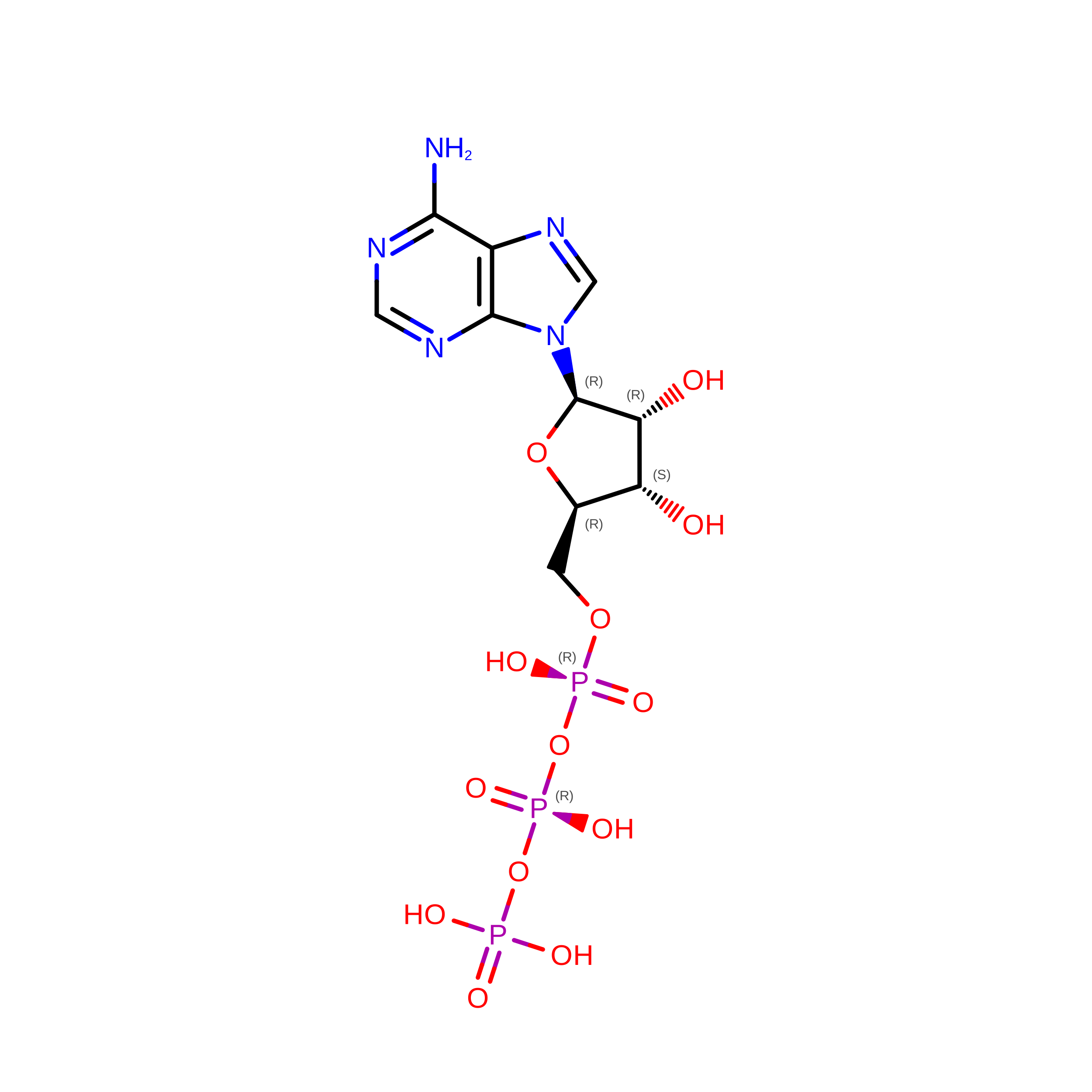
Legionella pneumophila employs effectors including kinases, phosphoryl-AMPylases, ATPases, etc. to exploit host ATP for infection. Ceg14, a member of the S-HxxxE family, modulates host-cell energy levels in concert with host actin and the metaeffector AnkJ: actin activates while AnkJ inhibits Ceg14 ATPase activity. However, the molecular basis of this regulation remains unclear. Here we present Cryo-EM structures of Ceg14-actin, Ceg14-AnkJ, and Ceg14-actin-AnkJ complexes at 2.89 Å, 2.93 Å, and 2.52 Å, respectively. Actin binds to the C-terminal α-helix of the Ceg14 catalytic domain (CD), inducing rearrangement of its N-terminal domain (NTD) and reconfiguration of the flexible Lid domain. Surprisingly, AnkJ binds to the surface opposite the catalytic pocket rather than occupying the pocket. Using integrated in silico, in vitro, and in cellulo approaches, we propose a mechanism for Ceg14-mediated ATP hydrolysis. Actin binding triggers NTD rotation, driving the catalytic pocket through open, intermediate, and closed states. In the open state, H571 catalyzes ATP conversion to AMP and PPi. AnkJ binding to an allosteric site locks the intermediate state, thereby inhibiting hydrolysis. Together, our study reveals the molecular mechanism by which actin and AnkJ reciprocally regulate Ceg14 activity.
- Fujian Engineering Research Center of Anti-infective Biotechnology Applications,Key Laboratory of Microbial Pathogenesis and Interventions of Fujian Province University, Key Laboratory of Innate Immune Biology of Fujian Province, Biomedical Research Center of South China, College of Life Sciences, Fujian Normal University, Fuzhou, China.
Organizational Affiliation: